

Archive position — measured, not model output
0 likes on Devpost
2,263 of the 7,850 archived projects have more likes, and 5,587 share exactly 0 — so this project's #7,209 place in the like-ranked listing is a tie-break inside that group, not a ranking.
Projects (log scale)
Likes on Devpost. ▲ marks this project's group.
Show the figures
| Likes | Projects | Share of archive |
|---|---|---|
| 0 | 5,587 | 71.2% |
| 1 | 1,758 | 22.4% |
| 2 | 284 | 3.6% |
| 3–4 | 132 | 1.7% |
| 5–9 | 75 | 1.0% |
| 10+ | 14 | 0.2% |
 User Stories BotA demo video on every pull request
Get a demo video on every new feature
GitHub App that watches your pull requests and records a narrated, captioned demo.
Save time on demo prep and make informed decisions faster with a video walkthrough of every new feature.
Executive Summary
The AI Software Team, as described by its author, is a self-reported hackathon project that claims to demonstrate a multi-agent AI system designed to automate software development planning from a single prompt. The platform envisions an AI-powered team of agents — each with specialized roles like Product Manager, UI/UX Designer, Frontend Developer, etc. — working sequentially to generate a complete software blueprint.
The author states the system uses OpenAI GPT APIs and prompt engineering within a React + FastAPI architecture. It is described as a proof-of-concept for transforming ideas into structured development plans, with ambitions to evolve into an automated full-stack code generator and deployment platform.
Key commercial due-diligence read
The project description contains no evidence of revenue, customers, or adoption beyond the author’s own claims. There is no indication that this system has been used in production or tested at scale. The described functionality appears to be a conceptual prototype rather than a functional product.
What The Product Actually Is
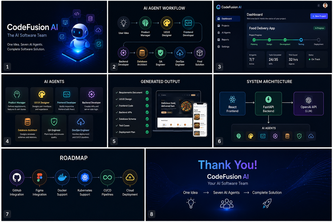
The description states that The AI Software Team is a multi-agent AI platform where each agent assumes a role such as:
- 🧠 Product Manager Agent
- 🎨 UI/UX Designer Agent
- 💻 Frontend Developer Agent
- ⚙️ Backend Developer Agent
- 🗄️ Database Architect Agent
- ✅ QA Engineer Agent
- 🚀 DevOps Agent
These agents are said to collaborate in sequence, with each building upon the output of the previous one. The final result is a "complete software blueprint" intended to accelerate idea-to-implementation.
The system uses:
- Frontend: React, Vite
- Backend: Python, FastAPI
- AI Layer: OpenAI GPT API, Prompt Engineering, Multi-Agent Architecture
It is described as a full-stack architecture that transforms a user-provided idea (e.g., “Build a food delivery application for university students”) into a structured development plan.
This is a self-reported description of a conceptual prototype, not a verified product or service.
Positioning & Claim Evolution
The author positions The AI Software Team as a tool that enables users to turn a simple idea into a production-ready software blueprint using AI agents. It claims to simulate the work of a real development team by assigning specialized roles to different AI agents.
Key claims:
- The system automates collaboration between multiple roles in software development.
- It allows users to describe their idea in natural language and get a structured plan.
- It is built on a modular architecture that supports future expansion with more agents.
- The goal is to evolve into an intelligent virtual software team capable of generating full-stack code, deploying applications, and integrating with tools like GitHub, Jira, and CI/CD pipelines.
These are claims about intent and vision, not evidence of traction or functionality beyond the hackathon project.
Target Customer & ICP
The author states that the intended users include:
- Developers
- Startups
- Students
- Businesses
They also mention a vision to help these groups "transform ideas into production-ready applications faster than ever before."
However, there is no evidence of actual customer segmentation or targeting beyond general categories. No specific personas, use cases, or market validation are provided.
Business Model & Pricing Evidence
There is no evidence in the description of any business model or pricing structure. The project is described as a hackathon submission and does not reference monetization strategies, subscriptions, licensing, or sales channels.
Technical & Delivery Signals
The system is said to be built with:
- Frontend: React, Vite
- Backend: Python, FastAPI
- AI Layer: OpenAI GPT API, Prompt Engineering, Multi-Agent System
- Architecture: Sequential orchestration of agents
- Version Control: Git & GitHub
The workflow is described as:
- User Idea
- Product Manager Agent
- UI/UX Designer Agent
- Frontend Agent
- Backend Agent
- Database Agent
- QA Agent
- DevOps Agent
- Final Software Blueprint
This suggests a modular, extensible architecture, but no evidence of actual delivery or performance metrics.
Traction & Maturity Signals
There is no evidence of traction or maturity beyond the hackathon submission. The project is described as a prototype and lacks:
- Revenue data
- Customer base
- Usage statistics
- Product-market fit validation
- Production deployment details
The author mentions future improvements, indicating this is still in early development.
Competitive Context
There is no evidence of competitive analysis or awareness of existing platforms. The description does not reference competitors, nor does it explain how this differs from other AI-powered development tools or platforms.
Open Questions & Risks
- Unverified claims: All functionality described is self-reported and untested.
- No traction or adoption: No evidence of real-world usage or customer feedback.
- Prototype nature: The system is presented as a hackathon project, not a product.
- Lack of commercial clarity: No pricing, business model or monetization strategy.
- Technical feasibility concerns: Multi-agent AI systems are complex; no indication of performance or reliability.
- Limited scope: Only a blueprint is generated, not actual code or deployment.
Questions the description leaves open
- What specific problems does this system solve that existing tools don’t?
- Has the system been tested with real users or in real-world scenarios?
- How does it handle edge cases or ambiguous inputs?
- What are the limitations of the current architecture and how will they be addressed?
- Are there any plans to integrate with existing development workflows (e.g., GitHub, Jira)?
- What is the roadmap for moving from prototype to a scalable product?
- How do you plan to monetize this platform?
Overall Assessment
The description presents a conceptual prototype of a multi-agent AI system aimed at automating software planning. It is not evidenced as a functioning product or service with revenue, customers, or adoption.
This project is best understood as an early-stage idea or proof-of-concept, likely intended for demonstration or further development rather than immediate investment or partnership consideration.
There is no commercial due-diligence basis to support any conclusion about viability, scalability, or market readiness. The author’s claims are aspirational and unverified.
User Stories BotA demo video on every pull request
Get a demo video on every new feature
GitHub App that watches your pull requests and records a narrated, captioned demo.
Save time on demo prep and make informed decisions faster with a video walkthrough of every new feature.
Source
Submitted to the OpenAI 2026 hackathon on Devpost. Project home on Devpost. Back to the full gallery on Devpost.
This competitive analysis was produced by top-founders.com (opens in a new tab)
Generated by a language model from this project's public Devpost page — its tagline, the author's own write-up and any built-with tags listed there — as captured in August 2026. Short quotations are the author's words. It is an opinion on the idea as a business, not on the people behind it, and it reflects the description as published then. If the project has moved on, request a correction below. The analysis is not independent research and contains no verified traction, revenue or customer data.
An independent guide by KFG International LLC — not affiliated with, endorsed by, or connected to Devpost or OpenAI.