

Archive position — measured, not model output
0 likes on Devpost
2,263 of the 7,850 archived projects have more likes, and 5,587 share exactly 0 — so this project's #3,285 place in the like-ranked listing is a tie-break inside that group, not a ranking.
Projects (log scale)
Likes on Devpost. ▲ marks this project's group.
Show the figures
| Likes | Projects | Share of archive |
|---|---|---|
| 0 | 5,587 | 71.2% |
| 1 | 1,758 | 22.4% |
| 2 | 284 | 3.6% |
| 3–4 | 132 | 1.7% |
| 5–9 | 75 | 1.0% |
| 10+ | 14 | 0.2% |
 User Stories BotA demo video on every pull request
Get a demo video on every new feature
GitHub App that watches your pull requests and records a narrated, captioned demo.
Save time on demo prep and make informed decisions faster with a video walkthrough of every new feature.
Executive Summary
What the company appears to be
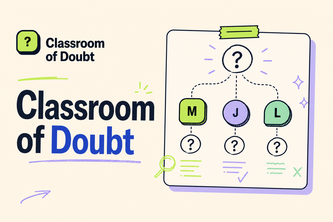
Classroom of Doubt is a self-reported educational product built as a hackathon submission. The author describes it as a "misconception-diagnosis game" for students reviewing previously encountered material. It uses AI to simulate three student classmates, each holding a different hidden misconception, and asks the learner to diagnose and repair their reasoning through explanation.
What changed
The project is presented as an experiment in using AI not to provide answers but to create conditions that force deeper learning. The author claims it flips traditional AI-assisted learning by having learners teach AI rather than ask it for explanations.
Single most important open question
Is there any evidence of traction, revenue, or user adoption beyond the single author's self-reported build and submission?
Note: This analysis is based entirely on the self-reported project description provided. No external verification, historical data, or third-party sources are available. All claims are stated by the author and not independently confirmed.
What The Product Actually Is
The description states that Classroom of Doubt is a "misconception-diagnosis game" where learners teach three simulated classmates, each with a hidden but plausible misconception. It includes:
- A belief-state engine that validates explanations.
- An Evidence Gate framework to control how misconceptions are addressed.
- A structured interface for teaching and diagnosis.
- Three curated Concept Packs (probability, forces and motion, natural selection).
- Support for both live GPT-5.6 experience and deterministic path.
The product is described as a browser-based app built with TypeScript, Vercel, and Codex, using GPT-5.6 in a role-separated architecture.
Claim: The author states that the core of the project is an Evidence Gate framework.
Inference: This implies a structured system for validating learning outcomes rather than open-ended AI interaction.
Positioning & Claim Evolution
The author positions Classroom of Doubt as a response to the problem of "fluency while assisted" not equating to "independent understanding." The project is framed around:
- Learning-by-teaching research.
- A critique of AI tools that offer ready-made answers without forcing cognitive work.
- An experiment in using AI to create learning conditions rather than replace thinking.
The author claims the product flips the script on AI-assisted learning by making learners teach AI, not ask it for help. It is described as a way to test whether explanations actually change reasoning and transfer to new problems.
Claim: The author states that AI should be used to create conditions for thinking, not remove the need for it.
Inference: This suggests a shift from passive consumption to active engagement in learning design.
Target Customer & ICP
The description states that Classroom of Doubt is for students reviewing material they have already encountered. It targets learners who are postgraduate students or high school students, based on the author's own experience.
It is not clear whether the product is intended for educators, institutions, or individual users. The focus is on self-directed learning and review rather than classroom deployment.
Claim: The author states that it is for students reviewing material they have already encountered.
Inference: This implies a target audience focused on reinforcement and remediation, not initial instruction.
Business Model & Pricing Evidence
There is no evidence of any business model or pricing structure in the description. The project is presented as a hackathon submission with no mention of monetization, subscriptions, or sales channels.
Claim: Not evidenced.
Inference: The lack of commercial information suggests either early-stage development or non-commercial intent.
Technical & Delivery Signals
The author describes a technical architecture that includes:
- GPT-5.6 used in bounded roles (Orchestrator, Evidence Evaluator, Classmate Actors, etc.)
- An application-owned state engine to validate belief states
- Separation of AI roles from decision-making authority
- Use of Codex for engineering collaboration and testing
- Responsive UI built with TypeScript and Vercel
The system is described as deterministic in some paths and uses structured outputs to avoid model hallucination.
Claim: The author states that the system separates GPT-5.6 roles from authority.
Inference: This suggests a deliberate design to prevent AI from overriding human judgment or state control.
Traction & Maturity Signals
There is no evidence of traction, revenue, customers, or adoption beyond the single author’s submission. The project is described as a hackathon entry and not as a product in use.
Claim: Not evidenced.
Inference: Absence of any user data, usage metrics, or commercial deployment indicates early-stage development.
Competitive Context
The description does not mention competitors or direct market comparisons. It references learning-by-teaching research and AI-assisted learning studies but does not name other tools or platforms in the space.
Claim: Not evidenced.
Inference: The lack of competitive context suggests either a niche or unproven market position.
Open Questions & Risks
- Single author: The project is built by one person, raising questions about scalability and team capacity.
- No commercial traction: No evidence of users, revenue, or adoption beyond the author’s own use.
- Unverified claims: The product is described as a "hackathon submission" with no independent validation.
- Limited scope: Only three Concept Packs are mentioned; no indication of expansion plans.
- AI dependency: Heavy reliance on GPT-5.6 and Codex may not be sustainable or scalable without further development.
Inference: The lack of team, traction, or commercialization raises concerns about viability as a product or business.
Questions the description leaves open
- What is the intended user base beyond the author’s own experience?
- How does the system handle edge cases in belief-state validation?
- Are there plans to expand beyond the three Concept Packs?
- Has the product been tested with real users or educators?
- What are the long-term goals for monetization or commercial deployment?
Overall Assessment
There is no evidence of a viable business, revenue, or traction. The project is described as a hackathon submission and lacks any indication of commercial viability or market demand.
Claim: Not evidenced.
Inference: Based on the self-reported description alone, this is an early-stage idea with no demonstrated product-market fit or commercial potential.
User Stories BotA demo video on every pull request
Get a demo video on every new feature
GitHub App that watches your pull requests and records a narrated, captioned demo.
Save time on demo prep and make informed decisions faster with a video walkthrough of every new feature.
Source
Submitted to the OpenAI 2026 hackathon on Devpost. Project home on Devpost. Back to the full gallery on Devpost.
This competitive analysis was produced by top-founders.com (opens in a new tab)
Generated by a language model from this project's public Devpost page — its tagline, the author's own write-up and any built-with tags listed there — as captured in August 2026. Short quotations are the author's words. It is an opinion on the idea as a business, not on the people behind it, and it reflects the description as published then. If the project has moved on, request a correction below. The analysis is not independent research and contains no verified traction, revenue or customer data.
An independent guide by KFG International LLC — not affiliated with, endorsed by, or connected to Devpost or OpenAI.