

Archive position — measured, not model output
0 likes on Devpost
2,263 of the 7,850 archived projects have more likes, and 5,587 share exactly 0 — so this project's #4,813 place in the like-ranked listing is a tie-break inside that group, not a ranking.
Projects (log scale)
Likes on Devpost. ▲ marks this project's group.
Show the figures
| Likes | Projects | Share of archive |
|---|---|---|
| 0 | 5,587 | 71.2% |
| 1 | 1,758 | 22.4% |
| 2 | 284 | 3.6% |
| 3–4 | 132 | 1.7% |
| 5–9 | 75 | 1.0% |
| 10+ | 14 | 0.2% |
 User Stories BotA demo video on every pull request
Get a demo video on every new feature
GitHub App that watches your pull requests and records a narrated, captioned demo.
Save time on demo prep and make informed decisions faster with a video walkthrough of every new feature.
Executive Summary
What the company appears to be
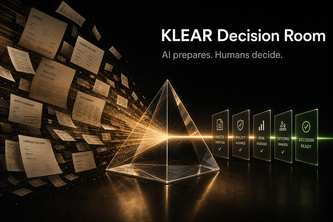
KLEAR Decision Room is a self-reported decision-support system built for finance review workflows. It claims to structure messy operational evidence into persistent, versioned "DecisionCases" that separate AI preparation from human ownership of decisions.
What changed
The author shifted focus from building an AI invoice reviewer to designing a system where the unit of work is the decision itself — not the document or model response. This repositioning centers on preserving auditability and human authority in decision-making processes.
Single most important open question
Is there any evidence that this system has been used beyond a demo, or that it has been adopted by any organization for real-world finance approvals?
What The Product Actually Is
The description states that KLEAR Decision Room is a system that turns "messy operational evidence" into a "persistent, versioned DecisionCase." It uses deterministic rules before calling models and preserves unknown facts explicitly as "UNKNOWN."
It claims to:
- Normalize intake and create stable evidence records.
- Use OpenAI’s Responses API for grounded case briefs.
- Validate model output against real evidence and policy results.
- Block unsafe approvals server-side.
- Record human requests for evidence.
- Generate a "Decision Handoff" with version lineage, ownership, and evidence.
The system is built using Node.js, vanilla JavaScript, HTML, CSS, and REST APIs. It stores immutable snapshots of DecisionCases, evidence objects, rule results, and decision events.
Inference This appears to be a prototype or proof-of-concept for managing decision-making workflows in finance review, with an emphasis on traceability and separation between AI preparation and human decision ownership.
Positioning & Claim Evolution
The author states that the project evolved from thinking about building a more detailed AI finance reviewer into recognizing that the real unit was not the invoice or model response — but the decision itself.
This shift in framing suggests an intent to build a framework for structured, auditable decision-making rather than just automating review tasks.
It also positions KLEAR as distinct from generic AI tools:
“KLEAR is not a prompt wrapped in an approval screen.”
The author emphasizes that:
- AI prepares the case.
- Systems verify facts.
- Humans own the decision.
This evolution reflects a move toward decision-centric architecture, where AI is used to support human judgment rather than replace it.
Inference The positioning implies a focus on compliance, auditability, and governance in high-stakes environments like finance, but no evidence of actual deployment or customer use cases exists.
Target Customer & ICP
The description states that the current product is focused on finance approval workflows, because they make "decision boundaries easy to prove."
It also mentions potential future expansion into:
- Compliance
- Underwriting
- Onboarding
- Maintenance
- Quality assurance
However, no specific customer segments or personas are named.
Inference The initial ICP appears to be finance teams within enterprises that require structured decision-making and audit trails. Future expansion targets seem aligned with other evidence-heavy domains requiring governance.
Business Model & Pricing Evidence
There is no mention of pricing, monetization strategy, or business model in the description.
Not evidenced
Technical & Delivery Signals
The system is built using:
- Node.js
- Vanilla JavaScript
- HTML/CSS
- REST API
- OpenAI’s Responses API
- Deterministic validators to check model outputs before display
- Immutable storage of DecisionCases and version history
It includes:
- 51 automated tests
- A public one-click reviewer journey
- No frontend build system
- Server-side rejection of unsafe approvals
- Append-only human decision events
The architecture supports:
- Evidence objects
- Rule results
- Human decision events
- History tracking
- Pack Back updates without pretending unfinished work is complete
Inference The technical stack and design choices suggest a lightweight, developer-focused prototype with strong emphasis on data integrity and auditability. The use of deterministic validation implies a deliberate attempt to avoid hallucinations or misalignment between AI output and real-world facts.
Traction & Maturity Signals
The description states:
- A public demo exists
- 51 automated tests are included
- One-click reviewer journey works without cloning or rebuilding
- No revenue, customers, or traction data are mentioned beyond the author’s own account
Not evidenced
Competitive Context
No mention of competitors is made in the description.
Not evidenced
Open Questions & Risks
- No real-world adoption or customer feedback: The entire description is self-reported and unverified; no evidence of usage outside a demo.
- Single-person team: Only one member listed (Peak Euarchukiati), which raises questions about scalability, support, and long-term maintenance.
- Prototype nature: The project was built during a hackathon and lacks enterprise-grade features like durable persistence, identity controls, or multi-reviewer chains.
- Dependency on OpenAI API: The system uses an external API key for demo purposes only — this raises concerns about how it would scale or integrate into enterprise systems without such access.
Inference While the architecture shows promise in terms of separation of AI and human authority, there is no indication that the product has moved beyond a prototype stage or gained traction among users.
Questions the description leaves open
- Has this system been tested or used in any real-world finance approval workflows?
- What are the specific use cases or domains where you plan to apply KLEAR Decision Room beyond finance?
- How does the system handle integration with existing ERP, CRM, or compliance tools?
- Are there plans for enterprise-level features like role-based access control, audit logs, or multi-user collaboration?
- What is your roadmap for moving from a demo to a production-ready product?
Overall Assessment
The description presents KLEAR Decision Room as an early-stage prototype with a clear architectural vision focused on decision-making frameworks that separate AI preparation from human ownership.
It shows technical maturity in its design and implementation, particularly around auditability and data integrity. However, there is no evidence of traction, revenue, or customer adoption beyond the author’s own account.
Confidence Level Low
Assessment Not ready for investment or partnership unless further validated through pilot usage or demonstration in actual enterprise settings.
User Stories BotA demo video on every pull request
Get a demo video on every new feature
GitHub App that watches your pull requests and records a narrated, captioned demo.
Save time on demo prep and make informed decisions faster with a video walkthrough of every new feature.
Source
Submitted to the OpenAI 2026 hackathon on Devpost. Project home on Devpost. Back to the full gallery on Devpost.
This competitive analysis was produced by top-founders.com (opens in a new tab)
Generated by a language model from this project's public Devpost page — its tagline, the author's own write-up and any built-with tags listed there — as captured in August 2026. Short quotations are the author's words. It is an opinion on the idea as a business, not on the people behind it, and it reflects the description as published then. If the project has moved on, request a correction below. The analysis is not independent research and contains no verified traction, revenue or customer data.
An independent guide by KFG International LLC — not affiliated with, endorsed by, or connected to Devpost or OpenAI.