

Archive position — measured, not model output
0 likes on Devpost
2,263 of the 7,850 archived projects have more likes, and 5,587 share exactly 0 — so this project's #4,814 place in the like-ranked listing is a tie-break inside that group, not a ranking.
Projects (log scale)
Likes on Devpost. ▲ marks this project's group.
Show the figures
| Likes | Projects | Share of archive |
|---|---|---|
| 0 | 5,587 | 71.2% |
| 1 | 1,758 | 22.4% |
| 2 | 284 | 3.6% |
| 3–4 | 132 | 1.7% |
| 5–9 | 75 | 1.0% |
| 10+ | 14 | 0.2% |
 User Stories BotA demo video on every pull request
Get a demo video on every new feature
GitHub App that watches your pull requests and records a narrated, captioned demo.
Save time on demo prep and make informed decisions faster with a video walkthrough of every new feature.
Executive Summary
What the company appears to be
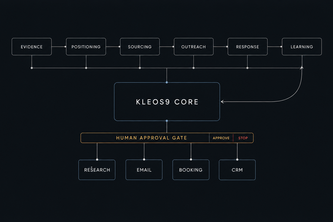
Kleos is a self-reported autonomous go-to-market (GTM) operator that aims to automate end-to-end GTM motions — from product onboarding through lead conversion — using a structured, policy-gated system. The author states it is built as a local-first tool with an interface for owners and experts, and uses LLMs, workflow orchestration (Temporal), and external APIs via a safety gate.
What changed
The project description reflects a first local build of a GTM automation system. It was submitted to the OpenAI 2026 hackathon and is described as an early-stage prototype with no revenue or customer traction evidenced.
Single most important open question
Is there sufficient evidence that Kleos can reliably and safely execute real-world GTM motions at scale, or does it remain a proof-of-concept?
What The Product Actually Is
The description states that Kleos is an autonomous GTM operator designed to run end-to-end sales motions. It allows users to onboard their product via conversation, then proposes a strategy and campaign plan. Once approved, the system runs the motion autonomously, but with safety gates in place.
- Product function:
- Onboard product information (documents, links, pricing) through guided conversation.
- Create structured knowledge base.
- Propose positioning, claims, and campaign plan.
- Allow owner to approve/reject/edit each item.
- Run sales motion: learn → stress-test → forecast → leads → campaigns → conversations → conversions → learning.
- Core components:
- Owner controls approvals and kill switch.
- Expert defines GTM strategy and playbooks.
- Engine (Temporal) runs long-running workflows.
- Gateway enforces policy before external calls.
- Modules interact with providers (e.g., CRM, email, calendar).
- Memory stores history, leads, outcomes.
- Not evidenced
- Actual product functionality beyond local prototype.
- Real-world performance or integration details.
- Customer data or usage metrics.
Positioning & Claim Evolution
The author states that Kleos is positioned to automate the hard part of GTM — which they describe as “the graveyard of great products keeps growing” because builders struggle with getting anyone to care. They claim that Kleos aims to be an agent that does what a fractional head-of-growth would do, and plugs into existing tools.
- Positioning:
- Autonomous GTM operator.
- Designed for founders who lack time or resources for full-time GTM.
- Built with “safe” automation — not fully autonomous but policy-gated.
- Claim evolution:
- Started from the idea that if agents can build, they should also be able to run sales motions.
- Evolved into a system that supports structured onboarding, planning, and execution.
- Emphasizes safety gates (kill switch, approvals, grounding) as key differentiators.
- Not evidenced
- Market positioning or competitive differentiation beyond self-report.
- Evidence of traction or adoption.
- Customer feedback or testimonials.
Target Customer & ICP
The description states that Kleos targets founders who lack the time or budget for full-time GTM roles, and who want to get their product in front of people who need it without needing to be a GTM pro.
- Target customer:
- Founders or small teams building products.
- Lacking dedicated GTM resources or expertise.
- Wanting to automate GTM without full-time hiring or expensive tools.
- ICP (Ideal Customer Profile):
- Product creators with early-stage traction or launch plans.
- Teams that already use CRM, email, calendar tools.
- Founders who want to delegate GTM but retain control.
- Not evidenced
- Specific customer segments or personas.
- Actual customers or user interviews.
- Revenue model or pricing strategy.
Business Model & Pricing Evidence
The description does not include any information about pricing, monetization, or business model.
- Business model:
- Not stated.
- No mention of revenue streams, subscriptions, usage fees, or licensing.
- Pricing evidence:
- Not evidenced.
- Not evidenced
- Any commercial details beyond self-reported intent.
Technical & Delivery Signals
The system is described as built with a spec-first approach and uses TypeScript, Temporal, MongoDB, and LLM routing. It includes modules for various GTM functions like outreach, booking, CRM sync, and campaign running.
- Technical architecture:
- Uses Temporal for deterministic workflows.
- TypeScript services for core components (Deck, Expert, Gateway, Engine).
- Modules connect to external providers via a safety gate.
- Memory system stores events, leads, claims, learning.
- Delivery signals:
- Local-first build with no production deployment yet.
- Has demonstrated onboarding UI and strategy rendering.
- End-to-end proof of campaign → reply → book loop.
- Modules exist for mail, CRM, booking, and campaign running.
- Not evidenced
- Production readiness or scalability.
- Performance benchmarks or reliability metrics.
- Real-world integration with external services beyond local testing.
Traction & Maturity Signals
The description states that this is a first local build, not yet production-ready. It has demonstrated some functionality but no real-world usage or adoption.
- Traction:
- Not evidenced.
- No customers, users, or revenue data provided.
- Maturity signals:
- Local prototype with working onboarding and strategy flow.
- End-to-end loop proofed for campaign → reply → book.
- Modules exist but not yet fully connected in live motion.
- Not evidenced
- Any real-world usage, adoption, or performance data.
- Customer feedback or product iteration history.
Competitive Context
The description does not mention any competitors or market positioning beyond self-report.
- Competitive context:
- Not evidenced.
- No mention of existing GTM automation tools or platforms.
- Not evidenced
- Competitor analysis, market size, or competitive advantages.
Open Questions & Risks
Several risks and open questions are implied by the self-reported nature and early-stage build:
- Risk: Early prototype with no production deployment.
The system is described as a local-first build, not yet production-ready.
- Risk: LLM reliability in machine pipelines.
The description notes challenges in making LLM output reliable for strict machine pipelines.
- Open question: No commercial traction or evidence of adoption.
There is no data on customers, revenue, or usage.
- Open question: Safety gates may not scale.
While the kill switch and approvals are presented as strengths, they may slow execution in real-world use.
- Not evidenced
- Any risk mitigation strategies.
- Market validation or competitive response.
Questions the description leaves open
- What is the current status of integration with external providers (e.g., CRM, email, calendar)?
- How does the system handle edge cases in LLM outputs that are not well-defined in specs?
- What are the plans for scaling beyond local deployment and handling real-world workflows?
- Are there any internal or external tests of the safety gates and grounding mechanisms?
- How is the system designed to prevent data duplication across CRM systems?
- What is the expected timeline for production-readiness and full automation?
- Is there a plan to monetize this product, and how does it align with current traction?
Overall Assessment
Assessment The description presents Kleos as an early-stage prototype of an autonomous GTM operator. It is not evidenced that the system has reached production readiness or achieved any commercial traction.
- Confidence level: Low.
- Reasoning: The project is described as a local-first build with no revenue, customers, or real-world usage data. While it shows some technical capability and design maturity, there is no evidence of real-world performance or scalability.
Recommendation
This is a speculative investment or partnership opportunity. Further due diligence would require evidence of traction, customer feedback, and production deployment. The project may be worth watching if it progresses to a functional, scalable system with early adopters.
User Stories BotA demo video on every pull request
Get a demo video on every new feature
GitHub App that watches your pull requests and records a narrated, captioned demo.
Save time on demo prep and make informed decisions faster with a video walkthrough of every new feature.
Source
Submitted to the OpenAI 2026 hackathon on Devpost. Project home on Devpost. Back to the full gallery on Devpost.
This competitive analysis was produced by top-founders.com (opens in a new tab)
Generated by a language model from this project's public Devpost page — its tagline, the author's own write-up and any built-with tags listed there — as captured in August 2026. Short quotations are the author's words. It is an opinion on the idea as a business, not on the people behind it, and it reflects the description as published then. If the project has moved on, request a correction below. The analysis is not independent research and contains no verified traction, revenue or customer data.
An independent guide by KFG International LLC — not affiliated with, endorsed by, or connected to Devpost or OpenAI.