

Archive position — measured, not model output
1 like on Devpost
505 of the 7,850 archived projects have more likes, and 1,758 share exactly 1 — so this project's #890 place in the like-ranked listing is a tie-break inside that group, not a ranking.
Projects (log scale)
Likes on Devpost. ▲ marks this project's group.
Show the figures
| Likes | Projects | Share of archive |
|---|---|---|
| 0 | 5,587 | 71.2% |
| 1 | 1,758 | 22.4% |
| 2 | 284 | 3.6% |
| 3–4 | 132 | 1.7% |
| 5–9 | 75 | 1.0% |
| 10+ | 14 | 0.2% |
 User Stories BotA demo video on every pull request
Get a demo video on every new feature
GitHub App that watches your pull requests and records a narrated, captioned demo.
Save time on demo prep and make informed decisions faster with a video walkthrough of every new feature.
Executive Summary
The company appears to be a solo-built educational tool for machine learning learners, designed to help them test beliefs through controlled experiments. The author states that CounterLab turns learner questions into verified experiments using GPT-5.6 and Codex, with fixed kernels for numerical verification and a structured six-stage process (Question → Prediction → Test → Boundary → Apply → Repair). It supports two misconception families: entity leakage and class imbalance.
The product is described as a complete system built by one person over a hackathon period, using Cloudflare Workers, React, TypeScript, and Python scientific libraries. The architecture separates generative AI from authority, with fixed systems handling numerical computation, verification, and learner judgment.
What changed
The project description shows a self-reported development of an experimental learning platform that integrates AI reasoning with deterministic verification. It is not clear whether this represents a prototype or a production-ready product.
The single most important open question
Is there any evidence of actual use by learners or adoption in educational contexts? The description contains no data on users, customers, revenue, or traction beyond the author's own claims.
What The Product Actually Is
The description states that CounterLab is a system for turning learner questions into verified experiments. It uses:
- GPT-5.6 for semantic and educational reasoning;
- Codex to compile bounded experiments;
- Fixed kernels (Python, NumPy, pandas, scikit-learn) for numerical computation;
- A frozen verifier to check technical, experimental, and epistemic validity;
- A learner-controlled process that includes six stages: Question, Prediction, Test, Boundary, Apply, Repair.
It supports two machine learning misconception families:
- Entity leakage
- Class imbalance
The system is described as a complete solo-built product with over 550 commits, built during a hackathon using Cloudflare Workers, React, and Python scientific libraries. It includes features like Proof Capsules, Boundary Maps, and transfer tasks.
Evidence The description states this is a "complete system" built by one person in a hackathon timeframe.
Inference This appears to be an experimental educational platform for machine learning learners, not a commercial product or service with users or customers.
Positioning & Claim Evolution
The author claims that CounterLab is different from traditional AI tutors or notebook linters. It is described as:
- Not just explaining concepts;
- Letting "reality answer" instead of relying on chatbots or static tools;
- Enabling learners to make their belief testable, commit to what they expect, and confront controlled evidence.
It positions itself as a scientific debugger for beliefs, where learners can explore competing ideas, design experiments, and validate or reject hypotheses in a structured way.
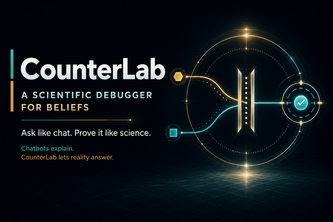
Evidence The author states: “Chatbots explain. CounterLab lets reality answer.”
Inference This is a positioning statement about the tool being more than an explanation tool — it's a belief-testing framework for learning.
Target Customer & ICP
The description indicates that CounterLab targets machine learning learners, particularly those who struggle with misconceptions like entity leakage or class imbalance. It is designed to help users understand what their models actually prove, rather than just reporting metrics.
It supports two misconception families:
- Entity leakage
- Class imbalance
Evidence The author states: “CounterLab currently supports two machine-learning misconception families.”
Inference The target audience is likely students or practitioners in ML education or training contexts. No explicit customer segments or personas are described.
Business Model & Pricing Evidence
There is no evidence of a business model, pricing structure, or monetization strategy in the description.
Evidence Not evidenced.
Inference Since this is a hackathon project with no mention of revenue, customers, or sales, it appears to be non-commercial at this stage.
Technical & Delivery Signals
The system is described as built using:
- Cloudflare Workers
- React
- TypeScript
- Python scientific libraries (NumPy, pandas, scikit-learn)
- Codex for engineering assistance
- GPT-5.6 for reasoning
- D1, R2, Durable Objects for backend infrastructure
It uses a strict separation between generative AI and authority systems:
- GPT-5.6 proposes explanations and visualizations
- Codex compiles experiments
- Fixed kernels compute numerical results
- A frozen verifier checks validity
- Learner controls judgment and repair approval
Evidence The author states: “CounterLab deliberately separates generation from authority.”
Inference This suggests a strong technical architecture focused on safety, reproducibility, and control over AI outputs.
Traction & Maturity Signals
There is no evidence of traction or maturity beyond the author’s own account. The project is described as:
- A solo-built hackathon project
- Built in under a hackathon window
- With over 550 commits
- Not yet commercialized or deployed for users
Evidence The author states: “I built the complete system myself with Codex as my primary engineering collaborator.”
Inference No evidence of customers, revenue, usage metrics, or product-market fit.
Competitive Context
The description does not mention any direct competitors. However, it contrasts itself with:
- AI tutors
- Notebook linters
- Chatbots that explain concepts
It implies a niche in scientific learning tools for ML education, where learners need to test their beliefs through controlled experiments.
Evidence The author states: “I did not want to build another chatbot that simply explains leakage.”
Inference This is positioned as a novel approach within the ML education space, but no competitive landscape is described.
Open Questions & Risks
- No commercial traction or adoption: The project is presented as a hackathon prototype with no evidence of real-world use.
- Single-person development: While impressive for a solo effort, it raises questions about scalability and long-term maintenance.
- Unverified claims: All descriptions are self-reported; there is no independent verification of the system’s performance or effectiveness.
- High technical complexity without external validation: The architecture involves many moving parts (AI, fixed systems, verifiers), but no evidence that they work together reliably in practice.
Evidence The author states: “This is a solo project,” and “The repository now contains more than 550 commits.”
Inference The lack of external validation or product-market fit is a key risk.
Questions the description leaves open
- What specific educational institutions or learners are using this tool, if any?
- How does the system handle edge cases in real-world notebook inputs?
- Has the learner authority model been tested with actual users?
- Are there plans to expand beyond the two supported misconception families?
- What is the long-term vision for monetization or product development?
- How are the fixed kernels validated and updated over time?
Overall Assessment
Not evidenced.
There is no evidence of revenue, customers, or traction to support an investment or partnership decision. The project is described as a hackathon prototype with no commercial deployment or user base.
Inference This appears to be a proof-of-concept or experimental tool, not a product ready for investment or partnership. Any potential value would depend on future development and adoption, which is not yet evidenced.
User Stories BotA demo video on every pull request
Get a demo video on every new feature
GitHub App that watches your pull requests and records a narrated, captioned demo.
Save time on demo prep and make informed decisions faster with a video walkthrough of every new feature.
Source
Submitted to the OpenAI 2026 hackathon on Devpost. Project home on Devpost. Back to the full gallery on Devpost.
This competitive analysis was produced by top-founders.com (opens in a new tab)
Generated by a language model from this project's public Devpost page — its tagline, the author's own write-up and any built-with tags listed there — as captured in August 2026. Short quotations are the author's words. It is an opinion on the idea as a business, not on the people behind it, and it reflects the description as published then. If the project has moved on, request a correction below. The analysis is not independent research and contains no verified traction, revenue or customer data.
An independent guide by KFG International LLC — not affiliated with, endorsed by, or connected to Devpost or OpenAI.