

Archive position — measured, not model output
1 like on Devpost
505 of the 7,850 archived projects have more likes, and 1,758 share exactly 1 — so this project's #892 place in the like-ranked listing is a tie-break inside that group, not a ranking.
Projects (log scale)
Likes on Devpost. ▲ marks this project's group.
Show the figures
| Likes | Projects | Share of archive |
|---|---|---|
| 0 | 5,587 | 71.2% |
| 1 | 1,758 | 22.4% |
| 2 | 284 | 3.6% |
| 3–4 | 132 | 1.7% |
| 5–9 | 75 | 1.0% |
| 10+ | 14 | 0.2% |
 User Stories BotA demo video on every pull request
Get a demo video on every new feature
GitHub App that watches your pull requests and records a narrated, captioned demo.
Save time on demo prep and make informed decisions faster with a video walkthrough of every new feature.
Executive Summary
What the company appears to be
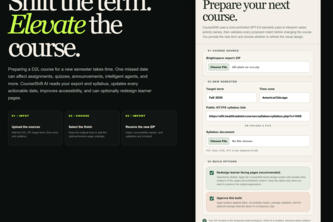
CourseShift AI is a self-reported tool that transforms Brightspace D2L course exports into import-ready packages for the next semester, automating date alignment, accessibility improvements, and design updates.
What changed
The author states they built this tool to reduce time spent by educators preparing courses each semester. It is presented as a working prototype deployed on Render, using AI (GPT-5.6) and deterministic code.
Single most important open question — the commercial due-diligence read
Is there any evidence of adoption or usage beyond the single founder’s personal use? The description contains no data on customers, revenue, or traction.
What The Product Actually Is
The description states that CourseShift AI:
- Takes a previous-semester Brightspace D2L course export
- Accepts a syllabus as URL or document
- Updates dates across assignments, quizzes, announcements, content restrictions, intelligent agents
- Repairs heading hierarchy and checks accessibility requirements
- Optionally applies a professional, responsive design system
- Preserves existing images and well-designed content
- Returns a ZIP ready for import into Brightspace
It is described as a Python application built with FastAPI, using GPT-5.6 through the OpenAI API, Beautiful Soup, lxml, Pydantic, and deployed on Render.
Inference The tool appears to be a semi-automated service that leverages AI for interpretation of syllabus language and deterministic code for date/time updates and validation.
Positioning & Claim Evolution
The author states:
- CourseShift AI is designed for educators preparing courses in Brightspace D2L
- It aims to save time, reduce errors, and improve accessibility
- The tool is positioned as a solution to repetitive, error-prone tasks in course preparation
Inference The positioning is self-described as an educational productivity tool aimed at reducing manual labor for instructors. There is no evidence of market positioning beyond the founder’s personal use case.
Target Customer & ICP
The description states:
- The primary user is a full-time college professor
- The tool targets educators preparing Brightspace D2L courses
- It is intended to help with date alignment, accessibility, and visual design
Inference The target customer is an individual educator or small group of educators using Brightspace D2L. No evidence of institutional adoption or broader ICP beyond the single user.
Business Model & Pricing Evidence
The description does not state:
- Whether CourseShift AI has a pricing model
- If it is free, subscription-based, or one-time purchase
- Any monetization strategy or revenue streams
Inference No evidence of a business model or pricing structure. The tool appears to be personal use only.
Technical & Delivery Signals
The description states:
- Built with Python and FastAPI
- Uses GPT-5.6 through OpenAI API for language interpretation
- Employs Pydantic for structured outputs
- Uses Beautiful Soup and lxml for HTML/XML processing
- Deployed on Render
- GitHub for version control
- 143 passing automated tests, strict type checking, linting
Inference The tool is built with a modern stack and includes test coverage. It uses AI for interpretation but relies on deterministic code for safety-critical operations.
Traction & Maturity Signals
The description states:
- CourseShift AI is a working, deployed product
- It accepts real Brightspace exports and syllabi
- It returns a downloadable ZIP ready for import
- The author plans to use it each semester and share with colleagues
- Future work includes feedback loops, reports, OCR support, authentication, audit history
Inference There is no evidence of external adoption or usage beyond the founder. No data on user base, engagement, or retention.
Competitive Context
The description does not mention:
- Competitors in the edtech space
- Other tools for course preparation or LMS automation
- Market positioning relative to existing solutions
Inference No evidence of competitive analysis or awareness of existing tools in this niche.
Open Questions & Risks
- The tool is described as a personal project by one person (founder)
- No evidence of adoption, customers, or revenue
- No pricing model or monetization strategy
- No indication of scalability beyond the single user
- AI dependency may create fragility if API access changes
- No mention of institutional partnerships or pilot programs
Inference The risk is high that this remains a prototype with no commercial traction or sustainable business model.
Questions the description leaves open
- What is your plan for scaling beyond personal use?
- Are there any educators currently using CourseShift AI, and how are they engaged?
- How do you intend to monetize the tool?
- Have you considered institutional licensing or integration with LMS providers?
- What would be the impact of OpenAI API changes on your service?
- Do you have a roadmap for additional LMS integrations beyond Brightspace?
Overall Assessment
The description states that CourseShift AI is a working, deployed product built by one person. It has no evidence of traction, revenue, or adoption beyond the founder’s use.
Inference No commercial viability or investment potential can be inferred from this self-reported description alone. The tool appears to be a prototype with no demonstrated market demand or business model.
User Stories BotA demo video on every pull request
Get a demo video on every new feature
GitHub App that watches your pull requests and records a narrated, captioned demo.
Save time on demo prep and make informed decisions faster with a video walkthrough of every new feature.
Source
Submitted to the OpenAI 2026 hackathon on Devpost. Project home on Devpost. Back to the full gallery on Devpost.
This competitive analysis was produced by top-founders.com (opens in a new tab)
Generated by a language model from this project's public Devpost page — its tagline, the author's own write-up and any built-with tags listed there — as captured in August 2026. Short quotations are the author's words. It is an opinion on the idea as a business, not on the people behind it, and it reflects the description as published then. If the project has moved on, request a correction below. The analysis is not independent research and contains no verified traction, revenue or customer data.
An independent guide by KFG International LLC — not affiliated with, endorsed by, or connected to Devpost or OpenAI.