

Archive position — measured, not model output
1 like on Devpost
505 of the 7,850 archived projects have more likes, and 1,758 share exactly 1 — so this project's #893 place in the like-ranked listing is a tie-break inside that group, not a ranking.
Projects (log scale)
Likes on Devpost. ▲ marks this project's group.
Show the figures
| Likes | Projects | Share of archive |
|---|---|---|
| 0 | 5,587 | 71.2% |
| 1 | 1,758 | 22.4% |
| 2 | 284 | 3.6% |
| 3–4 | 132 | 1.7% |
| 5–9 | 75 | 1.0% |
| 10+ | 14 | 0.2% |
 User Stories BotA demo video on every pull request
Get a demo video on every new feature
GitHub App that watches your pull requests and records a narrated, captioned demo.
Save time on demo prep and make informed decisions faster with a video walkthrough of every new feature.
Executive Summary
What the company appears to be
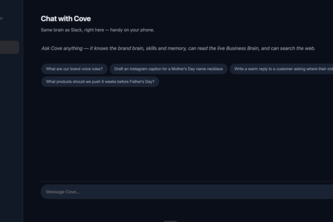
Cove is a Slack-first AI operator designed for small business teams. The author states it is built to help teams turn everyday requests into safe, useful operational work using AI, with features like memory, approvals, and live integrations. It is described as a tool that works within Slack but has a private dashboard for control.
What changed
During Build Week, Cove became more reliable by fixing issues around Slack context loss, artifact saving, verification of actions, and memory safety. These changes were made to ensure that AI work is actually completed and not just promised.
The single most important open question — the commercial due-diligence read
Is there a real market need for this type of AI operator in small businesses, or is this an experiment with limited commercial traction? The description does not provide evidence of revenue, customers, or adoption beyond one founder’s own business use case.
What The Product Actually Is
The description states that Cove is:
- A Slack-first AI operator.
- Built to turn team requests into safe, useful operational work.
- Uses Codex-built skills, memory, approvals, and live business integrations.
- Operates with a private dashboard, a business brain, workflow skills, memory, protected workspaces, and approval-gated integrations.
- Designed to help small businesses avoid bottlenecks by automating routine tasks without handing AI unlimited access.
It is not evidenced whether Cove is a SaaS product, an internal tool, or something else entirely. The author describes its functionality in terms of workflows and integrations but does not state how it is delivered (e.g., as a hosted service, self-hosted, or API).
Positioning & Claim Evolution
The author states that Cove was built to solve the problem of AI tools being too generic, isolated, or risky for real business use. It positions itself as:
- A production Slack assistant, not just a chatbot.
- An operator with memory and approvals, rather than a generic AI tool.
- A governed workflow tool that allows teams to use AI without handing it unlimited access.
The claim evolution shows a shift from a general "AI in business" idea to a more specific focus on:
- Controlled automation
- Business context awareness
- Operational safety and visibility
There is no evidence of prior positioning or product iteration beyond this single submission. The author’s own narrative suggests this is a new concept, not an evolution of an existing product.
Target Customer & ICP
The description states that Cove is built for:
- Small businesses.
- Teams that work in Slack, use ecommerce systems, and manage campaign tools.
- Founders or operators who want to reduce bottlenecks but still maintain control over AI-generated work.
It is not evidenced whether Cove targets a specific vertical (e.g., e-commerce, SaaS, etc.) or if it’s designed for general business use. The author says it is built for one real business first, but the pattern is described as scalable beyond that.
Business Model & Pricing Evidence
The description does not state:
- Whether Cove is a SaaS product.
- What its pricing model is (e.g., per user, per feature, or subscription).
- If it has any monetization strategy or revenue streams.
- Whether it is offered as a free tier, paid plan, or enterprise solution.
There is no evidence of pricing, sales process, or customer acquisition strategies. The author only describes the tool’s functionality and use case.
Technical & Delivery Signals
The description states:
- Cove is built using Slack Bolt, Next.js, TypeScript, Supabase, Vercel, and other tools.
- It uses Codex as a coding partner during Build Week.
- The Slack worker is written in TypeScript with Slack Bolt in Socket Mode.
- The dashboard is a Next.js app.
- Supabase stores shared memory, Spaces, research jobs, and usage events.
- Published Spaces are served through a separate public reader, keeping drafts private until reviewed.
It is not evidenced whether the tool is:
- Hosted or self-hosted.
- Scalable for multiple users or teams.
- Integrated with other platforms beyond Slack and Supabase.
- Deployed in production or still experimental.
Traction & Maturity Signals
The description states:
- Cove was built during Build Week (a hackathon).
- It is described as a real business tool, not just an experiment.
- The author runs a real ecommerce business and uses Cove for their own operations.
- It has been improved to be more reliable, fixing issues like Slack context loss and artifact saving.
However:
- There is no evidence of customers or users beyond the founder’s own team.
- No revenue, usage metrics, or adoption data are provided.
- The tool is described as a single-person project, not a product with a team or market traction.
Competitive Context
The description does not mention:
- Specific competitors.
- How Cove compares to existing AI assistants or workflow tools.
- Whether it competes with platforms like Notion AI, Slack + AI integrations, or Zapier + AI.
It is not evidenced whether Cove is part of a broader category (e.g., AI agents, workflow automation, business operators) or if it fills a niche that is currently underserved.
Open Questions & Risks
- No evidence of traction or customers: The tool is described as built for one business and used by one person.
- Single-founder project: No team or external validation beyond the author’s own account.
- Unproven market demand: The description does not show evidence that other businesses have a need for this type of AI operator.
- No pricing or monetization strategy: The tool is not described as a commercial product with a revenue model.
- Limited scalability claims: No indication of whether it can be scaled beyond one business use case.
Questions the description leaves open
- What specific business problems are you solving, and how do you know they’re real?
- How many teams or businesses are currently using Cove in production?
- What is your pricing model, if any? Are you planning to monetize it?
- How does Cove handle data privacy and security for sensitive business information?
- What are the key technical challenges that remain unresolved or untested at scale?
- What is your plan for scaling beyond a single-person project?
Overall Assessment
The author states that Cove is built for one real business first, but the pattern is described as scalable. However, no evidence of traction, revenue, or adoption exists beyond the founder’s own use case.
This is a self-reported, unverified product concept, not a proven commercial offering. The description shows a thoughtful approach to AI integration in business workflows but lacks any demonstration of market demand or commercial viability.
Confidence: Low.
The project is described as an experiment or prototype, not a product with a track record or validated demand. It may be a promising idea, but it is not yet a commercial opportunity based on the evidence provided.
User Stories BotA demo video on every pull request
Get a demo video on every new feature
GitHub App that watches your pull requests and records a narrated, captioned demo.
Save time on demo prep and make informed decisions faster with a video walkthrough of every new feature.
Source
Submitted to the OpenAI 2026 hackathon on Devpost. Project home on Devpost. Back to the full gallery on Devpost.
This competitive analysis was produced by top-founders.com (opens in a new tab)
Generated by a language model from this project's public Devpost page — its tagline, the author's own write-up and any built-with tags listed there — as captured in August 2026. Short quotations are the author's words. It is an opinion on the idea as a business, not on the people behind it, and it reflects the description as published then. If the project has moved on, request a correction below. The analysis is not independent research and contains no verified traction, revenue or customer data.
An independent guide by KFG International LLC — not affiliated with, endorsed by, or connected to Devpost or OpenAI.