

Archive position — measured, not model output
1 like on Devpost
505 of the 7,850 archived projects have more likes, and 1,758 share exactly 1 — so this project's #894 place in the like-ranked listing is a tie-break inside that group, not a ranking.
Projects (log scale)
Likes on Devpost. ▲ marks this project's group.
Show the figures
| Likes | Projects | Share of archive |
|---|---|---|
| 0 | 5,587 | 71.2% |
| 1 | 1,758 | 22.4% |
| 2 | 284 | 3.6% |
| 3–4 | 132 | 1.7% |
| 5–9 | 75 | 1.0% |
| 10+ | 14 | 0.2% |
 User Stories BotA demo video on every pull request
Get a demo video on every new feature
GitHub App that watches your pull requests and records a narrated, captioned demo.
Save time on demo prep and make informed decisions faster with a video walkthrough of every new feature.
Executive Summary
What the company appears to be
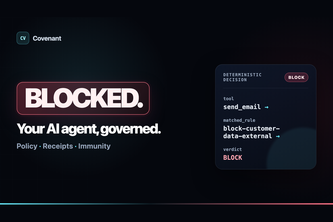
Covenant is a self-reported tool for deterministic governance of AI agents, built as a solo project during an OpenAI hackathon. The author describes it as a system that intercepts tool calls made by AI agents and enforces policy rules written in plain English, using GPT-5.6 for rule compilation and a typed TypeScript engine for enforcement. It includes a correction loop where human corrections are converted into regression tests.
What changed
The project was built solo over a short timeframe (a hackathon submission) with no prior traction or revenue evidence. It is presented as a proof-of-concept with 51 passing tests, an end-to-end browser test, and a live demo URL.
Single most important open question
Is there any evidence of commercial viability beyond the author’s personal use case in automated trading systems? The description does not indicate whether the tool has been adopted by others or integrated into existing workflows.
Note: This analysis is based entirely on the self-reported, unverified project description provided. No external data, revenue figures, customer names, or traction metrics are available.
What The Product Actually Is
The description states that Covenant:
- Sits between an AI agent and its tools.
- Accepts policy rules written in plain English.
- Compiles those rules into typed policies using GPT-5.6.
- Enforces these policies via a TypeScript engine before any tool call executes.
- Blocks, allows, or requires human approval for each action.
- Logs all decisions and executions in hash-linked receipts.
- Includes a correction loop where human corrections are transformed into regression tests.
- Uses a deterministic replay to validate changes before activation.
Inference: The system appears designed to prevent unintended behavior in AI agents by enforcing strict guardrails, similar to how automated trading systems apply risk caps and audit logs.
Claim vs Fact: These are claims made by the author; no independent verification or demonstration of actual deployment exists.
Positioning & Claim Evolution
The author positions Covenant as a solution for "deterministic governance" of AI agents — specifically addressing the lack of persistent, testable controls in current agent systems. The evolution of this claim is:
- From a personal need (trading bots) to a broader problem (AI agents).
- From a single-use tool to one with potential for integration into workflows.
- From a hackathon prototype to a product with future ambitions (MCP adapter, policy packs).
Inference: The author sees governance as a distinct product category, not just a prompt engineering exercise.
Claim vs Fact: This is the author’s own narrative about positioning and intent. No evidence of market adoption or competitive positioning exists.
Target Customer & ICP
The description does not name specific customers or personas. However, it implies:
- Users who operate AI agents that interact with external tools.
- Developers or engineers managing agent behavior in production environments.
- Organizations concerned with compliance (e.g., EU AI Act).
- Individuals or teams using AI agents for tasks involving sensitive data or actions.
Inference: The target is likely developers or technical decision-makers working with autonomous agents, especially those in regulated industries.
Claim vs Fact: This inference is based on the author’s framing of the problem but lacks evidence of actual customer segments or personas.
Business Model & Pricing Evidence
There is no mention of pricing models, monetization strategies, or business model details in the description. The project is presented as a solo hackathon effort with no indication of commercial intent beyond the demo.
Inference: If this becomes a product, it may be sold via SaaS or SDK licensing, but there is no evidence to support this.
Claim vs Fact: No pricing or business model data is provided; all assumptions are speculative.
Technical & Delivery Signals
The description provides some technical details:
- Built using Codex and GPT-5.6.
- Uses TypeScript, React, Node.js, Vercel, Playwright, Zod, and Responses API.
- Implements a typed policy engine with deterministic enforcement.
- Includes hash-linked receipts and correction loops.
- Has 51 passing tests and an end-to-end browser test.
- Runs in-memory sandboxed state on serverless infrastructure.
Inference: The system is technically sophisticated for a hackathon project, with clear architectural decisions around trust boundaries and testability.
Claim vs Fact: These are technical claims made by the author; no independent validation or performance data is available.
Traction & Maturity Signals
The description states:
- Solo-built in a short timeframe (submission window).
- 51 passing tests, plus an end-to-end browser test.
- Live demo URL available without login or key.
- No mention of users, customers, or adoption beyond the author’s own use case.
Inference: The project is at a very early stage — prototype-level with no evidence of real-world usage or scaling.
Claim vs Fact: This is self-reported maturity; no external indicators of traction or growth are present.
Competitive Context
The description does not reference competitors. However, the author notes that:
- There was no existing tool that did what Covenant does.
- The focus on deterministic enforcement and regression testing suggests a niche in agent governance.
Inference: Covenant may be addressing an underserved area of AI agent control, but there is no evidence of direct competition or market analysis.
Claim vs Fact: No competitive landscape data is provided; this is inferred from the author’s framing.
Open Questions & Risks
Key risks and open questions include:
- The project is a solo effort with no team or external validation.
- No revenue, customers, or traction are reported.
- The system relies heavily on GPT-5.6 for rule compilation — which may not be scalable or reliable in production.
- The correction loop involves human input, which could become a bottleneck.
- The demo is limited to a single user and does not reflect multi-agent or enterprise use cases.
Inference: The project has strong technical design but lacks commercial viability or scalability evidence.
Claim vs Fact: These are identified risks based on the self-reported nature of the project; no external data supports these concerns.
Questions the description leaves open
- What is your experience with deploying AI agents in production environments?
- How do you plan to scale this beyond a single-user demo?
- Have you tested the system under load or with multiple concurrent agents?
- Are there any known limitations of GPT-5.6 in compiling rules reliably?
- Do you have plans for integrating with existing agent frameworks (e.g., LangChain, LlamaIndex)?
- What are your thoughts on compliance requirements like the EU AI Act?
- How do you intend to monetize this tool if it becomes a product?
Note: These questions aim to probe beyond the self-reported claims and uncover deeper insights into feasibility, scalability, and commercial potential.
Overall Assessment
Assessment: Not evidenced.
The project is presented as a solo hackathon effort with no evidence of traction, revenue, or customer adoption. While the technical design shows promise, there is insufficient data to assess its commercial viability or strategic fit for investment or partnership.
Confidence Level: Low — based on minimal self-reported evidence and lack of third-party validation.
User Stories BotA demo video on every pull request
Get a demo video on every new feature
GitHub App that watches your pull requests and records a narrated, captioned demo.
Save time on demo prep and make informed decisions faster with a video walkthrough of every new feature.
Source
Submitted to the OpenAI 2026 hackathon on Devpost. Project home on Devpost. Back to the full gallery on Devpost.
This competitive analysis was produced by top-founders.com (opens in a new tab)
Generated by a language model from this project's public Devpost page — its tagline, the author's own write-up and any built-with tags listed there — as captured in August 2026. Short quotations are the author's words. It is an opinion on the idea as a business, not on the people behind it, and it reflects the description as published then. If the project has moved on, request a correction below. The analysis is not independent research and contains no verified traction, revenue or customer data.
An independent guide by KFG International LLC — not affiliated with, endorsed by, or connected to Devpost or OpenAI.