

Archive position — measured, not model output
0 likes on Devpost
2,263 of the 7,850 archived projects have more likes, and 5,587 share exactly 0 — so this project's #4,820 place in the like-ranked listing is a tie-break inside that group, not a ranking.
Projects (log scale)
Likes on Devpost. ▲ marks this project's group.
Show the figures
| Likes | Projects | Share of archive |
|---|---|---|
| 0 | 5,587 | 71.2% |
| 1 | 1,758 | 22.4% |
| 2 | 284 | 3.6% |
| 3–4 | 132 | 1.7% |
| 5–9 | 75 | 1.0% |
| 10+ | 14 | 0.2% |
 User Stories BotA demo video on every pull request
Get a demo video on every new feature
GitHub App that watches your pull requests and records a narrated, captioned demo.
Save time on demo prep and make informed decisions faster with a video walkthrough of every new feature.
Executive Summary
What the company appears to be
Knot is a self-reported local-first desktop application designed to manage and share knowledge in a portable format, with support for AI agents. It is built as a desktop studio using technologies like Electron and React, and claims to use Open Knowledge Format (OKF) for data handling.
What changed
The project was submitted to the OpenAI 2026 hackathon, indicating an early-stage development or prototype effort. No evidence of prior traction, revenue, or customer adoption is provided.
Single most important open question
Is there a clear, unambiguous definition of what "portable OKF knowledge" means in practice, and how it differs from existing tools like Notion, Obsidian, or local-first note-taking platforms?
What The Product Actually Is
The description states that Knot is “a local-first desktop studio that keeps portable OKF knowledge current, selectively shared, and safely usable by people and AI agents.” It is built using technologies such as Electron, React, TypeScript, Playwright, and codex-app-server.
Evidence
- The project is described as a "local-first desktop studio."
- It uses the Open Knowledge Format (OKF).
- It supports AI agent usage.
- Built with Electron, React, and other frontend/backend tools.
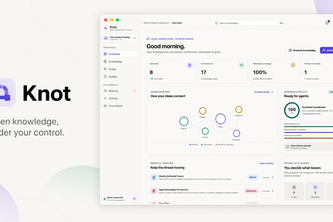
Inference It appears to be a knowledge management or content creation tool that stores data locally and allows for sharing and AI interaction. However, no functional description, UI mockups, or user flows are provided.
Positioning & Claim Evolution
The tagline states: “A local-first desktop studio that keeps portable OKF knowledge current, selectively shared, and safely usable by people and AI agents.”
Evidence
- The positioning is centered on local-first storage.
- Emphasis on portability of knowledge in OKF format.
- Intended for both human users and AI agents.
Inference The product positions itself as a tool for managing knowledge in a structured, portable way that supports AI integration. However, no evidence of prior positioning evolution or market feedback is provided.
Target Customer & ICP
The description does not specify the target customer or ideal customer profile (ICP).
Evidence
- No mention of personas, use cases, or target segments.
- No indication of whether it targets developers, researchers, knowledge workers, or AI agents directly.
Inference Given that it's built for AI agents and uses OKF, the ICP may include users who value structured, portable knowledge formats and are interested in AI-assisted workflows. However, this is speculative without further detail.
Business Model & Pricing Evidence
There is no evidence of a business model or pricing structure.
Evidence
- No mention of monetization strategy.
- No pricing information, subscription tiers, or licensing models.
Inference If the product is intended for AI agents and knowledge sharing, it may be positioned as a developer tool or platform. However, no commercial intent or revenue path is stated.
Technical & Delivery Signals
The project is built with technologies like Electron, React, Playwright, and TypeScript. It uses Open Knowledge Format (OKF) and model-context-protocol.
Evidence
- Built using Electron for desktop app.
- Uses React, TypeScript, Vitest, Playwright.
- Integrates with OKF and GPT models via codex-app-server.
Inference The technical stack suggests a modern, cross-platform desktop application. However, no evidence of delivery timeline, architecture diagrams, or performance benchmarks is provided.
Traction & Maturity Signals
There is no evidence of traction, adoption, or maturity.
Evidence
- Submitted to a hackathon (OpenAI 2026).
- Team size: 2.
- No mention of users, customers, revenue, or product usage metrics.
Inference This is likely an early-stage prototype or proof-of-concept. The lack of any traction indicators suggests it has not yet reached market readiness.
Competitive Context
The description does not provide a competitive analysis or context.
Evidence
- No mention of competitors.
- No comparison to existing tools like Notion, Obsidian, Roam Research, or local-first knowledge platforms.
Inference Given the focus on OKF and AI agent usage, it may compete with or complement tools in the knowledge management and AI-assisted productivity space. However, no competitive positioning is evident.
Open Questions & Risks
- Unclear value proposition: The term “portable OKF knowledge” is not defined.
- No traction or revenue: Submitted to a hackathon; no evidence of users or monetization.
- Unproven market fit: No indication of customer feedback or demand.
- Ambiguity in AI integration: The role of AI agents is not clearly explained.
Evidence
- No mention of user base, adoption, or revenue.
- No clear definition of OKF or how it’s different from other formats.
- No evidence of product-market fit or competitive differentiation.
Questions the description leaves open
- What does “portable OKF knowledge” mean in practice? How is it structured and used?
- Who are the intended users, and what problems do they have that this solves?
- How does Knot integrate with AI agents? What specific use cases are supported?
- Is there a plan for monetization or commercialization?
- What is the roadmap for product development beyond the hackathon prototype?
Overall Assessment
Not evidenced.
The project is in an early stage, submitted to a hackathon with no evidence of traction, revenue, or customer adoption. The description lacks clarity on core concepts like OKF and AI integration.
Confidence Low. This is a self-reported, unverified, early-stage idea with no demonstrated commercial viability or market validation.
User Stories BotA demo video on every pull request
Get a demo video on every new feature
GitHub App that watches your pull requests and records a narrated, captioned demo.
Save time on demo prep and make informed decisions faster with a video walkthrough of every new feature.
Source
Submitted to the OpenAI 2026 hackathon on Devpost. Project home on Devpost. Back to the full gallery on Devpost.
This competitive analysis was produced by top-founders.com (opens in a new tab)
Generated by a language model from this project's public Devpost page — its tagline and any built-with tags listed there, since the author published no write-up — as captured in August 2026. Short quotations are the author's words. It is an opinion on the idea as a business, not on the people behind it, and it reflects the description as published then. If the project has moved on, request a correction below. The analysis is not independent research and contains no verified traction, revenue or customer data.
An independent guide by KFG International LLC — not affiliated with, endorsed by, or connected to Devpost or OpenAI.