

Archive position — measured, not model output
0 likes on Devpost
2,263 of the 7,850 archived projects have more likes, and 5,587 share exactly 0 — so this project's #6,776 place in the like-ranked listing is a tie-break inside that group, not a ranking.
Projects (log scale)
Likes on Devpost. ▲ marks this project's group.
Show the figures
| Likes | Projects | Share of archive |
|---|---|---|
| 0 | 5,587 | 71.2% |
| 1 | 1,758 | 22.4% |
| 2 | 284 | 3.6% |
| 3–4 | 132 | 1.7% |
| 5–9 | 75 | 1.0% |
| 10+ | 14 | 0.2% |
 User Stories BotA demo video on every pull request
Get a demo video on every new feature
GitHub App that watches your pull requests and records a narrated, captioned demo.
Save time on demo prep and make informed decisions faster with a video walkthrough of every new feature.
Executive Summary
What the company appears to be
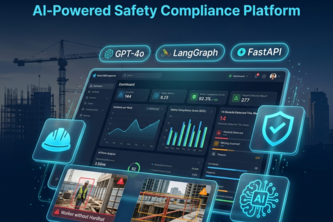
The project described by the author is a self-contained, personal development effort toward building an enterprise-grade AI-powered safety compliance platform for industrial environments — specifically targeting construction and infrastructure projects in the UAE. It is presented as a portfolio piece for Upwork contracts and client proposals.
What changed
This is a single-person project (1 team member) that demonstrates technical capability in designing and implementing a multi-agent AI system using LangGraph, FastAPI, vector databases, and LLMs to automate HSE inspections and weather-based safety alerts. It includes both backend engineering solutions for async task management and frontend UI components.
Single most important open question
Is this platform intended for commercial deployment or is it a prototype for demonstration purposes? The description does not indicate any revenue, customers, or product-market fit beyond the author’s own portfolio use case.
Analysis basis: Self-reported only. No external verification, traction data, or financials are available. All claims in the report are based on the author's own submission and should be treated as such.
What The Product Actually Is
The description states that Smart HSE Inspector is an enterprise digital command center designed to modernize Health, Safety, and Environment (HSE) compliance for large-scale construction, civil engineering, and infrastructure projects. It uses AI agents to automate tasks like:
- Visual hazard detection from site photos
- Matching violations against regional safety regulations (e.g., ADOSH-SF)
- Generating bilingual (English & Arabic) Non-Conformance Reports (NCRs)
- Verifying contractor remediation
- Compiling strategic safety metrics
Additionally, it includes a predictive weather-monitoring agent called Almonzer that evaluates real-time forecast data against UAE-specific occupational thresholds and dispatches automated warnings.
Inference: The system is built using LangGraph for multi-agent orchestration, FastAPI as the backend framework, Qdrant for vector search, Celery for async processing, and integrates with OpenAI and Anthropic LLMs. It also includes custom engineering solutions for handling asynchronous database connections and image preprocessing.
Claim vs Fact: The description claims this is a fully automated system but does not provide evidence of actual deployment or usage in real-world environments.
Positioning & Claim Evolution
The author positions the product as an enterprise-grade multi-agent safety compliance platform aimed at industrial clients, particularly those operating in high-risk environments like construction sites in the UAE. The project is framed as a solution to manual, slow, and error-prone HSE audit processes.
It emphasizes automation of tasks such as:
- Drafting NCRs
- Cross-referencing local legislation
- Translating reports into multiple languages
The author also highlights:
- Reduction in time to generate an NCR from 45 minutes to 8 seconds
- Accuracy of regulatory mapping at over 93%
- Bilingual reporting capability eliminating translation costs
- Proactive alerting for weather-related hazards
Inference: The positioning reflects a niche focus on industrial safety compliance, especially within the Gulf region. It is not positioned as a general-purpose AI tool but rather as a specialized solution tailored to specific regulatory and linguistic needs.
Claim vs Fact: These claims are self-reported and lack independent validation or proof of impact in live deployments.
Target Customer & ICP
The description implies that the primary target customer is:
- Large-scale construction, civil engineering, and infrastructure project owners
- Contractors working on projects in the UAE (specifically those subject to ADOSH-SF regulations)
- Municipal or government agencies requiring compliance monitoring
There is no explicit mention of:
- End-user personas beyond safety professionals
- Specific industry verticals beyond construction
- Geographic expansion plans beyond the UAE
Inference: The ICP appears to be mid-to-large enterprises in regulated industries with a need for automated HSE compliance and multilingual reporting.
Claim vs Fact: No evidence provided about actual customers, pilot programs, or market demand beyond the author’s own demonstration.
Business Model & Pricing Evidence
No information is provided regarding:
- Revenue streams
- Pricing models
- Customer acquisition strategies
- Monetization approach
The project is described as being developed for Upwork contracts and client proposals, suggesting it may be used to attract paid work or investment.
Inference: If commercialized, the business model likely involves SaaS licensing or consulting services tied to enterprise deployment. However, no pricing structure or monetization strategy is evident in the description.
Claim vs Fact: The author suggests this could be a revenue-generating tool but provides no concrete evidence of either.
Technical & Delivery Signals
The system architecture includes:
- Multi-agent workflows using LangGraph
- Integration with FastAPI, Next.js, Celery, PostgreSQL, Qdrant, Redis
- Use of OpenAI and Anthropic LLMs
- Custom engineering for handling async DB sessions and image preprocessing
- Dockerized deployment stack
Key technical features mentioned include:
- Persistent event loop in Celery workers
- Dual-context session model for database management
- EXIF auto-rotation and visual density clamping for images
Inference: The author demonstrates strong technical depth, particularly around async processing, vector search, and LLM integration. However, there is no evidence of production-grade scalability or performance benchmarks.
Claim vs Fact: These are described as engineering solutions but not validated in real-world use cases.
Traction & Maturity Signals
There is no evidence of:
- Revenue generation
- Customer adoption
- Product-market fit
- Deployment history
- User feedback or iteration cycles
The project is presented as a personal portfolio piece and hackathon submission, indicating it has not yet reached market traction.
Inference: The maturity level appears to be early-stage development with strong technical execution but no commercial validation.
Claim vs Fact: The author states this is a "fully automated" system, but there is no evidence of operational deployment or user engagement.
Competitive Context
The description does not reference:
- Direct competitors
- Market size estimates
- Competitive advantages
- Differentiation from existing HSE compliance tools
It focuses on the technical implementation rather than market positioning or competitive landscape analysis.
Inference: The niche focus on UAE-specific regulations and bilingual capabilities may differentiate it from generic safety platforms, but no competitive comparison is made.
Claim vs Fact: No evidence of competitor presence or market dynamics is provided.
Open Questions & Risks
- Lack of commercial traction: No evidence of revenue, customers, or product-market fit.
- Single-person development: The entire system was built by one individual, raising questions about scalability and long-term maintenance.
- Unverified claims: Many performance metrics (e.g., 93% accuracy) are self-reported without independent validation.
- Limited deployment context: The system is described as a prototype for Upwork proposals, not a deployed product.
- Regulatory specificity: Heavy reliance on UAE-specific legislation may limit broader applicability.
Inference: While technically impressive, the lack of real-world usage or commercial viability raises concerns about whether this will become a viable business.
Claim vs Fact: All claims are self-reported and unverified; no third-party confirmation exists.
Questions the description leaves open
- Has this system been tested in any real-world environment? If so, what were the results?
- What is the intended go-to-market strategy for commercial deployment?
- Are there any existing partnerships or pilot customers?
- How does the system handle data privacy and security compliance (e.g., GDPR, local UAE laws)?
- What are the scalability limitations of the current architecture?
- Is there a plan to expand beyond the UAE regulatory framework?
- What is the expected lifecycle of the knowledge ingestion pipeline for updating legislation?
- How is the system monitored and maintained post-deployment?
Overall Assessment
Not evidenced
The description does not contain sufficient information to assess:
- Commercial viability
- Market opportunity
- Financials or revenue potential
- Team capability beyond one person
- Product-market fit or traction
It is clear that the author has technical expertise and has built a functional prototype, but there is no indication of whether this will evolve into a scalable business.
Confidence level: Low. This is a self-reported portfolio project with no external validation or commercial evidence. Any investment or partnership decision should be contingent on further due diligence confirming real-world application, customer feedback, and scalability.
Inference: The project shows promise in terms of technical execution but lacks the commercial signals needed to evaluate its potential as an investment or strategic partner.
User Stories BotA demo video on every pull request
Get a demo video on every new feature
GitHub App that watches your pull requests and records a narrated, captioned demo.
Save time on demo prep and make informed decisions faster with a video walkthrough of every new feature.
Source
Submitted to the OpenAI 2026 hackathon on Devpost. Project home on Devpost. Back to the full gallery on Devpost.
This competitive analysis was produced by top-founders.com (opens in a new tab)
Generated by a language model from this project's public Devpost page — its tagline, the author's own write-up and any built-with tags listed there — as captured in August 2026. Short quotations are the author's words. It is an opinion on the idea as a business, not on the people behind it, and it reflects the description as published then. If the project has moved on, request a correction below. The analysis is not independent research and contains no verified traction, revenue or customer data.
An independent guide by KFG International LLC — not affiliated with, endorsed by, or connected to Devpost or OpenAI.