

Archive position — measured, not model output
1 like on Devpost
505 of the 7,850 archived projects have more likes, and 1,758 share exactly 1 — so this project's #889 place in the like-ranked listing is a tie-break inside that group, not a ranking.
Projects (log scale)
Likes on Devpost. ▲ marks this project's group.
Show the figures
| Likes | Projects | Share of archive |
|---|---|---|
| 0 | 5,587 | 71.2% |
| 1 | 1,758 | 22.4% |
| 2 | 284 | 3.6% |
| 3–4 | 132 | 1.7% |
| 5–9 | 75 | 1.0% |
| 10+ | 14 | 0.2% |
 User Stories BotA demo video on every pull request
Get a demo video on every new feature
GitHub App that watches your pull requests and records a narrated, captioned demo.
Save time on demo prep and make informed decisions faster with a video walkthrough of every new feature.
Executive Summary
What the company appears to be
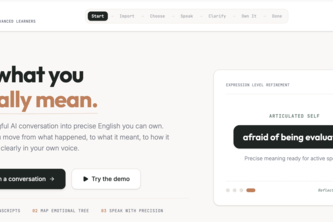
Cosu is an AI-powered English language-learning tool designed to help users articulate vague ideas more precisely through structured interaction with AI. The product aims to bridge the gap between what learners want to express and how they can express it, using a three-stage workflow: Capture, Clarify, and Own.
What changed
The project was initially an AI-powered spoken-English practice product with existing features like voice-based answers, transcription, language feedback, and acoustic scoring. During Build Week, the author focused on integrating GPT-5.6 into a new "Capture–Clarify–Own" workflow to refine how learners identify, understand, and express their ideas.
Single most important open question
Is there evidence of user engagement or adoption beyond the prototype stage? The description provides no data on usage, retention, or product-market fit.
Note: This analysis is based solely on the self-reported project description provided by the author. All claims are unverified and should be treated as stated by the author, not confirmed facts.
What The Product Actually Is
The description states that Cosu is an English-speaking and expression-training agent. It helps users move through three stages:
- Capture: Identifies useful expressions in AI responses and vague ideas in the learner’s own speech.
- Clarify: Uses GPT-5.6 to distinguish between possible meanings of vague expressions, then asks clarification questions.
- Own: Evaluates whether learners can independently express the clarified idea using acoustic scoring.
It is described as not being a vocabulary list builder but rather a system that builds a personal language system based on what the learner has genuinely tried to understand and communicate.
Claim: Cosu is an AI-powered spoken-English practice tool.
Evidence: Author's write-up.
Inference: The product uses GPT-5.6 for semantic reasoning, and an acoustic scoring API for spoken delivery evaluation.
Evidence: Author’s write-up.
Positioning & Claim Evolution
The author positions Cosu as a tool that helps learners move from vague expressions to precise ones by connecting insights from AI conversations with personal emotional or experiential understanding. It is framed not just as a language-learning tool but as one that supports cognitive development through language.
It draws parallels between second-language learning and psychoanalytic work, suggesting that precise language can change perception and understanding.
Claim: Cosu helps users move from broad labels to precise meanings.
Evidence: Author's write-up.
Inference: The tool is positioned as a cognitive aid for expression rather than a traditional vocabulary trainer.
Evidence: Author’s write-up.
Target Customer & ICP
The description states that the primary use case involves personal feelings, but also mentions academic opinions, professional experiences, and everyday ideas. It targets learners who struggle to articulate complex or nuanced thoughts in English.
It is implied that users may be language learners at various levels, particularly those seeking to improve clarity and precision in communication.
Claim: Users are English learners who want to express themselves more clearly.
Evidence: Author's write-up.
Inference: The tool appeals to individuals interested in self-improvement or personal development through language.
Evidence: Author’s write-up.
Business Model & Pricing Evidence
There is no evidence of pricing, monetization strategy, or business model in the provided description. No mention of subscriptions, freemium tiers, or any revenue streams.
Claim: Not evidenced.
Evidence: None provided.
Technical & Delivery Signals
The project was built using React, TypeScript, Node.js, Express.js, and integrates with OpenAI APIs (specifically GPT-4o-mini-transcribe, GPT-5.6). It uses Zod for validation and Vite for building.
It includes a structured memory schema called "Personal Expression Memory" that tracks expressions across contexts.
Milestone 1 of Build Week involved cleaning up the prototype and adding documentation, but no actual OpenAI API usage was implemented yet at that point.
Claim: Cosu uses GPT-5.6 for semantic reasoning.
Evidence: Author's write-up.
Inference: The tool is built on modern web technologies with a focus on frontend interactivity and backend integration.
Evidence: Technology tags and build log.
Traction & Maturity Signals
There is no evidence of traction, customers, or adoption beyond the prototype phase. The project was submitted to an OpenAI hackathon, but there is no indication of user engagement, retention, or product-market fit.
Claim: Not evidenced.
Evidence: None provided.
Competitive Context
No competitive landscape or market positioning relative to other language-learning tools or AI assistants is described. The author does not reference competitors or similar products.
Claim: Not evidenced.
Evidence: None provided.
Open Questions & Risks
- Prototype-only status: No live product, no real users, no data on effectiveness.
- No monetization strategy: No indication of how the tool will be sold or funded.
- Unproven AI integration: GPT-5.6 is used in concept but not yet implemented in Milestone 1.
- Lack of user feedback loops: No evidence of iterative improvement based on real-world usage.
Inference: The lack of traction and monetization signals raises concerns about viability.
Evidence: Author's write-up, build log.
Questions the description leaves open
- What specific metrics or outcomes are you measuring to assess whether learners have improved their ability to express ideas?
- How do you plan to scale beyond a single developer prototype?
- Have you tested the workflow with real users? If so, what were the results?
- What is your roadmap for integrating OpenAI APIs and moving from prototype to product?
- Are there any existing partnerships or pilot programs with language schools or educational institutions?
Overall Assessment
At this stage, Cosu appears to be a conceptual prototype with strong alignment to a potential market need—helping learners articulate complex ideas more precisely. However, there is no evidence of traction, revenue, or even basic user engagement.
Given the lack of data on product-market fit, scalability, or monetization, any investment or partnership decision would require further validation and demonstration of real-world utility.
Assessment: Not ready for investment or partnership without additional evidence of traction, user feedback, or product development progress.
Evidence: Author's write-up, build log.
User Stories BotA demo video on every pull request
Get a demo video on every new feature
GitHub App that watches your pull requests and records a narrated, captioned demo.
Save time on demo prep and make informed decisions faster with a video walkthrough of every new feature.
Source
Submitted to the OpenAI 2026 hackathon on Devpost. Project home on Devpost. Back to the full gallery on Devpost.
This competitive analysis was produced by top-founders.com (opens in a new tab)
Generated by a language model from this project's public Devpost page — its tagline, the author's own write-up and any built-with tags listed there — as captured in August 2026. Short quotations are the author's words. It is an opinion on the idea as a business, not on the people behind it, and it reflects the description as published then. If the project has moved on, request a correction below. The analysis is not independent research and contains no verified traction, revenue or customer data.
An independent guide by KFG International LLC — not affiliated with, endorsed by, or connected to Devpost or OpenAI.