

Archive position — measured, not model output
0 likes on Devpost
2,263 of the 7,850 archived projects have more likes, and 5,587 share exactly 0 — so this project's #4,750 place in the like-ranked listing is a tie-break inside that group, not a ranking.
Projects (log scale)
Likes on Devpost. ▲ marks this project's group.
Show the figures
| Likes | Projects | Share of archive |
|---|---|---|
| 0 | 5,587 | 71.2% |
| 1 | 1,758 | 22.4% |
| 2 | 284 | 3.6% |
| 3–4 | 132 | 1.7% |
| 5–9 | 75 | 1.0% |
| 10+ | 14 | 0.2% |
 User Stories BotA demo video on every pull request
Get a demo video on every new feature
GitHub App that watches your pull requests and records a narrated, captioned demo.
Save time on demo prep and make informed decisions faster with a video walkthrough of every new feature.
Executive Summary
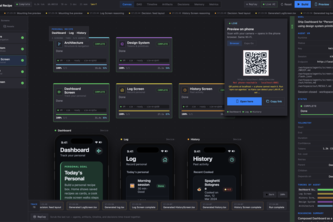
Kairo is a self-reported project that describes itself as a collaborative workspace for multi-agent mobile app development using Expo. The author states it enables agents to design and ship an Expo mobile app from a product brief, with all steps inspectable — including agents, VMs, events, artifacts, and decisions. It uses technologies like agent-os, codex, expo.io, laminar, mem0, openai, openrouter, and is built on Expo SDK 57, React Native, TypeScript, and others.
The description states that Kairo supports a live preview through Expo Go, visualizes agent workflows (agent DAG, timeline, artifact graph), and allows for replay and decision tracing. It is positioned as an observability tool for agent-driven development in mobile app creation.
Key open question
Is there any evidence of actual product use, customer feedback, or traction beyond the author’s own development?
What The Product Actually Is
The description states that Kairo:
- Turns a product brief into an Expo mobile app plan
- Coordinates specialized agents to design navigation, design system, primary screen, and remaining screens
- Exposes the entire process through a canvas, agent DAG, timeline, artifact graph, decision explorer, memory, metrics, replay, live preview, and Expo Go QR code
It is built with:
- Expo SDK 57, Expo Router, React 19, React Native, TypeScript, Reanimated, react-native-svg
- OpenAI-compatible inference layer for planning
- Laminar for telemetry
- Optional mem0 memory
- Local Express-based agentOS bridge for isolated per-agent workspaces
The workspace renders generated screens dynamically and supports both mock and live AI modes.
Inference Kairo appears to be a prototype or proof-of-concept tool that integrates AI agents into mobile app development, with an emphasis on observability and traceability of the agent workflow.
Positioning & Claim Evolution
The author states:
- Mobile app generation often feels opaque
- Built Kairo to make multi-agent mobile development observable, inspectable, and easier to trust
It is positioned as a tool that:
- Makes agent-driven mobile development more transparent
- Enables debugging and evaluation through full traceability of decisions and artifacts
- Supports live device previews and collaboration between teams
Inference The positioning evolves from a general-purpose AI tool to one focused on observability in agent-based workflows, particularly for mobile app creation.
Target Customer & ICP
The description does not state:
- Who the target customer is
- What the ideal customer profile (ICP) is
- Whether it targets product managers, designers, engineers, or teams
Not evidenced.
Business Model & Pricing Evidence
The description does not state:
- How Kairo would generate revenue
- Whether there are any pricing models or monetization strategies
- If it's a freemium, enterprise, or B2B offering
Not evidenced.
Technical & Delivery Signals
The description states:
- Built with Expo SDK 57, Expo Router, React 19, React Native, TypeScript, Reanimated, react-native-svg
- Uses OpenAI-compatible inference layer for planning
- Laminar for telemetry
- Optional mem0 memory
- Local Express-based agentOS bridge for isolated per-agent workspaces
- Supports both mock and live AI modes
- Renders generated screens dynamically
- Provides Expo Go QR code for live preview
Inference The technical stack suggests a prototype or early-stage product, built on modern mobile development tools and AI integration. It is not clear if this is a hosted solution or local tooling.
Traction & Maturity Signals
The description states:
- This project was submitted to the OpenAI 2026 hackathon
- Team size: 0
- No mention of customers, revenue, or adoption
- No evidence of product-market fit or usage beyond the author’s own development
Not evidenced.
Competitive Context
The description does not state:
- Who the competitors are
- What similar tools already exist in the market
- How Kairo differentiates from existing agent orchestration or mobile app generation platforms
Not evidenced.
Open Questions & Risks
- The project is a self-reported hackathon submission with no evidence of traction, revenue, or customers.
- No team size or structure is stated beyond “0”.
- No mention of funding, partnerships, or product-market fit.
- The author’s own account is the only source of information — no third-party validation.
- The tool is described as a prototype or proof-of-concept, not a production-ready product.
Inference The lack of any evidence of real-world use or commercial viability raises significant risk that this is an unproven concept.
Questions the description leaves open
- What specific problem are you solving for users beyond the author’s own development?
- Have you tested Kairo with real users, and if so, what feedback did you get?
- How do you plan to monetize this tool?
- Are there any existing competitors or similar tools in the market?
- What is your roadmap for moving from prototype to product?
- Do you have a team beyond the author?
Overall Assessment
The description states that Kairo is a self-reported hackathon project with no evidence of traction, revenue, customers, or commercial viability.
Assessment Not evidenced as a viable investment or partnership opportunity at this stage. The project appears to be an early-stage prototype with no demonstrated product-market fit or commercial model.
User Stories BotA demo video on every pull request
Get a demo video on every new feature
GitHub App that watches your pull requests and records a narrated, captioned demo.
Save time on demo prep and make informed decisions faster with a video walkthrough of every new feature.
Source
Submitted to the OpenAI 2026 hackathon on Devpost. Project home on Devpost. Back to the full gallery on Devpost.
This competitive analysis was produced by top-founders.com (opens in a new tab)
Generated by a language model from this project's public Devpost page — its tagline, the author's own write-up and any built-with tags listed there — as captured in August 2026. Short quotations are the author's words. It is an opinion on the idea as a business, not on the people behind it, and it reflects the description as published then. If the project has moved on, request a correction below. The analysis is not independent research and contains no verified traction, revenue or customer data.
An independent guide by KFG International LLC — not affiliated with, endorsed by, or connected to Devpost or OpenAI.