

Archive position — measured, not model output
0 likes on Devpost
2,263 of the 7,850 archived projects have more likes, and 5,587 share exactly 0 — so this project's #4,751 place in the like-ranked listing is a tie-break inside that group, not a ranking.
Projects (log scale)
Likes on Devpost. ▲ marks this project's group.
Show the figures
| Likes | Projects | Share of archive |
|---|---|---|
| 0 | 5,587 | 71.2% |
| 1 | 1,758 | 22.4% |
| 2 | 284 | 3.6% |
| 3–4 | 132 | 1.7% |
| 5–9 | 75 | 1.0% |
| 10+ | 14 | 0.2% |
 User Stories BotA demo video on every pull request
Get a demo video on every new feature
GitHub App that watches your pull requests and records a narrated, captioned demo.
Save time on demo prep and make informed decisions faster with a video walkthrough of every new feature.
Executive Summary
What the company appears to be
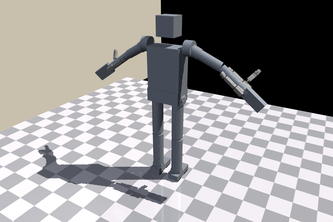
Kaji-Suru Moto is a self-reported project by a single developer (Moto Kajimoto) aiming to build a household humanoid robot. The author describes it as an end-to-end development and evaluation platform for such a robot, with focus on simulation, training, and testing infrastructure rather than autonomous task execution.
What changed
The project evolved from a personal joke about doing housework into a technical endeavor involving robotics simulation tools, procedural environment generation, and robot model construction. It is described as progressing from a robot-model project to an integrated development stack during a hackathon.
Single most important open question — the commercial due-diligence read
Is there evidence of any traction, revenue, or customer adoption beyond the author’s own development work? The description does not indicate any external validation, market interest, or commercial use.
What The Product Actually Is
The description states that Kaji-Suru Moto is:
- An end-to-end development and evaluation platform for a household humanoid robot.
- A simulation and evaluation foundation needed to train behaviors reliably.
- Not yet capable of autonomously performing complete household tasks.
- Designed to be 1.35 meters tall, weigh approximately 28 kilograms, and have 29 actuated degrees of freedom.
- Focused on moving dishes from a dining table to a kitchen sink as its first practical target.
The current output includes:
- Importing real rooms from captured images
- Calibrating and evaluating reconstructed scenes
- Procedurally generating varied household environments
- Exporting environments to MJCF and USD formats
- Generating synchronized full-body robot and hand models
- Running standing, contact, grasping, and household-interaction evaluations
- Recording metrics, diagnostic logs, audit data, and demonstration videos
Inference The product is a software stack for robotics simulation and development, not a commercial product or service.
Positioning & Claim Evolution
The author states:
- Kaji-Suru Moto means “Moto who does housework,” which started as a wordplay.
- It evolved into a serious project to design a household humanoid robot.
- The goal is to eventually operate the robot in a real home, starting with carrying dishes.
Inference The positioning has shifted from a humorous idea to a technical challenge in robotics development. There is no evidence of any market positioning or branding beyond the author’s own description.
Target Customer & ICP
The description does not state:
- Who the intended users are
- Whether there are existing customers or target markets
- Any segmentation or persona-based targeting
Not evidenced No indication of a defined customer base or ideal customer profile (ICP).
Business Model & Pricing Evidence
The description does not contain:
- Any mention of pricing models
- Revenue streams
- Monetization strategies
- Customer acquisition plans
Not evidenced No evidence of business model or pricing.
Technical & Delivery Signals
The author reports:
- Development of pipelines for real-scene reconstruction, procedural environment generation, full-body model generation, hand construction, collision analysis, evaluation, diagnostics, and demonstration production.
- Use of tools like COLMAP, ArUco, MuJoCo, MJCF, USD, and GPT/Codex for engineering assistance.
- Implementation of automated checks for mass, joint limits, symmetry, deterministic generation, and self-collision analysis.
- A test suite that currently passes four tests, with corrected full-body model able to maintain a standing pose in MuJoCo without unsupported root stabilization.
Inference The project shows technical maturity in simulation infrastructure but lacks evidence of real-world deployment or task completion.
Traction & Maturity Signals
The description states:
- The project progressed from a robot-model project into an integrated robotics development stack.
- It includes failed evaluations recorded as first-class results.
- A 500-case robustness test, grasp results for twelve objects, collision diagnostics, benchmark metrics, and audit logs are provided.
- The demo test suite currently passes four tests.
However:
- No revenue or customer data is mentioned.
- No evidence of product-market fit or adoption.
- The system does not yet autonomously perform household tasks.
- The hand’s self-collision and tactile-interference failures remain unresolved.
Not evidenced No traction, adoption, or commercial success indicators beyond the author's own development work.
Competitive Context
The description does not mention:
- Competitors
- Market dynamics
- Product differentiation
- Industry trends
Not evidenced No competitive landscape information.
Open Questions & Risks
Key risks and open questions based on the description:
- The project is described as a personal development effort by one individual.
- It has not yet achieved autonomous task execution.
- Several technical issues remain unresolved, including self-collision failures in the hand and grasp evaluation problems.
- No evidence of external validation or funding.
- The author acknowledges that passing a test does not mean building a correct robot.
Inference High risk due to lack of commercial traction, unresolved engineering challenges, and limited team size.
Questions the description leaves open
- What is the timeline for resolving the hand’s self-collision and tactile-interference failures?
- Are there any external partners or investors involved in this project?
- Has the author considered how they will transition from simulation to physical deployment?
- What are the plans for monetization or commercialization of this platform?
- How does the author plan to validate that the simulation accurately reflects real-world behavior?
Overall Assessment
The description indicates:
- This is a self-reported personal project by one developer.
- It involves significant technical development in robotics simulation and evaluation.
- There is no evidence of traction, revenue, or customer adoption.
- The project remains in early-stage development with unresolved engineering issues.
Assessment Not ready for investment or partnership at this stage. The project lacks commercial viability indicators and shows only personal development progress. Any potential value lies in the technical stack built so far, but no clear path to market or product-market fit is evident.
User Stories BotA demo video on every pull request
Get a demo video on every new feature
GitHub App that watches your pull requests and records a narrated, captioned demo.
Save time on demo prep and make informed decisions faster with a video walkthrough of every new feature.
Source
Submitted to the OpenAI 2026 hackathon on Devpost. Project home on Devpost. Back to the full gallery on Devpost.
This competitive analysis was produced by top-founders.com (opens in a new tab)
Generated by a language model from this project's public Devpost page — its tagline, the author's own write-up and any built-with tags listed there — as captured in August 2026. Short quotations are the author's words. It is an opinion on the idea as a business, not on the people behind it, and it reflects the description as published then. If the project has moved on, request a correction below. The analysis is not independent research and contains no verified traction, revenue or customer data.
An independent guide by KFG International LLC — not affiliated with, endorsed by, or connected to Devpost or OpenAI.