

Archive position — measured, not model output
0 likes on Devpost
2,263 of the 7,850 archived projects have more likes, and 5,587 share exactly 0 — so this project's #4,623 place in the like-ranked listing is a tie-break inside that group, not a ranking.
Projects (log scale)
Likes on Devpost. ▲ marks this project's group.
Show the figures
| Likes | Projects | Share of archive |
|---|---|---|
| 0 | 5,587 | 71.2% |
| 1 | 1,758 | 22.4% |
| 2 | 284 | 3.6% |
| 3–4 | 132 | 1.7% |
| 5–9 | 75 | 1.0% |
| 10+ | 14 | 0.2% |
 User Stories BotA demo video on every pull request
Get a demo video on every new feature
GitHub App that watches your pull requests and records a narrated, captioned demo.
Save time on demo prep and make informed decisions faster with a video walkthrough of every new feature.
Executive Summary
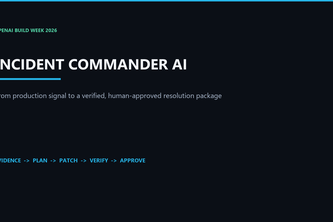
What the company appears to be: Incident Commander AI is a self-reported tool designed to automate and structure incident response in engineering teams. It claims to turn production alerts into resolution packages with evidence-backed diagnoses, bounded patches, deterministic verification, and auditable postmortems. The product is built by one person (Atchayam Ganesh) and uses technologies including GPT-5.6, FastAPI, Next.js, Docker, and PostgreSQL.
What changed: This project was submitted to the OpenAI 2026 hackathon. It represents an early-stage prototype or proof-of-concept, not a commercial product with traction or customers.
Single most important open question: Is there any evidence of actual usage, revenue, or customer adoption beyond the author’s own demonstration and testing?
What The Product Actually Is
The description states that Incident Commander AI provides one incident room that:
- Normalizes production-style alerts and redacts secret-shaped data;
- Correlates telemetry, deploy history, repository evidence, and runbooks;
- Ranks cited hypotheses and maps evidence to code;
- Proposes a bounded remediation plan, then stops for human approval;
- Creates a candidate patch inside an isolated workspace;
- Reconstructs and verifies the patch with targeted tests, full tests, lint, typecheck, regression coverage, and deterministic risk review;
- Requires a second, artifact-bound approval before recording a draft-PR package;
- Drafts stakeholder communications and an evidence-linked postmortem.
Inference: The system appears to be a workflow engine integrating AI agents with sandboxed code execution, test verification, and human oversight. It is not described as a general-purpose AI assistant but rather as a structured incident response automation tool.
Positioning & Claim Evolution
The author states that Incident Commander AI aims to keep the chain of incident response “evidence-backed, bounded, and human-controlled.” It positions itself as a solution for small engineering teams lacking dedicated incident commanders. The tagline emphasizes deterministic verification, auditable postmortems, and human approval.
Inference: The positioning is focused on reliability, control, and auditability in high-stakes environments like production incidents. It does not claim to be a general-purpose AI assistant or a full-stack observability platform.
Target Customer & ICP
The description states that small engineering teams rarely have a dedicated incident commander on every shift. Incident Commander AI is intended for these teams, where one senior engineer becomes the integration layer across alerts, logs, deployments, code, tests, stakeholder updates, and postmortems.
Inference: The target customer is likely small to mid-sized tech companies or engineering teams with limited incident response resources. It is not described as targeting large enterprises or SaaS providers.
Business Model & Pricing Evidence
No evidence of pricing, business model, or monetization strategy is provided in the description. The project is presented as a hackathon submission and does not mention any revenue streams, subscriptions, or paid features.
Inference: There is no evidence of a commercial business model or pricing structure beyond the author’s own development efforts.
Technical & Delivery Signals
The system uses:
- Frontend: Next.js 15 with strict TypeScript
- Backend/API: FastAPI, Pydantic v2, SQLAlchemy, Alembic, PostgreSQL, Redis
- AI integration: GPT-5.6 via OpenAI Responses API with structured output
- Testing and sandboxing: Codex CLI gateway, workspace-write confinement, secret-free environment, deterministic fixture providers
- Security checks: Gitleaks, dependency security checks
Inference: The system is built with a focus on safety, reproducibility, and sandboxed execution. It uses structured AI outputs and deterministic workflows to avoid uncontrolled behavior.
Traction & Maturity Signals
The description includes:
- 185 backend tests, 20 web tests, 6 shared-contract tests, and 22 Chromium scenarios pass
- Eight deterministic safety evaluations cover golden path, insufficient evidence, flaky tests, risky migrations, redaction, prompt injection, noisy telemetry, rollback cancellation
- Five consecutive fresh-database CLI demos pass
- Both production Docker images build; stack reports healthy
- Gitleaks and dependency security checks pass
Inference: The project shows technical maturity in testing, sandboxing, and reproducibility. However, there is no evidence of real-world usage or customer adoption.
Competitive Context
The description does not mention competitors or market positioning beyond the general idea of incident response automation. No specific tools or platforms are named as direct competitors.
Inference: The competitive landscape is unclear. It may overlap with tools like PagerDuty, Opsgenie, or internal incident management systems, but no such comparison is made.
Open Questions & Risks
- No real-world usage: The project is described as a hackathon submission and lacks evidence of actual deployment or adoption.
- Self-reported demo only: The demo uses deterministic fixtures and simulated outputs; no live GitHub write or production deployment is claimed.
- Single founder: The team size is listed as one person, which may limit scalability or development velocity.
- Unproven AI integration: While GPT-5.6 is mentioned, there is no evidence of real-world performance or reliability in production.
Questions the description leaves open
- What specific engineering teams or organizations are you targeting with this tool?
- Have any teams actually used this system in a production environment?
- How do you plan to scale beyond the current single-person development model?
- What is your roadmap for integrating with real deployment systems (e.g., GitHub, Slack)?
- How do you intend to monetize or commercialize this product?
Overall Assessment
Not evidenced: There is no evidence of revenue, customers, or traction beyond the author’s own development and testing. The project is described as a hackathon submission with no commercialization strategy or market validation.
Confidence level: Low. The description is self-reported and unverified, and lacks any data on product-market fit, customer feedback, or financial performance.
Inference: This is an early-stage prototype with strong technical execution but no demonstrated commercial viability or traction. It may be a promising idea for future development, but it does not currently meet the criteria for investment or partnership.
User Stories BotA demo video on every pull request
Get a demo video on every new feature
GitHub App that watches your pull requests and records a narrated, captioned demo.
Save time on demo prep and make informed decisions faster with a video walkthrough of every new feature.
Source
Submitted to the OpenAI 2026 hackathon on Devpost. Project home on Devpost. Back to the full gallery on Devpost.
This competitive analysis was produced by top-founders.com (opens in a new tab)
Generated by a language model from this project's public Devpost page — its tagline, the author's own write-up and any built-with tags listed there — as captured in August 2026. Short quotations are the author's words. It is an opinion on the idea as a business, not on the people behind it, and it reflects the description as published then. If the project has moved on, request a correction below. The analysis is not independent research and contains no verified traction, revenue or customer data.
An independent guide by KFG International LLC — not affiliated with, endorsed by, or connected to Devpost or OpenAI.