

Archive position — measured, not model output
0 likes on Devpost
2,263 of the 7,850 archived projects have more likes, and 5,587 share exactly 0 — so this project's #4,624 place in the like-ranked listing is a tie-break inside that group, not a ranking.
Projects (log scale)
Likes on Devpost. ▲ marks this project's group.
Show the figures
| Likes | Projects | Share of archive |
|---|---|---|
| 0 | 5,587 | 71.2% |
| 1 | 1,758 | 22.4% |
| 2 | 284 | 3.6% |
| 3–4 | 132 | 1.7% |
| 5–9 | 75 | 1.0% |
| 10+ | 14 | 0.2% |
 User Stories BotA demo video on every pull request
Get a demo video on every new feature
GitHub App that watches your pull requests and records a narrated, captioned demo.
Save time on demo prep and make informed decisions faster with a video walkthrough of every new feature.
Executive Summary
What the company appears to be
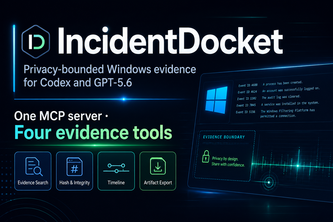
IncidentDocket is a self-reported developer tool for Windows incident investigation that collects only narrowly scoped, privacy-bounded evidence from Windows systems. It runs locally as an MCP server and provides four tools for planning, collecting, inspecting, and exporting support reports without giving AI agents unrestricted access to diagnostic data.
What changed
The project description indicates this was built as a hackathon submission (OpenAI 2026) by a single developer (Ai Zawa). It represents an experiment in using AI-assisted development for building a technical tool with privacy controls, rather than traditional code generation. The author states it was developed through a human-controlled, phase-gated process using Codex and GPT-5.6.
Single most important open question
Is there evidence of real-world usage or adoption beyond the hackathon context? The description makes no claims about customers, revenue, or traction beyond its own self-reporting.
What The Product Actually Is
The description states IncidentDocket is a "privacy-bounded Windows evidence collector for developers and first-line technical support who maintain Windows applications or drivers." It runs locally as a stdio MCP server and exposes four tools:
- plan_collection
- collect_incident_window
- inspect_evidence
- export_support_report
It collects only requested synthetic or Windows evidence, masks sensitive identifiers, assigns stable evidence IDs, and validates cited IDs before exporting reports. The tool does not repair machines, execute recommendations, or autonomously declare root causes.
Positioning & Claim Evolution
The description states the product was built to address a concern about "as agents gain access to operating-system tools and sensitive data, guardrail design becomes as important as model capability." It positions itself as placing "a controlled, inspectable evidence layer between Windows and the reasoning model—one that gives the model enough context to help without treating the whole machine as its context window."
The author frames this as both a technical challenge ("how far could a first-time hackathon participant take a real developer tool") and a product design question ("how far could a first-time hackathon participant take a real developer tool when Codex was used as an implementation and review partner").
Target Customer & ICP
The description states IncidentDocket is for "developers and first-line technical support who maintain Windows applications or drivers." It's specifically designed for Windows incident investigation where the usual next step is to gather more data but broad diagnostic dumps can expose sensitive information.
Business Model & Pricing Evidence
Not evidenced. The description makes no claims about pricing, revenue streams, or business model beyond its own self-reporting.
Technical & Delivery Signals
The tool is described as an ESM TypeScript application with Windows PowerShell 5.1 collectors. It uses the Model Context Protocol SDK and Zod as runtime dependencies. It implements no network client or direct OpenAI API integration. The server runs locally on Windows 11 as current user without automatic elevation.
Traction & Maturity Signals
Not evidenced. The description states this was a hackathon submission by a single developer, with no claims about customers, revenue, or traction beyond its own self-reporting.
Competitive Context
Not evidenced. The description does not mention competitors or competitive positioning beyond its own stated approach to privacy controls in Windows incident investigation.
Open Questions & Risks
- Single-person development team (1 member)
- Self-reported only, no independent verification
- No evidence of customers, revenue, or traction
- Limited to Windows 11 environment
- Hackathon submission context with no indication of post-hackathon development
- Relies heavily on AI-assisted development process rather than traditional product development
Questions the description leaves open
- What is the actual development timeline and whether this was a one-off hackathon effort or ongoing project?
- Has there been any real-world testing beyond the synthetic fixture?
- Are there plans for expansion beyond Windows 11 or additional evidence sources?
- How does the team plan to scale beyond single-person development?
- What is the actual privacy boundary enforcement mechanism and how is it tested?
Overall Assessment
Not evidenced. The description makes no claims about funding, valuation, or investment status beyond its own self-reporting. No evidence of commercial traction or market validation exists in the provided information.
User Stories BotA demo video on every pull request
Get a demo video on every new feature
GitHub App that watches your pull requests and records a narrated, captioned demo.
Save time on demo prep and make informed decisions faster with a video walkthrough of every new feature.
Source
Submitted to the OpenAI 2026 hackathon on Devpost. Project home on Devpost. Back to the full gallery on Devpost.
This competitive analysis was produced by top-founders.com (opens in a new tab)
Generated by a language model from this project's public Devpost page — its tagline, the author's own write-up and any built-with tags listed there — as captured in August 2026. Short quotations are the author's words. It is an opinion on the idea as a business, not on the people behind it, and it reflects the description as published then. If the project has moved on, request a correction below. The analysis is not independent research and contains no verified traction, revenue or customer data.
An independent guide by KFG International LLC — not affiliated with, endorsed by, or connected to Devpost or OpenAI.