

Archive position — measured, not model output
0 likes on Devpost
2,263 of the 7,850 archived projects have more likes, and 5,587 share exactly 0 — so this project's #4,625 place in the like-ranked listing is a tie-break inside that group, not a ranking.
Projects (log scale)
Likes on Devpost. ▲ marks this project's group.
Show the figures
| Likes | Projects | Share of archive |
|---|---|---|
| 0 | 5,587 | 71.2% |
| 1 | 1,758 | 22.4% |
| 2 | 284 | 3.6% |
| 3–4 | 132 | 1.7% |
| 5–9 | 75 | 1.0% |
| 10+ | 14 | 0.2% |
 User Stories BotA demo video on every pull request
Get a demo video on every new feature
GitHub App that watches your pull requests and records a narrated, captioned demo.
Save time on demo prep and make informed decisions faster with a video walkthrough of every new feature.
Executive Summary
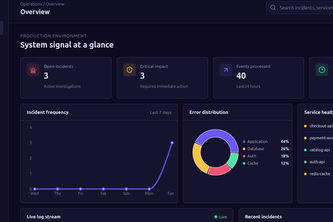
IncidentPilot is an AI-powered incident investigation platform described by its author as a tool to help software engineers, DevOps teams, and SREs diagnose production failures faster. The project was built for the OpenAI 2026 hackathon and includes both a demonstration application and a dashboard. It claims to use deterministic analysis (log parsing, timeline reconstruction) before invoking an AI model, aiming to reduce noise and improve efficiency.
The description states that IncidentPilot is built by one person, Mahad Sultan ch, and uses technologies such as FastAPI, React, OpenAI SDK, and Docker. The author describes the platform as a complete end-to-end system with structured logging, incident detection, AI reasoning, and visualization — but does not provide evidence of revenue, customers, or real-world usage.
Key open question
Is IncidentPilot’s approach to combining deterministic software engineering with AI a viable path for production use, or is it limited to demonstration environments?
What The Product Actually Is
The description states that IncidentPilot is an AI-powered incident investigation platform designed to help engineers diagnose production failures faster. It includes:
- A FastAPI-based e-commerce backend, which acts as a self-contained demonstration environment.
- A React-based dashboard for visualizing incidents and evidence.
- An AI layer using the OpenAI SDK, supporting any OpenAI-compatible provider.
- A pipeline that parses structured logs, reconstructs timelines, extracts stack traces, and correlates request IDs before sending relevant data to an LLM.
The author describes IncidentPilot as a platform that does not simply summarize logs but instead performs deterministic analysis first, then sends only the relevant evidence to an AI model for root-cause analysis, executive summaries, suggested fixes, and postmortems.
Inference: The product is described as a hybrid system combining deterministic software engineering with AI reasoning. It is not a standalone chatbot or log summarizer.
Positioning & Claim Evolution
The description states that IncidentPilot was built to solve the author’s own “late-night on-call headaches” from reading logs, and aims to cut troubleshooting time from hour to second.
It positions itself as an AI-powered incident investigation tool, not a general-purpose logging or observability platform. The author emphasizes:
- That it is built for software engineers, DevOps teams, and SREs.
- That it uses structured logs and deterministic analysis before AI involvement.
- That it supports any OpenAI-compatible provider, suggesting flexibility in model choice.
The claim evolution appears to be from a personal pain point (on-call troubleshooting) to a productized solution for incident response, with an emphasis on efficiency and automation.
Inference: The positioning is focused on speed and precision in incident diagnosis, not broad observability or alerting.
Target Customer & ICP
The description states that IncidentPilot is designed for:
- Software engineers
- DevOps teams
- Site Reliability Engineers (SREs)
These are the target customer personas, and they align with a technical audience focused on production systems, incident response, and system reliability.
There is no evidence of segmentation beyond these roles. No mention of enterprise vs. startup use cases, or specific verticals.
Inference: The ICP appears to be technical practitioners in SRE/DevOps roles, who are likely already using logging or observability tools but want faster root-cause analysis.
Business Model & Pricing Evidence
The description does not state anything about a business model or pricing. It only describes the platform as a self-contained demonstration environment and a hackathon project.
There is no mention of monetization, licensing, subscriptions, or any commercial offering.
Inference: The business model is not evidenced, and it is unclear whether IncidentPilot intends to be a commercial product.
Technical & Delivery Signals
The description provides several technical details:
- Built with FastAPI, React, TypeScript, Vite, Recharts, OpenAI SDK, Docker, GitHub, Codex, GPT-5.6
- Uses structured logging with timestamps, request IDs, correlation IDs, stack traces
- Implements a deterministic pipeline for parsing logs, reconstructing timelines, and correlating evidence
- Supports OpenAI-compatible providers via environment variables
- Includes a demo e-commerce app that generates intentional failures
The author also states that the system was built using Codex and GPT-5.6, which helped with architecture, implementation, and refactoring.
Inference: The technical stack is modern and aligned with SRE/DevOps tooling. The use of structured logs and deterministic analysis suggests a focus on reliability and explainability.
Traction & Maturity Signals
The description states that IncidentPilot was built for the OpenAI 2026 hackathon, and is described as a demo environment with:
- A deliberately faulty e-commerce application
- A dashboard for visualizing incidents
- A complete pipeline from log parsing to AI reasoning
There is no evidence of real-world usage, customers, revenue, or adoption.
The author states that the next step is to evolve beyond the demo into a platform capable of analyzing real-world production systems, but this is not yet implemented.
Inference: The project is in a demo or prototype phase, with no traction or commercial maturity evidenced.
Competitive Context
The description does not mention any competitors. It focuses on IncidentPilot’s own approach, which involves:
- Deterministic analysis before AI
- Structured logging and timeline reconstruction
- Integration with observability tools (mentioned as future plans)
No direct comparison to existing platforms like Splunk, Datadog, New Relic, or PagerDuty is made.
Inference: The competitive context is not evidenced. It is unclear whether IncidentPilot is positioned to compete with, complement, or replace existing observability tools.
Open Questions & Risks
- No commercial traction or revenue evidence: The project is described as a hackathon submission and demo.
- Single-person team: The author states that the team size is 1, which may limit scalability or product development speed.
- Unproven production readiness: The platform is described as being in a demo phase, with plans to evolve into real-world use — but no evidence of that transition yet.
- Dependency on AI providers: The system relies on OpenAI-compatible models, which could be a risk if those services change or become unavailable.
- Lack of customer feedback or real-world testing: No mention of user testing or feedback loops.
Inference: The biggest risk is that IncidentPilot remains a demo-level prototype, with no clear path to commercial viability or adoption.
Questions the description leaves open
- What are the specific use cases where IncidentPilot has been tested in real-world environments?
- How does IncidentPilot handle log formats from different systems (e.g., Kubernetes, CloudWatch, Datadog)?
- Is there a plan to support real-time alerting and integration with existing observability platforms?
- What is the expected performance of the deterministic pipeline at scale?
- How does the AI layer handle edge cases or ambiguous data that doesn’t fit the structured log format?
- Are there any plans for monetization or commercial partnerships?
Overall Assessment
The description states that IncidentPilot was built as a hackathon project and is currently in a demo phase, with no evidence of traction, revenue, or real-world adoption.
It is described as a technical prototype with a clear architecture and use case, but it has not yet been proven in production environments.
Inference: The project is not ready for investment or partnership at this stage. It shows promise in concept and execution, but lacks commercial maturity, traction, or scalability evidence.
The author’s claim that IncidentPilot solves a real-world problem (fast incident response) is supported by the architecture described, but there is no evidence of adoption or impact yet.
User Stories BotA demo video on every pull request
Get a demo video on every new feature
GitHub App that watches your pull requests and records a narrated, captioned demo.
Save time on demo prep and make informed decisions faster with a video walkthrough of every new feature.
Source
Submitted to the OpenAI 2026 hackathon on Devpost. Project home on Devpost. Back to the full gallery on Devpost.
This competitive analysis was produced by top-founders.com (opens in a new tab)
Generated by a language model from this project's public Devpost page — its tagline, the author's own write-up and any built-with tags listed there — as captured in August 2026. Short quotations are the author's words. It is an opinion on the idea as a business, not on the people behind it, and it reflects the description as published then. If the project has moved on, request a correction below. The analysis is not independent research and contains no verified traction, revenue or customer data.
An independent guide by KFG International LLC — not affiliated with, endorsed by, or connected to Devpost or OpenAI.