

Archive position — measured, not model output
1 like on Devpost
505 of the 7,850 archived projects have more likes, and 1,758 share exactly 1 — so this project's #701 place in the like-ranked listing is a tie-break inside that group, not a ranking.
Projects (log scale)
Likes on Devpost. ▲ marks this project's group.
Show the figures
| Likes | Projects | Share of archive |
|---|---|---|
| 0 | 5,587 | 71.2% |
| 1 | 1,758 | 22.4% |
| 2 | 284 | 3.6% |
| 3–4 | 132 | 1.7% |
| 5–9 | 75 | 1.0% |
| 10+ | 14 | 0.2% |
 User Stories BotA demo video on every pull request
Get a demo video on every new feature
GitHub App that watches your pull requests and records a narrated, captioned demo.
Save time on demo prep and make informed decisions faster with a video walkthrough of every new feature.
Executive Summary
What the company appears to be
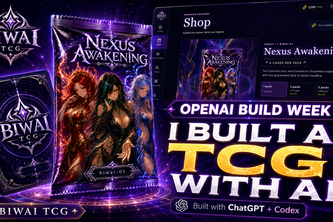
BIWAI TCG is a single-player, anime-inspired trading card game built as a browser-based experience. The author states it includes animated pack opening, collection building, team formation, and battle mechanics. It was developed by one person over roughly three days using AI tools like GPT-5.6 Sol and Codex.
What changed
The project is presented as a completed prototype or early release, submitted to the OpenAI 2026 hackathon. No further development or commercial activity beyond this submission is evidenced.
Single most important open question
Is there any evidence of user engagement, monetization, or traction beyond the author’s own account?
What The Product Actually Is
The description states that BIWAI TCG is a single-player, anime-inspired trading card game. It includes:
- Animated four-card pack opening with staged reveal
- 48 collectible characters across 132 printings
- Battle system with elements, resonance bonuses, status effects, and auto-battle
- Campaign with three chapters and 60 encounters
- Local browser-based gameplay with no backend or account requirements
- Team builder with drag-and-drop interface
- Support for mouse and touch interactions
The author claims the game was built using React 19, TypeScript 6, Vite 8, Zustand, Zod, Playwright, and Web Audio API. It uses seeded randomness for pack opening and battle resolution.
Inference The product is a browser-based prototype, not a commercial offering with users or monetization.
Positioning & Claim Evolution
The author states that BIWAI TCG was inspired by physical trading card games and YouTube pack openings, aiming to recreate the emotional anticipation of pack opening without real-money elements. It positions itself as a browser-based game where every card has equal combat power but different visual treatments.
It also emphasizes:
- No account or backend required
- Fully local gameplay
- Emphasis on the pack-opening experience
- Tactical depth in team building and battle
The author claims to have built it in three days using AI tools, suggesting a rapid prototyping approach rather than a long-term product development strategy.
Inference The positioning is centered on nostalgia, accessibility, and AI-assisted creation, not on scalability or monetization.
Target Customer & ICP
The description states that BIWAI TCG is a single-player game, with no evidence of targeting multiple user types or segments. It appears to be aimed at:
- Fans of anime-inspired trading card games
- Players who enjoy collecting and building teams
- Individuals interested in browser-based, local gameplay experiences
There is no mention of demographics, user personas, or specific customer segments.
Inference The target customer is likely a niche audience of anime and TCG enthusiasts, but the lack of data means this is unproven.
Business Model & Pricing Evidence
The description states that BIWAI TCG runs locally in the browser with no account, backend, purchases, or analytics. There is no mention of:
- Monetization strategy
- In-game purchases
- Subscription model
- Freemium structure
It also says the game was built without real-money packs or locked content.
Inference No business model or pricing evidence is provided. The project appears to be a non-commercial prototype.
Technical & Delivery Signals
The author states that BIWAI TCG was built using:
- AI tools: GPT-5.6 Sol, OpenAI Codex
- Frameworks: React 19, TypeScript 6, Vite 8, React Router, Zustand, Zod
- Libraries: Playwright, Web Audio API
- Testing: 124 unit and integration tests, desktop/mobile browser coverage
The game features:
- Staged pack opening with visual effects
- Responsive card layouts
- Battle system with animations and UI synchronization
- Drag-and-drop interface for team building
- Seeded randomness for gameplay consistency
Inference The technical stack is modern and well-structured. AI tools were used extensively, suggesting a highly automated development process.
Traction & Maturity Signals
The description states that the author built BIWAI TCG in roughly three days. It includes:
- 48 collectible characters
- 132 printings
- 60 campaign encounters
- 124 unit and integration tests
- Playable loop with collection, battle, and rewards
However, there is no evidence of:
- User engagement or retention
- Customer acquisition or marketing
- Revenue or monetization
- Public playtesting or feedback
- Post-submission development or updates
Inference The project is a prototype, not a mature product. No traction data is provided.
Competitive Context
The author does not mention any direct competitors or market positioning in relation to existing TCGs or browser-based games. The description implies that BIWAI TCG is unique in its approach to:
- Pack opening
- Local gameplay
- Equal combat power across card versions
- Anime-inspired visuals
There is no evidence of market analysis, competitive differentiation, or comparison to other products.
Inference No competitive context is provided. The product appears to be independent of known TCG ecosystems.
Open Questions & Risks
- No monetization strategy: The game runs locally with no purchases or backend — raises questions about long-term viability.
- Single-person development: The entire project was built by one person, which may limit scalability or future development.
- Prototype nature: No evidence of user testing, feedback loops, or product-market fit beyond the author’s own account.
- AI dependency: Heavy reliance on AI tools raises questions about sustainability and control over product evolution.
- No traction data: No evidence of users, engagement, or adoption.
Inference The project is a high-risk, low-traction prototype, not a commercial venture.
Questions the description leaves open
- What is the long-term vision for BIWAI TCG beyond this hackathon submission?
- Are there any plans to monetize or scale the product?
- How was user feedback gathered during development, if at all?
- What are the technical limitations of running entirely in the browser?
- Has the author considered how to handle content updates or expansions?
- Is there a plan for community engagement or player retention?
Overall Assessment
Not evidenced.
The description provides no evidence of:
- Revenue
- Customers
- Traction
- Market demand
- Commercial viability
It is a self-reported, unverified prototype, built by one person in three days using AI tools. It lacks any commercial or user engagement signals.
Inference There is no basis for investment or partnership consideration at this stage. The project is a conceptual or experimental prototype, not a product with demonstrated market potential or business traction.
User Stories BotA demo video on every pull request
Get a demo video on every new feature
GitHub App that watches your pull requests and records a narrated, captioned demo.
Save time on demo prep and make informed decisions faster with a video walkthrough of every new feature.
Source
Submitted to the OpenAI 2026 hackathon on Devpost. Project home on Devpost. Back to the full gallery on Devpost.
This competitive analysis was produced by top-founders.com (opens in a new tab)
Generated by a language model from this project's public Devpost page — its tagline, the author's own write-up and any built-with tags listed there — as captured in August 2026. Short quotations are the author's words. It is an opinion on the idea as a business, not on the people behind it, and it reflects the description as published then. If the project has moved on, request a correction below. The analysis is not independent research and contains no verified traction, revenue or customer data.
An independent guide by KFG International LLC — not affiliated with, endorsed by, or connected to Devpost or OpenAI.