

Archive position — measured, not model output
1 like on Devpost
505 of the 7,850 archived projects have more likes, and 1,758 share exactly 1 — so this project's #702 place in the like-ranked listing is a tie-break inside that group, not a ranking.
Projects (log scale)
Likes on Devpost. ▲ marks this project's group.
Show the figures
| Likes | Projects | Share of archive |
|---|---|---|
| 0 | 5,587 | 71.2% |
| 1 | 1,758 | 22.4% |
| 2 | 284 | 3.6% |
| 3–4 | 132 | 1.7% |
| 5–9 | 75 | 1.0% |
| 10+ | 14 | 0.2% |
 User Stories BotA demo video on every pull request
Get a demo video on every new feature
GitHub App that watches your pull requests and records a narrated, captioned demo.
Save time on demo prep and make informed decisions faster with a video walkthrough of every new feature.
Executive Summary
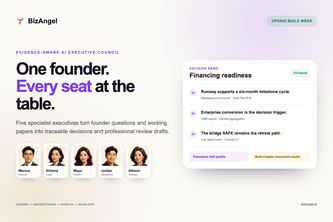
BizAngel is described as an AI-powered workspace that serves two primary user groups: solo founders and professional teams (lawyers, bankers, consultants, finance teams, investors). The product presents itself as an "evidence-aware AI cofounder team" for founders and a "research-and-documents desk" for professionals. It includes five specialist AI roles — Athena (Strategy), Marcus (CFO), Victoria (CLO), Jordan (COO), and Maya (CMO) — that are intended to collaborate on decision-making, with outputs structured around evidence, risks, next actions, and kill criteria.
The system is built using a multi-model AI architecture, separating generation from review layers to avoid model bias. It supports long-form document workflows, integrates private Skill profiles derived from ZIP archives, and maintains sentence-level evidence tracking. The product is presented as not replacing human judgment but enhancing it through structured output and traceability.
Key commercial due-diligence question: Is there any evidence of traction, revenue or customer adoption beyond the self-reported project description?
What The Product Actually Is
The description states that BizAngel is an AI-powered workspace with two core functions:
- For solo founders, it acts as an "AI cofounder team" composed of five specialist agents:
- Athena (Strategy Counsel)
- Marcus (CFO)
- Victoria (CLO)
- Jordan (COO)
- Maya (CMO)
- For professionals and investment teams, it functions as a "research-and-documents desk" designed for reviewable work, supporting workflows in legal, finance, banking, strategy consulting, and investment analysis.
The system is described as having:
- A multi-model AI architecture.
- Sentence-level evidence tracking.
- Private Skill profiles built from uploaded ZIP archives.
- Long-form document workflows with integrated review gates.
- Evidence ledger and managed release states.
Inference: The product appears to be a hybrid of AI assistant, document automation tool, and collaborative workspace. It is not a general-purpose AI platform but rather a domain-specific solution for strategic decision-making and high-stakes drafting.
Positioning & Claim Evolution
The author positions BizAngel as an evidence-aware intelligence core that bridges the gap between solo founders and professional support teams.
It claims to:
- Serve as an "on-demand AI cofounder team" for founders.
- Provide a "research-and-documents desk" for professionals.
- Support both strategic decision-making and document drafting.
- Offer structured outputs with evidence, risks, and next steps.
- Avoid replacing human judgment by making uncertainty visible.
The positioning evolves from:
- A tool to help solo founders build products faster.
- To one that also supports professional teams in high-stakes work.
- To a system that emphasizes reviewability, evidence, and traceability over automation or autonomy.
Inference: The positioning is evolving toward a niche market of decision support and reviewable drafting, not general-purpose AI tools.
Target Customer & ICP
The description identifies two main user groups:
- Solo founders:
- Need support with strategy, finance, contracts, operations, growth, and fundraising.
- Are described as lacking access to full leadership teams early in their journey.
- Professional teams:
- Include lawyers, bankers, consultants, finance teams, and investors.
- Work on high-stakes documents such as legal opinions, diligence reports, investment memoranda, and prospectus drafts.
The product is said to support workflows across:
- Legal
- Finance
- Banking
- Strategy consulting
- Investment analysis
Inference: The ICP appears to be early-stage solo founders and professional teams in capital-intensive or regulated industries, with a focus on reviewable outputs rather than broad AI adoption.
Business Model & Pricing Evidence
Not evidenced.
The description does not state:
- Whether BizAngel has a pricing model.
- If it is subscription-based, usage-based, or freemium.
- What the monetization strategy might be.
- Whether there are paid tiers or enterprise features.
Inference: No evidence of business model or pricing structure is provided. The product is described as a hackathon submission with no commercial deployment details.
Technical & Delivery Signals
The system is built using:
- Frontend: Next.js, React, TypeScript, Tailwind CSS
- Backend: Supabase (PostgreSQL, authentication), Inngest (multi-step jobs)
- AI Layer: GPT-5.6 (with model separation for review and creation)
- Other Tools: Playwright, Vitest, Remotion, Vercel, OpenRouter, Paddle, Redis, Zustand
Key technical features include:
- Multi-model architecture with cross-model adversarial review.
- Sentence-level evidence audit using three independently requested models.
- Private Skill profiles from ZIP uploads.
- Long-form workflows with durable job management.
- Evidence ledger and release-ready states.
Inference: The product shows strong engineering maturity, especially in handling long-form documents, model separation, and traceability. It is not a simple chatbot but a structured system for professional-grade drafting.
Traction & Maturity Signals
Not evidenced.
The description does not include:
- Any revenue data.
- Customer or user numbers.
- Product adoption metrics.
- Market traction or usage history.
- Any evidence of real-world deployment beyond the hackathon.
Inference: There is no evidence of product traction, customer base, or commercial viability. The project is presented as a prototype or proof-of-concept.
Competitive Context
Not evidenced.
The description does not:
- Name competitors.
- Describe market size or competitive positioning.
- Compare BizAngel to existing tools in the AI assistant, document automation, or professional drafting space.
Inference: No competitive context is provided. The product appears to be positioned in a niche that may overlap with tools like Notion AI, Jasper, or legal drafting platforms, but no such comparison is made.
Open Questions & Risks
- No commercial traction or revenue evidence — the project is described as a hackathon submission.
- Unverified claims about AI behavior — the system’s model separation and adversarial review are described but not independently verified.
- Highly specialized use case — may limit scalability or market appeal.
- No pricing or monetization strategy — unclear how it would generate revenue.
- Self-reported technical architecture — no independent validation of claims about AI safety, model separation, or evidence tracking.
Inference: The product is in a very early stage and lacks commercial proof-of-concept or market validation.
Questions the description leaves open
- What is the actual business model? Is there a monetization strategy?
- How does the multi-model architecture prevent correlated blind spots in practice?
- Are there any real-world use cases or early adopters beyond the hackathon?
- How is the private Skill profile data handled to ensure no leakage of proprietary content?
- What are the technical and legal risks of using AI for high-stakes professional work like legal opinions or investment memoranda?
- Has the team considered how to scale this system beyond a single developer?
- What are the plans for integrating verified data sources (e.g., SEC filings, legal databases)?
- How does the product handle jurisdiction-specific compliance in cross-border workflows?
Overall Assessment
Not evidenced.
The description provides no information on:
- Valuation or funding history.
- Investor interest or partnership opportunities.
- Commercial readiness or go-to-market strategy.
Inference: This is a pre-product, pre-revenue, pre-traction project. It is not ready for investment or partnership consideration based on the evidence provided. The product shows strong engineering and conceptual maturity but lacks any commercial signal.
User Stories BotA demo video on every pull request
Get a demo video on every new feature
GitHub App that watches your pull requests and records a narrated, captioned demo.
Save time on demo prep and make informed decisions faster with a video walkthrough of every new feature.
Source
Submitted to the OpenAI 2026 hackathon on Devpost. Project home on Devpost. Back to the full gallery on Devpost.
This competitive analysis was produced by top-founders.com (opens in a new tab)
Generated by a language model from this project's public Devpost page — its tagline, the author's own write-up and any built-with tags listed there — as captured in August 2026. Short quotations are the author's words. It is an opinion on the idea as a business, not on the people behind it, and it reflects the description as published then. If the project has moved on, request a correction below. The analysis is not independent research and contains no verified traction, revenue or customer data.
An independent guide by KFG International LLC — not affiliated with, endorsed by, or connected to Devpost or OpenAI.