

Archive position — measured, not model output
1 like on Devpost
505 of the 7,850 archived projects have more likes, and 1,758 share exactly 1 — so this project's #704 place in the like-ranked listing is a tie-break inside that group, not a ranking.
Projects (log scale)
Likes on Devpost. ▲ marks this project's group.
Show the figures
| Likes | Projects | Share of archive |
|---|---|---|
| 0 | 5,587 | 71.2% |
| 1 | 1,758 | 22.4% |
| 2 | 284 | 3.6% |
| 3–4 | 132 | 1.7% |
| 5–9 | 75 | 1.0% |
| 10+ | 14 | 0.2% |
 User Stories BotA demo video on every pull request
Get a demo video on every new feature
GitHub App that watches your pull requests and records a narrated, captioned demo.
Save time on demo prep and make informed decisions faster with a video walkthrough of every new feature.
Executive Summary
What the company appears to be
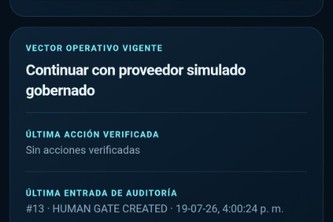
BLUE LITE is a self-reported prototype for an executive governance layer for artificial intelligence, designed to give non-technical users control over AI usage in small businesses. It is described as not being a chatbot or generic model router but rather a system that defines and locks human purpose, bounds AI authority, validates memory, records decisions, and exposes a "Human Gate" to stop AI when needed.
What changed
The author states that BLUE LITE began from a practical question: whether advanced AI can be governable by ordinary people and small businesses without requiring them to become programmers. It is presented as an evolution of thinking beyond task automation toward authority control.
The single most important open question
Is there evidence that the described governance model has any real-world traction, adoption or commercial viability beyond a single-person prototype?
Note: This analysis is based entirely on the self-reported description provided by the author. No external verification, revenue data, customer base, or independent sources are available.
What The Product Actually Is
The description states that BLUE LITE is an “executive management layer for artificial intelligence.” It is described as:
- Not a chatbot
- Not a generic model router
- Not a multi-agent wrapper
Its core responsibility is executive control, including:
- Preserving human purpose
- Bounding model and tool authority
- Validating memory before reuse
- Recording calls, tokens, cost, evidence, and decisions
- Exposing a Human Gate
- Stopping when the evidence or authority is insufficient
The system includes components such as:
- Purpose Lock
- Human Gate
- Verified-memory gate
- Stale-state detection
- Mission Ledger
- API cost accounting
- Evidence packages
- Interfaces
- Regression protections
It uses Codex as an engineering executor, GPT-5.6 Sol for strategic reasoning during Mission A, and ChatGPT Work for operational production under draft-only authority.
Claim: The system is described as a bounded prototype, not a production deployment.
Evidence: “BLUE LITE is currently a bounded prototype, not a production deployment.”
Positioning & Claim Evolution
The author positions BLUE LITE as addressing a gap in current AI tools — the layer above task automation where decisions about authority, memory, cost, and stopping are made.
Key claims:
- AI systems are becoming more capable but capability is not the same as authority.
- Most tools focus on generating answers or automating tasks.
- BLUE LITE addresses who decides when intelligence should be activated, what authority it receives, which memory can be trusted, what it costs, and when the system must stop.
The tagline states:
“AI already has power. BLUE LITE governs where it flows—locking human purpose, validating memory, bounding authority, exposing cost, and stopping when needed.”
This suggests a shift from AI-as-tool to AI-as-controlled-system.
Claim: The positioning is that of an executive governance layer for AI.
Evidence: “BLUE LITE is an executive management layer for artificial intelligence.” and the tagline.
Target Customer & ICP
The author identifies the target as:
- Ordinary people
- Small businesses
- Founders
- Small teams
- SMEs (small and medium enterprises)
They state:
“I am a Chilean small-business owner, not a software engineer. BLUE LITE began from a practical question: can advanced AI become governable by ordinary people and small businesses without requiring them to become programmers?”
The system is described as intended for non-technical users who want control over AI usage.
Claim: The ICP includes non-technical users in small businesses or teams.
Evidence: “I am a Chilean small-business owner, not a software engineer.” and “The next steps are external integrations, stronger security and reliability testing, broader provider support, user validation, and real operational deployments for founders, small teams, and SMEs.”
Business Model & Pricing Evidence
No pricing, revenue model, or monetization strategy is described.
Claim: No evidence of business model or pricing.
Evidence: Not evidenced.
Technical & Delivery Signals
The system is built with:
- Codex
- GPT-5.6 Sol
- ChatGPT Work
- FastAPI
- Python
- GitHub
It includes:
- A clean submission repository (no credentials, personal paths, or private research)
- Test suite: 134 tests, 132 passed, 2 skipped
- Remote telemetry demonstration from smartphone while working in different locations
Claim: The system is built with modern AI tools and has a testable prototype.
Evidence: “Codex served as the engineering executor...” and “The clean submission repository contains no credentials...”
Traction & Maturity Signals
The project is described as:
- A bounded prototype
- Not a production deployment
- Tested in field for less than one day
- No external integrations or user validation mentioned
- No evidence of revenue, customers, or adoption
Claim: The system has not reached production or real-world traction.
Evidence: “BLUE LITE is currently a bounded prototype, not a production deployment.” and “The field test did not involve GPS, autonomous physical operations, vending-machine management, or direct machine telemetry.”
Competitive Context
No mention of competitors or market context.
Claim: No evidence of competitive landscape.
Evidence: Not evidenced.
Open Questions & Risks
- The system is a prototype, not production-ready
- No evidence of real-world usage or adoption
- No pricing, monetization, or revenue model described
- No indication of scalability or integration beyond the author’s own use case
- The author is a single individual (1-person team)
- The system relies on specific AI models (GPT-5.6 Sol, ChatGPT Work) that may not be available to others
Inference: The lack of commercial traction and external validation raises questions about viability.
Evidence: “BLUE LITE is currently a bounded prototype, not a production deployment.” and “The field test did not involve GPS, autonomous physical operations, vending-machine management, or direct machine telemetry.”
Questions the description leaves open
- What are the specific use cases you’ve identified for BLUE LITE in small businesses?
- How do you plan to scale beyond a single-person prototype?
- Have you validated the need for this governance layer with actual users or customers?
- What is your roadmap for external integrations and broader provider support?
- How do you intend to monetize this system, if at all?
- What are the technical limitations of relying on specific AI models like GPT-5.6 Sol?
- Are there any legal or compliance considerations around AI governance that you’ve addressed?
Overall Assessment
The description presents BLUE LITE as a conceptual prototype addressing an important but unvalidated market need — executive control over AI usage for non-technical users.
There is no evidence of:
- Revenue
- Customers
- Product-market fit
- Commercial traction
- Scalability or integration beyond the author’s own environment
Inference: The project shows potential in concept but lacks evidence of viability or commercial readiness.
Evidence: “BLUE LITE is currently a bounded prototype, not a production deployment.” and “The next steps are external integrations, stronger security and reliability testing, broader provider support, user validation, and real operational deployments for founders, small teams, and SMEs.”
Assessment: Not ready for investment or partnership. The project requires significant development, validation, and traction before it can be considered a viable commercial proposition.
User Stories BotA demo video on every pull request
Get a demo video on every new feature
GitHub App that watches your pull requests and records a narrated, captioned demo.
Save time on demo prep and make informed decisions faster with a video walkthrough of every new feature.
Source
Submitted to the OpenAI 2026 hackathon on Devpost. Project home on Devpost. Back to the full gallery on Devpost.
This competitive analysis was produced by top-founders.com (opens in a new tab)
Generated by a language model from this project's public Devpost page — its tagline, the author's own write-up and any built-with tags listed there — as captured in August 2026. Short quotations are the author's words. It is an opinion on the idea as a business, not on the people behind it, and it reflects the description as published then. If the project has moved on, request a correction below. The analysis is not independent research and contains no verified traction, revenue or customer data.
An independent guide by KFG International LLC — not affiliated with, endorsed by, or connected to Devpost or OpenAI.