

Archive position — measured, not model output
1 like on Devpost
505 of the 7,850 archived projects have more likes, and 1,758 share exactly 1 — so this project's #705 place in the like-ranked listing is a tie-break inside that group, not a ranking.
Projects (log scale)
Likes on Devpost. ▲ marks this project's group.
Show the figures
| Likes | Projects | Share of archive |
|---|---|---|
| 0 | 5,587 | 71.2% |
| 1 | 1,758 | 22.4% |
| 2 | 284 | 3.6% |
| 3–4 | 132 | 1.7% |
| 5–9 | 75 | 1.0% |
| 10+ | 14 | 0.2% |
 User Stories BotA demo video on every pull request
Get a demo video on every new feature
GitHub App that watches your pull requests and records a narrated, captioned demo.
Save time on demo prep and make informed decisions faster with a video walkthrough of every new feature.
Executive Summary
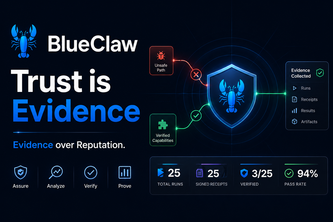
BlueClaw is a self-reported governance and assurance layer for AI agent capabilities, skills, and composed capability packs. The project claims to turn trust in AI skills into reproducible evidence using GPT-5.6 for hypothesis generation, controlled behavioral probes, and deterministic policy decisions (PASS/REVIEW/BLOCK). It operates as an evidence-gathering system that evaluates artifact versions or pack compositions under defined environments and policies.
The author states this is a complete lifecycle implementation built during OpenAI Build Week, including capability analysis, probe execution, evidence recording, and deterministic decision-making. The system integrates with existing BlueClaw components like receipts, locks, install guards, and Action Passport approvals.
Key commercial due-diligence questions:
- Is there any actual customer traction or usage beyond the demo?
- What is the actual business model or monetization strategy?
- How does this differ from other governance tools in the market?
The single most important open question: What evidence exists that this system has been used outside of a demonstration context, and whether it has achieved any commercial adoption or revenue?
What The Product Actually Is
The description states BlueClaw is:
- An "evidence and governance layer for agent capabilities, skills, MCP servers, and composed capability packs"
- A system that evaluates one exact artifact version or pack composition
- Capable of extracting and binding declared capabilities to exact versions
- Able to compare versions for meaningful permission changes
- Analyzing pack graphs for sensitive-source-to-external-sink paths
- Using GPT-5.6 to propose targeted, schema-validated test hypotheses
- Executing only supported probes in a controlled, instrumented environment
- Recording capability deltas, graph paths, traces, canary access, intercepted egress, findings, and evidence hashes
- Applying deterministic policy outside the model to return PASS, REVIEW, or BLOCK decisions
The system is described as having a complete Assurance lifecycle including:
- Shared assurance contracts and lifecycle states
- Capability, version-delta, and composition analysis
- A GPT-5.6 structured planning boundary
- Secret-redacted canonical model context
- A controlled behavioral probe runner
- Synthetic canary and intercepted-egress evidence
- Deterministic PASS/REVIEW/BLOCK policy
- Integration with receipts, pack locks, install guards, and Action Passport approvals
Evidence: This is a self-reported technical architecture. The author claims to have built it during OpenAI Build Week using Codex with GPT-5.6 Sol.
Positioning & Claim Evolution
The description states:
- Agent ecosystems are becoming skill ecosystems
- Adoption follows popularity, official status, and download counts due to difficulty inspecting unfamiliar capabilities
- This creates two problems: promising community-built skills remain unused; evaluating capabilities individually is insufficient for composed systems
- BlueClaw turns that trust problem into reproducible evidence
The author positions BlueClaw as:
- A governance and assurance system for agent capabilities
- A way to make trust based on inspectable evidence rather than reputation alone
- An evidence-gathering layer that evaluates artifact versions or pack compositions under defined policies
The claim evolution shows a progression from identifying a problem (trust in AI skills) to proposing a solution (reproducible evidence through controlled testing and deterministic policy).
Evidence: This is the author's own self-description of positioning and claims.
Target Customer & ICP
Not evidenced. The description does not state who the target customers are, what their needs are, or how they would use BlueClaw beyond the demonstration context.
Business Model & Pricing Evidence
Not evidenced. The description does not contain any information about pricing models, revenue streams, monetization strategies, or business model assumptions.
Technical & Delivery Signals
The author states:
- Built with: api, bullmq, codex, compose, docker, drizzle, fastify, gpt-5.6, mcp, next.js, node.js, openai, orm, pnpm, postgresql, react, redis, responses, turborepo, typescript, vitest, zod
- Used Codex with GPT-5.6 Sol as an implementation and coordination environment
- A primary integration thread established contracts and owned the final architecture
- Analyzer, runner, and interface work proceeded in isolated Git worktrees
- Dedicated QA/red-team and submission workstreams
- GPT-5.6 proposes targeted hypotheses from canonical, secret-redacted context
- Its output is schema-validated, unsupported probes cannot execute, and provider failures fail closed
- Deterministic evidence and policy...not model opinion, make the final decision
The system includes:
- A complete API-backed Assurance interface
- Five deterministic end-to-end cases
- Judge setup, testing, screenshots, and documentation
- Shared assurance contracts and lifecycle states
- Capability, version-delta, and composition analysis
- GPT-5.6 structured planning boundary
- Secret-redacted canonical model context
- Controlled behavioral probe runner
- Synthetic canary and intercepted-egress evidence
- Deterministic PASS/REVIEW/BLOCK policy
Evidence: This is the author's own technical description of implementation and architecture.
Traction & Maturity Signals
Not evidenced. The description does not contain any information about actual customers, usage metrics, revenue, or adoption beyond the demonstration context.
Competitive Context
Not evidenced. The description does not mention any competitors or competitive landscape.
Open Questions & Risks
Inferences:
- Unproven commercial viability: The system is described as built during a hackathon with no evidence of real-world usage or revenue
- Limited scope in demonstration: The author explicitly states the runner executes controlled, instrumented in-process fixtures and records "isolated: false", indicating it's not a true sandbox
- Dependency on GPT-5.6 for planning but not decision-making: This suggests potential inconsistency between planning and execution layers
- No evidence of production deployment or scaling: The system appears to be a demonstration-only implementation
Open questions:
- The author states "The submitted behavioral runner executes controlled, instrumented in-process fixtures and records isolated: false" - this is a significant limitation for safety-critical applications
- "Live GPT-5.6 planning is opt-in and requires separately supplied credentials" - indicates the core AI component is not fully integrated or accessible in the demo
- "Local receipts remain visibly unsigned development receipts unless signing keys are configured" - suggests incomplete production readiness
Evidence: These are based on the author's own statements about limitations and scope.
Questions the description leaves open
- What evidence exists that this system has been used outside of a demonstration context?
- How does BlueClaw differentiate from existing governance tools in the market?
- What is the actual business model or monetization strategy?
- How do you plan to scale beyond the current demonstration scope?
- What are the specific use cases where customers would pay for this service?
- How do you ensure that the deterministic policy decisions are robust and not easily circumvented?
- What are the technical limitations of the current implementation that prevent production deployment?
- How does BlueClaw handle edge cases or unexpected behaviors in composed capability packs?
Overall Assessment
Not evidenced. The description contains no information about funding rounds, valuations, partnerships, or investment status.
The author states this is a complete lifecycle implementation built during OpenAI Build Week, but there is no evidence of any commercial traction, revenue, or customer adoption beyond the demonstration context. The system appears to be a proof-of-concept with significant limitations noted by the author himself, particularly around sandboxing and production readiness.
The project shows technical capability in building an assurance system for AI agent capabilities, but lacks evidence of market demand, commercial viability, or any real-world application beyond the hackathon demonstration.
The author's own statements about "isolated: false", "development receipts", and "opt-in" GPT-5.6 planning indicate significant gaps between this demonstration and a production-ready system that would be attractive to investors or partners.
User Stories BotA demo video on every pull request
Get a demo video on every new feature
GitHub App that watches your pull requests and records a narrated, captioned demo.
Save time on demo prep and make informed decisions faster with a video walkthrough of every new feature.
Source
Submitted to the OpenAI 2026 hackathon on Devpost. Project home on Devpost. Back to the full gallery on Devpost.
This competitive analysis was produced by top-founders.com (opens in a new tab)
Generated by a language model from this project's public Devpost page — its tagline, the author's own write-up and any built-with tags listed there — as captured in August 2026. Short quotations are the author's words. It is an opinion on the idea as a business, not on the people behind it, and it reflects the description as published then. If the project has moved on, request a correction below. The analysis is not independent research and contains no verified traction, revenue or customer data.
An independent guide by KFG International LLC — not affiliated with, endorsed by, or connected to Devpost or OpenAI.