

Archive position — measured, not model output
0 likes on Devpost
2,263 of the 7,850 archived projects have more likes, and 5,587 share exactly 0 — so this project's #2,668 place in the like-ranked listing is a tie-break inside that group, not a ranking.
Projects (log scale)
Likes on Devpost. ▲ marks this project's group.
Show the figures
| Likes | Projects | Share of archive |
|---|---|---|
| 0 | 5,587 | 71.2% |
| 1 | 1,758 | 22.4% |
| 2 | 284 | 3.6% |
| 3–4 | 132 | 1.7% |
| 5–9 | 75 | 1.0% |
| 10+ | 14 | 0.2% |
 User Stories BotA demo video on every pull request
Get a demo video on every new feature
GitHub App that watches your pull requests and records a narrated, captioned demo.
Save time on demo prep and make informed decisions faster with a video walkthrough of every new feature.
Executive Summary
What the company appears to be
APEX is a self-reported private daily operating system for body, mind, and work — nutrition, training, breathwork, and reflection in one connected record. The author states it is a mobile-first Progressive Web App built with React, TypeScript, Vite, Tailwind CSS, OpenAI APIs, and browser-native features like audio, speech, vibration, and wake-lock.
What changed
The project evolved from separate tools the founder built for personal use into an integrated system that reads and writes to one shared daily data record across health, fitness, and productivity domains. It was submitted as a hackathon entry for the OpenAI 2026 competition.
Single most important open question
Is there any evidence of user adoption or product-market fit beyond the founder’s personal use? The description states no revenue, customers, or traction data exist — only self-reported features and functionality.
What The Product Actually Is
The description states that APEX is a mobile-first Progressive Web App (PWA) built with:
- React + TypeScript + Vite
- Tailwind CSS
- OpenAI vision, structured outputs, and language models
- Browser APIs: audio, speech, vibration, wake-lock
- Service-worker caching for offline use
It functions as a unified daily data model, where all inputs (nutrition, hydration, fasting, cardio, breathwork, meditation, strength training, reflection) are stored in one date-based record (DayRecord) and read/written by other components.
The app includes:
- A “Today” screen showing real-time status across multiple domains
- AI-powered meal analysis from photos with manual override capability
- Guided cardio protocols with timers and visual transitions
- Breathing and meditation practices with synchronized guides
- Strength training program builder with exercise tracking and progress charts
- Evening debriefing with reflection prompts and AI-generated weekly briefs
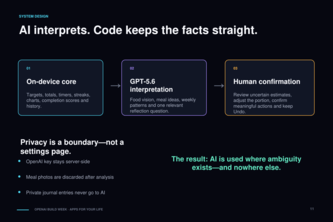
The system is designed to be installable, work offline, and keep all data private on the device. No AI-generated health record gets saved without user confirmation.
Positioning & Claim Evolution
The author claims APEX is a private daily operating system for body, mind, and work — combining nutrition, training, breathwork, and reflection into one connected record.
It positions itself as:
- Not another app that collects numbers
- But something that helps users understand their day, pick the next right action, and slowly build a better life
The evolution of this positioning appears to be from personal experimentation tools (separate apps for food logging, workouts, etc.) into an integrated system that connects these domains through a shared data model.
This claim is self-reported and not independently verified. The author emphasizes the importance of connections between inputs, rather than isolated tracking.
Target Customer & ICP
The description states that APEX was built by someone who personally struggled with:
- Anxiety
- Distraction
- Weight gain
- Forgetting to drink water
- Workout streaks that start strong and fizzled
It is described as a tool for people who want to understand their day, make better decisions, and slowly build a better life.
There is no explicit mention of target personas or segments beyond the founder’s personal experience. No customer names, demographics, or use cases are provided.
Business Model & Pricing Evidence
The description does not contain any information about:
- Revenue streams
- Pricing models
- Monetization strategy
- Subscription plans or fees
It is stated that APEX is a private, local-first app, with no AI-generated health records saved without user confirmation. The author also notes that the OpenAI key never leaves the server and photos are discarded after analysis.
No commercial or pricing evidence is present in the self-reported description.
Technical & Delivery Signals
The technical stack includes:
- React + TypeScript + Vite
- Tailwind CSS
- OpenAI vision, structured outputs, language models
- Browser-native APIs: audio, speech, vibration, wake-lock
- Service-worker caching for offline use
- Serverless functions via Vercel
Key delivery signals include:
- Installable PWA that works offline
- Unified daily data model across all domains
- Deterministic calculations on device (e.g., calorie targets, workout volume)
- AI only involved where interpretation adds value (not in core math)
- Photos and journal entries never sent to AI or stored persistently
- Export/restore functionality for user data
The app is described as being tested on real mobile devices, not just desktop browsers.
Traction & Maturity Signals
There is no evidence of traction, revenue, or customer adoption in the self-reported description.
The author states:
- APEX is deployed and running on their phone
- It was submitted to a hackathon (OpenAI 2026)
- It includes over 100 automated production checks
- It has four complete visual themes
However, there are no mentions of:
- Users or customers
- Usage metrics
- Revenue or monetization
- Product-market fit indicators
- Growth data
Competitive Context
The description does not provide any information about:
- Competitors
- Market positioning relative to existing tools
- How APEX differentiates from similar offerings
It only mentions that the founder tried “separate apps for food, fasting, workouts, meditation, productivity” before building this unified solution.
No competitive landscape or market analysis is included.
Open Questions & Risks
Several risks and open questions are implied by the self-reported nature of the description:
- No independent verification: All claims are unverified
- Founder-only development: Only one team member (Krishna Sitaula) is mentioned
- No revenue or traction data: No evidence of monetization, users, or adoption
- Limited scalability assumptions: The app is described as working offline and locally — but no mention of how it would scale beyond a single user
- AI integration risk: While AI is used selectively, there’s no clarity on how AI decisions might evolve or be audited in future versions
Questions the description leaves open
- What specific problems are you solving for users beyond your own?
- Have you tested APEX with others outside of yourself?
- How do you plan to monetize this product, if at all?
- What is the long-term vision for scaling beyond a single-user experience?
- Are there any known technical limitations or trade-offs in the current architecture that could impact future growth?
- How do you ensure data privacy and security as features expand?
- What are your plans for integrating wearable devices or third-party APIs?
Overall Assessment
There is no evidence of commercial traction, revenue, customers, or market validation beyond the founder’s personal use.
The description is self-reported and unverified, with no data on:
- Product-market fit
- User engagement
- Revenue models
- Scalability
- Competitive positioning
This project appears to be a personal prototype or hackathon submission, not a commercial venture. Any potential investment or partnership value would depend on whether the founder intends to move beyond personal use and into a scalable, monetized product.
Confidence level: Low
User Stories BotA demo video on every pull request
Get a demo video on every new feature
GitHub App that watches your pull requests and records a narrated, captioned demo.
Save time on demo prep and make informed decisions faster with a video walkthrough of every new feature.
Source
Submitted to the OpenAI 2026 hackathon on Devpost. Project home on Devpost. Back to the full gallery on Devpost.
This competitive analysis was produced by top-founders.com (opens in a new tab)
Generated by a language model from this project's public Devpost page — its tagline, the author's own write-up and any built-with tags listed there — as captured in August 2026. Short quotations are the author's words. It is an opinion on the idea as a business, not on the people behind it, and it reflects the description as published then. If the project has moved on, request a correction below. The analysis is not independent research and contains no verified traction, revenue or customer data.
An independent guide by KFG International LLC — not affiliated with, endorsed by, or connected to Devpost or OpenAI.