

Archive position — measured, not model output
0 likes on Devpost
2,263 of the 7,850 archived projects have more likes, and 5,587 share exactly 0 — so this project's #6,594 place in the like-ranked listing is a tie-break inside that group, not a ranking.
Projects (log scale)
Likes on Devpost. ▲ marks this project's group.
Show the figures
| Likes | Projects | Share of archive |
|---|---|---|
| 0 | 5,587 | 71.2% |
| 1 | 1,758 | 22.4% |
| 2 | 284 | 3.6% |
| 3–4 | 132 | 1.7% |
| 5–9 | 75 | 1.0% |
| 10+ | 14 | 0.2% |
 User Stories BotA demo video on every pull request
Get a demo video on every new feature
GitHub App that watches your pull requests and records a narrated, captioned demo.
Save time on demo prep and make informed decisions faster with a video walkthrough of every new feature.
Executive Summary
What the company appears to be
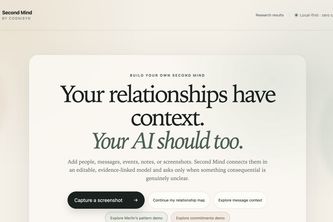
Second Mind by Cognisyn is a self-reported project that builds an inspectable, evidence-linked contextual reasoning system for personal communication. It aims to improve AI-assisted decision-making in interpersonal relationships by structuring context and separating evidence, interpretation, confidence, and alternatives before generating advice.
What changed
The author states this is a hackathon submission (Devpost entry for OpenAI 2026) and not a commercial product or service. It is described as a prototype with a zero-cost demo path, built using Codex, GPT-5.6, Tesseract.js, and other technologies.
Single most important open question
Is there any evidence of traction, revenue, or customer adoption beyond the author's own demonstration? The description does not state whether this project has moved beyond prototype or if it is being used by anyone outside its creator.
What The Product Actually Is
The description states that Second Mind is an inspectable contextual reasoning system. It organizes messages, notes, events, and screenshots into a relationship graph and timeline, using only the context selected by the user. It does not decide what another person intended or tell the user what to do — it helps people reason and communicate with better context while keeping judgment human.
Key features include:
- Invariant reasoning lenses (Think through, Pause & parse, Clarity, Reflect, Challenge)
- Communication Studio (Draft, Reply, Review, Rewrite, Predict, Compare)
- Natural capture via browser-local OCR (Tesseract.js)
- Evidence-linked memory that retains source and allows correction or removal
- Relationship graph & timeline
- Epistemic discipline (Merlin) with competing hypotheses and Bayesian updates
- Perspective Simulation to rehearse how a recipient might read a response
- Context comparison between isolated and contextually grounded responses
The system is built using Codex, GPT-5.6, Tesseract.js, JavaScript, Node.js, OpenAI Responses API, scikit-learn, Convokit, JSON Schema, IndexedDB, and more.
Evidence
- The author describes the product’s functionality in detail.
- Technology stack is explicitly listed.
Inference
- This is a prototype or proof-of-concept built for a hackathon.
Positioning & Claim Evolution
The author states that most AI assistants treat ambiguous messages as if they arrive in isolation, and that fluent answers built on missing context can be persuasively wrong about the people you care about. Second Mind aims to address this by building inspectable, evidence-linked context first — and keeping judgment human.
It positions itself as a tool for improving interpersonal communication through structured reasoning, rather than replacing it. It emphasizes:
- User control
- Evidence transparency
- Separation of evidence, interpretation, alternatives, and confidence
- No AI interpretation becomes trusted memory automatically
Evidence
- The author’s own write-up describes the positioning.
- The tagline supports this narrative.
Inference
- This is a self-reported positioning, not validated in the market or by users.
Target Customer & ICP
The description does not explicitly identify a target customer or ideal customer profile (ICP). It implies that people already use general AI systems to interpret messages, draft replies, and make sense of relationships — but it does not name specific personas or user segments.
Evidence
- No explicit customer or persona described.
- The system is aimed at improving interpersonal communication, but no segment is named.
Inference
- Likely intended for individuals managing complex personal or professional relationships, but this is speculative without further evidence.
Business Model & Pricing Evidence
The description does not state any business model or pricing information. It mentions that the prototype can be run locally with no API key required and includes a zero-cost judge path (npm install, npm start). The author also notes that it runs fully locally with no paid API calls in its demo.
Evidence
- No pricing or monetization strategy described.
- Demo is free to run locally.
Inference
- No business model is evident beyond the prototype’s current state.
Technical & Delivery Signals
The system uses:
- Browser-local OCR (Tesseract.js)
- Codex and GPT-5.6 for design, implementation, and testing
- Node.js, JavaScript, IndexedDB, JSON Schema, scikit-learn, Convokit
- OpenAI Responses API as an optional paid path
- A deterministic engine for local demo runs
- 68 automated tests and 28 full-pipeline evaluations
It is described as a prototype built in one week with no external funding or team beyond the author.
Evidence
- Technology stack and implementation details are listed.
- The system includes automated testing and evaluation suites.
- It supports both local and live GPT-5.6 paths.
Inference
- This is a technical prototype, not a production-ready product.
Traction & Maturity Signals
The description states that this is a hackathon submission (OpenAI 2026) and not a commercial product or service. It includes no evidence of revenue, customers, or adoption beyond the author’s own demonstration. The system has a zero-cost demo path and runs locally with no cloud database.
Evidence
- No traction data provided.
- No customer names, usage metrics, or revenue figures.
Inference
- This is a prototype, not a mature product or service.
Competitive Context
The description does not mention any competitors. It does not state whether similar tools exist in the market for managing interpersonal communication or contextual reasoning.
Evidence
- No competitive landscape described.
- No mention of existing products or services addressing this space.
Inference
- The competitive context is unknown, and no evidence of prior art or competition is provided.
Open Questions & Risks
- Prototype-only: This is a hackathon submission, not a commercial product. No evidence of traction or adoption.
- No monetization strategy: No pricing, business model, or revenue path described.
- Unproven market demand: The description does not indicate whether users actually need this tool or if it solves a real problem at scale.
- Limited team: Only one person (Abby Fitzgerald) is involved in the project.
- Self-reported only: All claims are unverified and based on the author’s own description.
Evidence
- No evidence of revenue, customers, or adoption.
- No business model or pricing.
- No mention of competitors or market validation.
Inference
- The risk of misalignment between perceived need and actual demand is high.
Questions the description leaves open
- What problem are you solving that users currently cannot solve with existing tools?
- Have you validated this idea with any real users or early adopters?
- What is your path to product-market fit, if any?
- How do you plan to monetize this tool beyond the prototype?
- What are the technical limitations of running this at scale?
- Are there any existing tools in this space that you’re aware of?
- What would a minimum viable product (MVP) look like for this idea?
Overall Assessment
Not evidenced.
The description does not provide evidence of traction, revenue, customers, or a clear business model. It is a self-reported hackathon prototype with no indication of commercial viability or market adoption.
This project appears to be an experimental idea by one person, not a product or service ready for investment or partnership. The author states that it is a prototype built in one week and does not indicate any further development or commercialization plans.
Confidence Low.
Risk
High — no evidence of market need, traction, or monetization.
User Stories BotA demo video on every pull request
Get a demo video on every new feature
GitHub App that watches your pull requests and records a narrated, captioned demo.
Save time on demo prep and make informed decisions faster with a video walkthrough of every new feature.
Source
Submitted to the OpenAI 2026 hackathon on Devpost. Project home on Devpost. Back to the full gallery on Devpost.
This competitive analysis was produced by top-founders.com (opens in a new tab)
Generated by a language model from this project's public Devpost page — its tagline, the author's own write-up and any built-with tags listed there — as captured in August 2026. Short quotations are the author's words. It is an opinion on the idea as a business, not on the people behind it, and it reflects the description as published then. If the project has moved on, request a correction below. The analysis is not independent research and contains no verified traction, revenue or customer data.
An independent guide by KFG International LLC — not affiliated with, endorsed by, or connected to Devpost or OpenAI.