

Archive position — measured, not model output
0 likes on Devpost
2,263 of the 7,850 archived projects have more likes, and 5,587 share exactly 0 — so this project's #2,667 place in the like-ranked listing is a tie-break inside that group, not a ranking.
Projects (log scale)
Likes on Devpost. ▲ marks this project's group.
Show the figures
| Likes | Projects | Share of archive |
|---|---|---|
| 0 | 5,587 | 71.2% |
| 1 | 1,758 | 22.4% |
| 2 | 284 | 3.6% |
| 3–4 | 132 | 1.7% |
| 5–9 | 75 | 1.0% |
| 10+ | 14 | 0.2% |
 User Stories BotA demo video on every pull request
Get a demo video on every new feature
GitHub App that watches your pull requests and records a narrated, captioned demo.
Save time on demo prep and make informed decisions faster with a video walkthrough of every new feature.
Executive Summary
What the company appears to be: AOS Project Architect is a self-reported AI-powered tool that transforms real-world organizational problems into structured human–AI projects using GPT-5.6. It claims to help teams move from idea to action by generating structured project outputs, assigning roles (Atlas, Librarian, Guardian, Human Collaborator), and capturing reusable knowledge.
What changed: The author states this was built during OpenAI Build Week as a prototype for the 2026 OpenAI hackathon. It is described as a functioning application that sends inputs to GPT-5.6 and returns structured outputs, but no commercial product or traction is evidenced.
Single most important open question: Is there evidence of any real-world adoption, revenue, or customer feedback beyond the prototype’s existence?
What The Product Actually Is
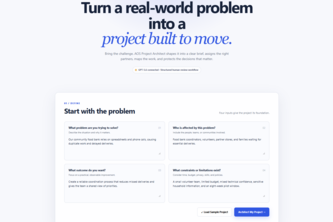
The description states that AOS Project Architect turns a real-world organizational problem into a structured human–AI project. It takes four inputs from users:
- the problem they are trying to solve;
- the people or communities affected;
- the desired outcome;
- known constraints and limitations.
It then uses GPT-5.6 to generate five structured sections:
- Project Brief
- Partner Assignments
- Action Plan
- Risks and Human Approvals
- Knowledge Card
Each section is assigned to a role:
- Atlas (strategy, priorities, milestones)
- Librarian (assumptions, decisions, reusable knowledge)
- Guardian (risks, privacy, approval boundaries)
- Human Collaborator (accountability for key decisions)
The tool also includes input validation and uses server-side API keys with structured outputs via Zod schema.
Evidence: The author describes how the application was built using Next.js, React, TypeScript, OpenAI APIs, and Codex CLI. It is deployed on Vercel and uses a protected server route to handle API requests securely.
Inference: This appears to be a prototype built for a hackathon, not a commercial product with ongoing use or customer feedback.
Positioning & Claim Evolution
The author states that AOS Project Architect was inspired by the principle: “Every solution begins with a problem, every problem becomes a project, every project creates knowledge, and every piece of knowledge strengthens AOS.”
It positions itself as a tool to help teams structure unclear problems into executable projects while preserving human accountability.
Evidence: The author claims this is not just a concept but a functioning prototype that demonstrates the workflow.
Inference: The positioning reflects an intent to offer structured AI-assisted project management, but no evidence of market traction or competitive positioning beyond its hackathon origin.
Target Customer & ICP
The description states that AOS Project Architect targets “founders, small teams, and organizations” who have valuable ideas but struggle to turn them into structured and executable projects.
It addresses issues like unclear responsibilities, late-discovered risks, undocumented decisions, and lost lessons from completed work.
Evidence: The author identifies the core user group as those with organizational problems needing structure and execution support.
Inference: No evidence of specific customer segments, personas, or use cases beyond general small teams or startups.
Business Model & Pricing Evidence
There is no evidence in the description of a business model or pricing strategy. The tool is described as a prototype built for a hackathon with no mention of monetization, subscriptions, or paid features.
Evidence: None provided.
Inference: It's unclear whether this will ever become a commercial offering or how it would be sold.
Technical & Delivery Signals
The application was built using:
- Next.js App Router
- React
- TypeScript
- Zod for schema validation
- OpenAI GPT-5.6 via Responses API
- Codex CLI for development workflow
- Vercel for deployment
- GitHub for version control
It uses server-side API keys and structured outputs to ensure consistent formatting.
Evidence: The author describes the tech stack, architecture, and how inputs are processed through the AI.
Inference: This is a functional prototype with secure handling of sensitive data (API key), but no evidence of scalability or production-grade infrastructure.
Traction & Maturity Signals
The description states that this was built during OpenAI Build Week as part of a hackathon submission. It includes accomplishments such as:
- Sending real requests to GPT-5.6
- Returning all five structured sections
- Assigning distinct roles
- Identifying risks and approvals
- Converting completed work into reusable knowledge
However, there is no evidence of:
- Real-world usage or adoption
- Customer feedback or engagement
- Revenue or monetization
- Product iteration beyond the prototype stage
Evidence: The tool was deployed publicly as a working demo during a hackathon.
Inference: This is a proof-of-concept with limited maturity or traction.
Competitive Context
No evidence of competitors or competitive positioning is provided in the description. The author does not reference existing tools for project management, AI-assisted planning, or organizational knowledge systems.
Evidence: None.
Inference: It’s unclear whether similar tools exist or how this would differentiate in a crowded market.
Open Questions & Risks
- Prototype-only: No evidence of commercial viability or real-world adoption.
- No revenue model: No indication of monetization strategy.
- Limited scope: The prototype is described as intentionally focused and not production-ready.
- Dependency on AI provider: Relies heavily on OpenAI’s GPT-5.6, which may change or become unavailable.
- Human accountability emphasis: While a strength in design, it raises questions about scalability and automation potential.
Evidence: The author explicitly states that this is a prototype with intentional limitations.
Questions the description leaves open
- What specific organizational problems are you solving, and how do you know these are real?
- Have you tested the tool with actual users or teams beyond yourself?
- How will you scale beyond the current prototype?
- Do you have a plan to monetize this product or service?
- Are there any legal or compliance concerns around AI-generated project plans?
- What are your long-term goals for AOS Project Architect — is it meant to be a standalone tool or part of a larger platform?
Overall Assessment
This is a self-reported prototype built during an OpenAI hackathon. It demonstrates a functional application that uses AI to structure organizational projects and assign roles, but there is no evidence of traction, revenue, customers, or a defined business model.
Confidence level: Low — based solely on the author’s own description, which lacks corroboration.
Assessment: Not ready for investment or partnership at this stage. It shows potential as an idea but has not yet proven its value in real-world use cases or market demand.
User Stories BotA demo video on every pull request
Get a demo video on every new feature
GitHub App that watches your pull requests and records a narrated, captioned demo.
Save time on demo prep and make informed decisions faster with a video walkthrough of every new feature.
Source
Submitted to the OpenAI 2026 hackathon on Devpost. Project home on Devpost. Back to the full gallery on Devpost.
This competitive analysis was produced by top-founders.com (opens in a new tab)
Generated by a language model from this project's public Devpost page — its tagline, the author's own write-up and any built-with tags listed there — as captured in August 2026. Short quotations are the author's words. It is an opinion on the idea as a business, not on the people behind it, and it reflects the description as published then. If the project has moved on, request a correction below. The analysis is not independent research and contains no verified traction, revenue or customer data.
An independent guide by KFG International LLC — not affiliated with, endorsed by, or connected to Devpost or OpenAI.