

Archive position — measured, not model output
0 likes on Devpost
2,263 of the 7,850 archived projects have more likes, and 5,587 share exactly 0 — so this project's #2,665 place in the like-ranked listing is a tie-break inside that group, not a ranking.
Projects (log scale)
Likes on Devpost. ▲ marks this project's group.
Show the figures
| Likes | Projects | Share of archive |
|---|---|---|
| 0 | 5,587 | 71.2% |
| 1 | 1,758 | 22.4% |
| 2 | 284 | 3.6% |
| 3–4 | 132 | 1.7% |
| 5–9 | 75 | 1.0% |
| 10+ | 14 | 0.2% |
 User Stories BotA demo video on every pull request
Get a demo video on every new feature
GitHub App that watches your pull requests and records a narrated, captioned demo.
Save time on demo prep and make informed decisions faster with a video walkthrough of every new feature.
Executive Summary
The description states that AO Stack is a system designed to turn software goals into bounded, tested Codex changes using GPT-5.6 for requirement clarification, producing an auditable evidence trail for every run. It is described as an "evidence-first software factory" with a multi-repository architecture and structured workflow stages. The author claims the system separates planning, approval, execution, observation, and promotion authority, and produces replayable evidence rather than relying on terminal scrollback or chat history.
The key commercial due-diligence question is: What traction, revenue or customer adoption exists for this system, if any?
The description is self-reported and unverified. No evidence of revenue, customers, or product-market fit is provided. The system appears to be a proof-of-concept demonstration built as part of a hackathon project.
What The Product Actually Is
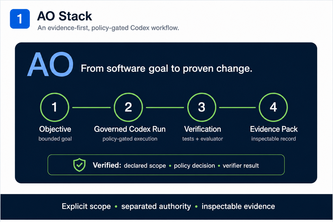
The description states that AO Stack is an "evidence-first software factory" that turns software objectives into bounded, tested Codex changes using GPT-5.6 for requirement clarification and produces an auditable evidence trail for every run.
It is described as a multi-repository architecture with explicit responsibility and authority boundaries, where each component owns one part of the workflow. The primary workflow stages are:
- Objective
- Requirements
- Workgraph
- Safe task selection
- Policy decision
- Codex execution
- Tests and evaluation
- Evidence bundle
- Operator readback
The system uses GPT-5.6 during development to help clarify requirements, plan work, interpret results, evaluate outcomes, and improve documentation.
It is described as producing structured records including:
- mission and routing records;
- requirements and authorization packets;
- dependency-aware workgraphs;
- policy decisions and approval tickets;
- execution plans and generated patches;
- test and evaluator results;
- evidence packs and cryptographic digests;
- safety and regression assessments;
- promotion and rollback plans.
Positioning & Claim Evolution
The description states that AO Stack was inspired by the problem of autonomous coding agents producing impressive results but being difficult to trust. The authors wanted to explore "how can autonomous software engineering remain useful while also being bounded, inspectable, and verifiable?"
The guiding principle stated is: Trust = Execution + Verification + Evidence.
The system is positioned as an evidence-first approach that produces not just code changes, but a replayable evidence trail showing how the change was planned, authorized, executed, tested, and evaluated. It aims to be more than a single-agent demonstration, offering a runnable governed-execution workflow with structured policy decisions, dependency-aware planning, evaluator closure, evidence packs, operator readbacks, regression monitoring, and promotion gates.
The claim evolution shows a shift from general autonomous agent problems to a specific solution focused on trustworthiness through bounded execution and evidence preservation.
Target Customer & ICP
The description does not state who the target customer is or what the ideal customer profile (ICP) might be. It describes the system as being designed for developers who want to provide an objective or authorized issue and receive a proven draft change, a clearly explained blocker, or a precise request for human input.
It mentions that the next milestone is a "governed autonomous GitHub issue-repair routine" which suggests potential use cases in software development teams working with GitHub repositories. However, no specific customer segments, personas or market targeting information is provided.
Business Model & Pricing Evidence
The description does not provide any evidence of business model or pricing structures. It describes the system as a proof-of-concept demonstration built for a hackathon and mentions future work to make the workflow practical for routine repository maintenance, but no commercial arrangements, pricing tiers, or revenue streams are described.
Technical & Delivery Signals
The description states that AO Stack was built as a multi-repository architecture with explicit responsibility and authority boundaries. Each component owns one part of the workflow, and planning systems do not automatically gain execution authority, observer systems cannot approve changes, and evidence storage remains separate from promotion decisions.
Key technical elements mentioned:
- Built with: a2a-protocol, bash, cargo, cli, css, cyclonedx, devops, docker, git, github, github-actions, go, gpt-5.6, html, javascript, json-schema, node.js, powershell, python, rest-apis, rust, sarif, sha-256, telegram-bot-api
- Uses GPT-5.6 during development for requirement clarification, planning, result interpretation, outcome evaluation, and documentation improvement
- Implements structured contracts and digest-bound artifacts
- Stores important outputs as machine-readable records rather than terminal output or chat history
- Includes read-only operator interfaces that explain what happened, evidence produced, whether the run passed gates, and what should happen next
Traction & Maturity Signals
The description states that this project was submitted to the OpenAI 2026 hackathon on Devpost. It is described as a "proof-of-concept demonstration" built for a hackathon with no evidence of revenue, customers or adoption beyond its own self-description.
The authors mention accomplishments including:
- A runnable governed-execution workflow
- Structured policy decisions
- Dependency-aware planning
- Evaluator closure
- Evidence packs
- Operator readbacks
- Regression monitoring
- Promotion gates
However, there is no evidence of actual usage, customer feedback, or product-market fit beyond the hackathon demonstration.
Competitive Context
The description does not provide any information about competitive landscape or direct competitors. It focuses on the unique aspects of AO Stack's approach to autonomous coding agents - specifically its emphasis on bounded execution, verification, and evidence preservation - but makes no mention of existing solutions in this space or how it compares to them.
Open Questions & Risks
- No traction evidence: The system is described as a hackathon project with no revenue, customers or adoption data
- Unproven commercial viability: No business model or pricing information provided
- Limited team size: Only one team member mentioned (torachiyo uesugi)
- Speculative technology: Uses GPT-5.6 which may not exist in the described form
- High technical complexity: Multi-repository architecture with strict boundaries suggests significant development effort required
- Unclear path to monetization: No indication of how this would be commercialized or scaled
Questions the description leaves open
- What specific problems are you solving that existing tools don't address?
- How do you plan to transition from a hackathon demo to a commercially viable product?
- What is your go-to-market strategy and target customer acquisition approach?
- Have you identified any potential customers or early adopters who would be interested in this solution?
- What are the key technical challenges that remain before this can be deployed at scale?
- How do you plan to validate the trustworthiness claims in practice?
- What is your roadmap for moving beyond the GitHub issue-repair routine?
- How will you handle the complexity of maintaining multiple repositories and their interdependencies?
Overall Assessment
The description states that AO Stack is a proof-of-concept demonstration built as part of a hackathon project with no evidence of revenue, customers or traction beyond its own self-description.
The system appears to be an experimental approach to autonomous software engineering focused on trustworthiness through bounded execution and evidence preservation. It has not demonstrated any commercial viability or product-market fit.
Confidence Level: Low
This is a self-reported, unverified description with no evidence of traction, revenue, customers or adoption. The project appears to be a technical demonstration rather than a commercial product in development.
User Stories BotA demo video on every pull request
Get a demo video on every new feature
GitHub App that watches your pull requests and records a narrated, captioned demo.
Save time on demo prep and make informed decisions faster with a video walkthrough of every new feature.
Source
Submitted to the OpenAI 2026 hackathon on Devpost. Project home on Devpost. Back to the full gallery on Devpost.
This competitive analysis was produced by top-founders.com (opens in a new tab)
Generated by a language model from this project's public Devpost page — its tagline, the author's own write-up and any built-with tags listed there — as captured in August 2026. Short quotations are the author's words. It is an opinion on the idea as a business, not on the people behind it, and it reflects the description as published then. If the project has moved on, request a correction below. The analysis is not independent research and contains no verified traction, revenue or customer data.
An independent guide by KFG International LLC — not affiliated with, endorsed by, or connected to Devpost or OpenAI.