

Archive position — measured, not model output
0 likes on Devpost
2,263 of the 7,850 archived projects have more likes, and 5,587 share exactly 0 — so this project's #2,664 place in the like-ranked listing is a tie-break inside that group, not a ranking.
Projects (log scale)
Likes on Devpost. ▲ marks this project's group.
Show the figures
| Likes | Projects | Share of archive |
|---|---|---|
| 0 | 5,587 | 71.2% |
| 1 | 1,758 | 22.4% |
| 2 | 284 | 3.6% |
| 3–4 | 132 | 1.7% |
| 5–9 | 75 | 1.0% |
| 10+ | 14 | 0.2% |
 User Stories BotA demo video on every pull request
Get a demo video on every new feature
GitHub App that watches your pull requests and records a narrated, captioned demo.
Save time on demo prep and make informed decisions faster with a video walkthrough of every new feature.
Executive Summary
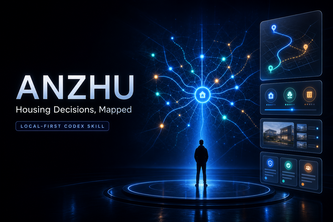
What the company appears to be: Anzhu is a self-reported Codex Skill that enables users to make family housing decisions through an interactive map. The product uses GPT-5.6 for conversational reasoning and structured planning, with deterministic local rendering and state management.
What changed: The author shifted from an enterprise AI agent model (that would require sharing sensitive data) to a local-first Skill architecture that keeps planning state on the user's machine while using external AI for flexible reasoning.
Single most important open question: Does Anzhu have any commercial traction, revenue, or customer adoption beyond the single developer's prototype?
The description is self-reported and unverified. No evidence of revenue, customers, or usage exists in this analysis. The author states that the project was submitted to a hackathon, but no further commercial evidence is provided.
What The Product Actually Is
The description states that Anzhu is:
- A Codex Skill
- An interactive housing-planning workbench
- A local-first application with deterministic state management
- Built using Codex and GPT-5.6 for reasoning, with a Next.js frontend
- Designed to help users make family housing decisions through conversation and visual planning
The author describes it as a "local-first Skill" that separates flexible AI reasoning from deterministic execution, keeping sensitive data local while allowing the model to reason about complex family constraints.
Positioning & Claim Evolution
The description states:
- The product was initially imagined as a "fully hosted real-estate agent"
- This evolved into a "local-first Skill" that lets users choose their host model
- The positioning shifted from requiring users to hand over sensitive data to keeping planning state local
- The author claims this approach makes the model's creativity usable over time through guardrails
The claim evolution shows a shift from an enterprise AI agent model to a privacy-preserving, deterministic local-first architecture.
Target Customer & ICP
Not evidenced. The description does not specify:
- Who the target customers are beyond "family housing decisions"
- What demographic or geographic segments they serve
- Whether there's a specific customer persona or ideal customer profile
Business Model & Pricing Evidence
Not evidenced. The description does not contain:
- Any information about pricing models
- Revenue streams
- Monetization strategies
- Customer acquisition costs
- Unit economics
Technical & Delivery Signals
The description states:
- Built with: codex, gpt-5.6, maplibre-gl-js, next.js, node.js, react, typescript, zustand
- Architecture separates flexible intelligence (Codex/GPT-5.6) from deterministic execution (local workbench)
- Uses a strict Skill contract as boundary between AI and state management
- Includes automated tests (85 passing regression tests)
- Has session isolation with unique visual session IDs per conversation
- Employs guardrails to make output auditable
- Supports voice walkthroughs synchronized with map markers
Traction & Maturity Signals
Not evidenced. The description does not contain:
- Any evidence of revenue or customers
- Usage metrics or adoption data
- Product-market fit indicators
- Growth trends or user engagement
- Market traction beyond the hackathon submission
Competitive Context
Not evidenced. The description does not contain:
- Information about competitors
- Market positioning relative to existing solutions
- Competitive advantages or differentiators
- Industry landscape or market size
Open Questions & Risks
Inferences based on self-reported information:
- Single developer team: Only one member listed (zhulijin1991 zhulijin)
- Hackathon prototype: Submitted to OpenAI 2026 hackathon, suggesting it's a prototype
- No commercial evidence: No revenue, customers or traction data provided
- Unproven market demand: The author states they don't know if there's demand for this specific approach
- Technical complexity risk: The architecture requires balancing AI flexibility with deterministic state management
- Privacy vs. utility tradeoff: The local-first approach may limit the product's utility compared to cloud-based solutions
Questions the description leaves open
- What is your actual customer acquisition strategy beyond the hackathon?
- How do you plan to monetize this product if it remains a developer tool?
- What specific family housing decisions are users currently making with this tool?
- How do you plan to scale from one developer to a full team?
- What evidence do you have that there's market demand for this approach?
- How will you handle the technical complexity of maintaining deterministic state while using flexible AI models?
- What is your go-to-market strategy for reaching families with housing decisions?
Overall Assessment
Not evidenced. The description does not contain:
- Any financial information
- Valuation or funding data
- Commercial traction metrics
- Strategic partnership opportunities
- Investment potential indicators
The author states this was a hackathon submission, and there is no evidence of commercial viability beyond the prototype. The product appears to be a technical demonstration rather than a commercial offering with proven traction.
User Stories BotA demo video on every pull request
Get a demo video on every new feature
GitHub App that watches your pull requests and records a narrated, captioned demo.
Save time on demo prep and make informed decisions faster with a video walkthrough of every new feature.
Source
Submitted to the OpenAI 2026 hackathon on Devpost. Project home on Devpost. Back to the full gallery on Devpost.
This competitive analysis was produced by top-founders.com (opens in a new tab)
Generated by a language model from this project's public Devpost page — its tagline, the author's own write-up and any built-with tags listed there — as captured in August 2026. Short quotations are the author's words. It is an opinion on the idea as a business, not on the people behind it, and it reflects the description as published then. If the project has moved on, request a correction below. The analysis is not independent research and contains no verified traction, revenue or customer data.
An independent guide by KFG International LLC — not affiliated with, endorsed by, or connected to Devpost or OpenAI.