

Archive position — measured, not model output
0 likes on Devpost
2,263 of the 7,850 archived projects have more likes, and 5,587 share exactly 0 — so this project's #6,586 place in the like-ranked listing is a tie-break inside that group, not a ranking.
Projects (log scale)
Likes on Devpost. ▲ marks this project's group.
Show the figures
| Likes | Projects | Share of archive |
|---|---|---|
| 0 | 5,587 | 71.2% |
| 1 | 1,758 | 22.4% |
| 2 | 284 | 3.6% |
| 3–4 | 132 | 1.7% |
| 5–9 | 75 | 1.0% |
| 10+ | 14 | 0.2% |
 User Stories BotA demo video on every pull request
Get a demo video on every new feature
GitHub App that watches your pull requests and records a narrated, captioned demo.
Save time on demo prep and make informed decisions faster with a video walkthrough of every new feature.
Executive Summary
What the company appears to be
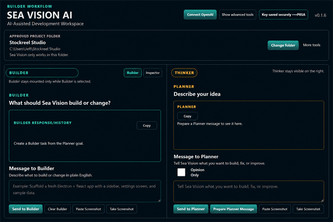
Sea Vision AI is an AI-assisted software development workspace designed to help non-coders create software safely by assigning specialized roles to different AIs—Inspector, Builder, and Thinker—to investigate, build, and review changes before they are applied. The author states this is a self-reported project built through an AI-assisted process using tools like OpenAI’s Codex and GPT-5.6, with no verified revenue, customers or traction.
What changed
The project evolved from the author's personal experience building a software application (Data Levee) using AI, where he found that verifying AI-generated code was difficult. This led to the idea of separating AI roles into investigation, building, and independent review stages.
Single most important open question
Is there evidence that the described architecture—Inspector, Builder, Thinker—can be reliably implemented or scaled beyond a single-person prototype?
What The Product Actually Is
The description states that Sea Vision AI is an AI-assisted software development workspace. It assigns three distinct roles to AIs:
- Inspector: Investigates the project workspace and gathers evidence.
- Builder: Proposes code changes based on the investigation.
- Thinker: Independently reviews the proposed changes before they are applied.
The system aims to make AI-assisted development more reliable, understandable, and safe for non-programmers. It is built using modern web technologies including Electron, React, and TypeScript, and was developed with human direction and thousands of iterations.
Evidence
- The author states that the product assigns specialized roles to AIs.
- The system is described as designed to help non-coders create software safely.
- Built using Electron, React, TypeScript, and tools like OpenAI’s Codex and GPT-5.6.
Inference The architecture implies a multi-agent AI workflow where each agent has a defined function in the development process.
Positioning & Claim Evolution
The author states that Sea Vision AI is not another coding assistant but a system where AI helps supervise AI. It focuses on investigating first, building second, and verifying before applying changes.
Key claims
- The goal is not just faster software development but more reliable and understandable AI-assisted development.
- Unlike traditional AI coding assistants, it emphasizes transparency and reviewability.
- Designed to help people who are not professional programmers work with AI more confidently.
Evidence
- The author explicitly contrasts Sea Vision with “traditional AI coding assistants.”
- States that the system is designed for non-coders.
- Mentions that the architecture grew out of real experience building software with AI.
Inference The positioning implies a shift from code generation to code governance and verification, which may be a novel approach in AI-assisted development.
Target Customer & ICP
The description states that Sea Vision AI is designed to help non-coders create software safely. The author identifies himself as someone who is not a traditional programmer but can design software and guide AI toward desired outcomes.
Evidence
- The tagline says it helps “non-coders create software safely.”
- The author describes his own background: “I am not a software developer in the traditional sense.”
- The system aims to make AI-assisted development more approachable for people who have ideas but no programming experience.
Inference The target customer is likely individuals or small teams without formal programming skills, who want to build applications using AI but need confidence and safety in the process.
Business Model & Pricing Evidence
Not evidenced. The description does not mention any pricing model, monetization strategy, or business model.
Evidence
- No mention of revenue streams, pricing tiers, or customer acquisition strategies.
- No indication of whether this is a freemium, subscription, or one-time purchase model.
Technical & Delivery Signals
The system is built using modern web technologies:
- Electron
- React
- TypeScript
- Node.js
- Vite
- OpenAI API (Codex, GPT-5.6)
The author states that the development process involved extensive iteration and testing, with AI used for design, debugging, and implementation.
Evidence
- The project was built using Electron, React, TypeScript, and other web technologies.
- The author used ChatGPT for reasoning and design, Codex with GPT-5.6 for implementation.
- Every change was tested repeatedly and refined through real-world use.
Inference The technical stack suggests a desktop or web-based application, possibly with AI integration via API. The iterative development process implies a hands-on, user-centered approach.
Traction & Maturity Signals
Not evidenced. There is no mention of users, customers, revenue, or adoption metrics.
Evidence
- No data on active users, customer base, or product usage.
- No mention of published versions, downloads, or market traction.
- The project was submitted to a hackathon and is described as a prototype.
Inference The project appears to be in an early stage, likely a prototype or proof-of-concept, with no verified traction or commercial deployment.
Competitive Context
Not evidenced. No mention of competitors, existing solutions, or market positioning relative to others.
Evidence
- The author contrasts Sea Vision with “traditional AI coding assistants.”
- No reference to specific competitors or similar tools in the marketplace.
- No indication of how it compares to existing AI development platforms or IDEs.
Open Questions & Risks
- Unproven architecture: The described multi-agent AI workflow (Inspector, Builder, Thinker) has not been demonstrated at scale or in production.
- Single-person development: The entire project was built by one person (Jeff Johnson), raising questions about scalability and robustness.
- No commercial evidence: No revenue, customers, or traction data are provided.
- Unclear execution path: The author states the system is designed for non-coders but does not explain how it will be made accessible or automated at scale.
Evidence
- The project is described as a self-reported prototype.
- No mention of testing with users or real-world deployment.
- No evidence of any commercialization strategy or product roadmap.
Questions the description leaves open
- How does the Inspector gather and interpret evidence from the codebase?
- What mechanisms ensure that the Builder’s proposals are aligned with the Inspector's findings?
- How is the Thinker’s review process implemented, and what criteria does it use to evaluate changes?
- Has the system been tested with non-coders? If so, what were the results?
- What is the plan for scaling beyond a single-person development model?
- How will the product be monetized or distributed?
- Are there any technical limitations in how the AI roles interact that could hinder adoption?
Overall Assessment
Not evidenced. No information is provided about funding, valuation, or investment interest.
Evidence
- No mention of funding rounds, investors, or financial backing.
- No indication of whether this is a startup seeking investment or a personal project.
Inference Given the lack of traction, revenue, or commercial strategy, it's unclear if this represents a viable business opportunity or merely an experimental prototype. The author’s own account suggests a strong personal motivation but no clear path to market adoption or scalability.
User Stories BotA demo video on every pull request
Get a demo video on every new feature
GitHub App that watches your pull requests and records a narrated, captioned demo.
Save time on demo prep and make informed decisions faster with a video walkthrough of every new feature.
Source
Submitted to the OpenAI 2026 hackathon on Devpost. Project home on Devpost. Back to the full gallery on Devpost.
This competitive analysis was produced by top-founders.com (opens in a new tab)
Generated by a language model from this project's public Devpost page — its tagline, the author's own write-up and any built-with tags listed there — as captured in August 2026. Short quotations are the author's words. It is an opinion on the idea as a business, not on the people behind it, and it reflects the description as published then. If the project has moved on, request a correction below. The analysis is not independent research and contains no verified traction, revenue or customer data.
An independent guide by KFG International LLC — not affiliated with, endorsed by, or connected to Devpost or OpenAI.