

Archive position — measured, not model output
1 like on Devpost
505 of the 7,850 archived projects have more likes, and 1,758 share exactly 1 — so this project's #699 place in the like-ranked listing is a tie-break inside that group, not a ranking.
Projects (log scale)
Likes on Devpost. ▲ marks this project's group.
Show the figures
| Likes | Projects | Share of archive |
|---|---|---|
| 0 | 5,587 | 71.2% |
| 1 | 1,758 | 22.4% |
| 2 | 284 | 3.6% |
| 3–4 | 132 | 1.7% |
| 5–9 | 75 | 1.0% |
| 10+ | 14 | 0.2% |
 User Stories BotA demo video on every pull request
Get a demo video on every new feature
GitHub App that watches your pull requests and records a narrated, captioned demo.
Save time on demo prep and make informed decisions faster with a video walkthrough of every new feature.
Executive Summary
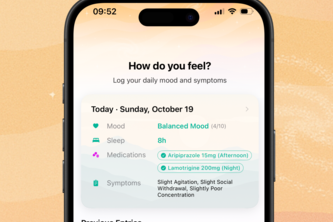
What the company appears to be: Bipolar Mood Companion is a self-reported, unverified project described as an iOS application designed to support individuals with bipolar disorder in tracking mood, sleep, medication adherence, and symptoms. It uses structured daily check-ins and AI-generated insights grounded in personal data trends.
What changed: The author states that the app was built for a hackathon (OpenAI 2026), implying this is an early-stage prototype or proof-of-concept. There is no evidence of prior development, funding, or product release beyond this submission.
Single most important open question: Is there any evidence of user adoption, data usage, or clinical validation that would suggest the app has moved beyond a personal project into a potential commercial or therapeutic tool?
Analysis basis: The entire report is based on a single self-reported description from the author, submitted to a hackathon. No third-party verification, revenue, traction, or customer data is available.
What The Product Actually Is
The description states that Bipolar Mood Companion is:
- A native iOS application
- Designed for daily check-ins around mood, sleep, medication adherence, symptoms, and notes
- Built using codex, node.js, python, swift
- Intended to turn structured data into visual trends, summaries, and AI-generated insights
- Not intended to diagnose conditions or replace professional care
The app is described as a companion tool, not a medical device or therapy platform.
Inference: The product appears to be an early-stage prototype built for personal use or demonstration. No evidence of production deployment, user base, or monetization exists in the description.
Positioning & Claim Evolution
The author claims that:
- Current mood-tracking apps are good at collecting data but leave users to interpret it themselves
- Bipolar Mood Companion aims to go beyond a simple diary by offering personalised AI insights
- It is designed to support self-awareness, not diagnosis or replacement of healthcare
- The app emphasizes non-judgmental, calm interaction, avoiding guilt or streak pressure
Inference: The positioning reflects an intent to create a responsible mental health companion that bridges self-tracking and clinical communication. However, the description does not indicate any prior market testing, user feedback, or product iteration beyond the hackathon.
Target Customer & ICP
The author states:
- The app is for people living with bipolar disorder
- It supports those who track mood, sleep, medication adherence, and symptoms
- It aims to help users prepare for conversations with healthcare professionals
Inference: The target customer is an individual with bipolar disorder seeking a structured way to understand their condition. No evidence of segmentation, personas, or market research beyond the author’s personal experience.
Business Model & Pricing Evidence
The description does not state:
- Any pricing model
- Revenue streams
- Monetization strategy
- Subscription plans or in-app purchases
Not evidenced: There is no indication of how the product would be monetized, if at all. The project appears to be a prototype with no commercial framework described.
Technical & Delivery Signals
The author states:
- Built as a native iOS app
- Uses codex, node.js, python, swift
- Daily check-ins store structured data
- AI insights are generated by preparing concise summaries before prompting the model
- The system is designed to avoid unsupported claims or diagnoses
- It compares recent values with personal baselines, not universal thresholds
Inference: The technical approach shows an awareness of responsible AI use and personalization. However, no evidence of scalability, data security, or production deployment exists.
Traction & Maturity Signals
The description states:
- This is a hackathon submission
- The app was built by one person (Evgenii Bykov)
- No mention of users, downloads, or usage metrics
- No evidence of product release, funding, or team expansion
Not evidenced: There are no signs of traction, adoption, or maturity beyond the initial prototype.
Competitive Context
The description does not reference:
- Competitors in the mental health or mood-tracking space
- Existing apps or platforms with similar features
- Market positioning relative to others
Not evidenced: No competitive analysis or differentiation strategy is provided.
Open Questions & Risks
Key risks inferred from the description:
- The app is a single-person hackathon project, not a scalable product
- It is not clinically validated and does not replace professional care
- AI insights are limited to structured data and constrained prompts
- No evidence of data privacy, security, or compliance measures (e.g., HIPAA, GDPR)
- The app may be too early-stage for commercial viability or investment interest
Inference: The project is in a very early phase with no clear path to product-market fit or commercialization.
Questions the description leaves open
- What is the source of the AI model used, and how is it trained or constrained?
- Has the app been tested with actual users with bipolar disorder?
- Are there any plans for clinical validation or partnership with mental health professionals?
- How does the app handle data privacy and user consent, especially in a healthcare context?
- What are the technical limitations of the current prototype that would need to be addressed before release?
Overall Assessment
The description states that this is a hackathon submission by one individual. There is no evidence of:
- Revenue or customer traction
- Product-market fit
- Team expansion or funding
- Commercial viability
Assessment: Not evidenced as a viable investment or partnership opportunity at this stage. The project appears to be an early prototype with potential but no demonstrated progress toward commercialization or impact.
User Stories BotA demo video on every pull request
Get a demo video on every new feature
GitHub App that watches your pull requests and records a narrated, captioned demo.
Save time on demo prep and make informed decisions faster with a video walkthrough of every new feature.
Source
Submitted to the OpenAI 2026 hackathon on Devpost. Project home on Devpost. Back to the full gallery on Devpost.
This competitive analysis was produced by top-founders.com (opens in a new tab)
Generated by a language model from this project's public Devpost page — its tagline, the author's own write-up and any built-with tags listed there — as captured in August 2026. Short quotations are the author's words. It is an opinion on the idea as a business, not on the people behind it, and it reflects the description as published then. If the project has moved on, request a correction below. The analysis is not independent research and contains no verified traction, revenue or customer data.
An independent guide by KFG International LLC — not affiliated with, endorsed by, or connected to Devpost or OpenAI.