

Archive position — measured, not model output
0 likes on Devpost
2,263 of the 7,850 archived projects have more likes, and 5,587 share exactly 0 — so this project's #4,534 place in the like-ranked listing is a tie-break inside that group, not a ranking.
Projects (log scale)
Likes on Devpost. ▲ marks this project's group.
Show the figures
| Likes | Projects | Share of archive |
|---|---|---|
| 0 | 5,587 | 71.2% |
| 1 | 1,758 | 22.4% |
| 2 | 284 | 3.6% |
| 3–4 | 132 | 1.7% |
| 5–9 | 75 | 1.0% |
| 10+ | 14 | 0.2% |
 User Stories BotA demo video on every pull request
Get a demo video on every new feature
GitHub App that watches your pull requests and records a narrated, captioned demo.
Save time on demo prep and make informed decisions faster with a video walkthrough of every new feature.
Executive Summary
What the company appears to be
HomePilot is a self-reported web-based planning tool designed to help users create personalized room-by-room furnishing plans based on budget, location, priorities, and property size. It claims to generate actionable purchasing strategies with timeline tracking, shared progress views, and multi-device synchronization.
What changed
The project was built as part of a hackathon (OpenAI 2026) in four days. The description indicates it is currently a functional prototype or MVP, not yet a commercial product.
Single most important open question
Is there evidence of early user traction, revenue, or market validation beyond the self-reported build process?
What The Product Actually Is
The description states that HomePilot is a responsive web application built with:
- Next.js
- React
- TypeScript
- Supabase (for authentication, storage, and synchronization)
- Vercel (deployment)
It uses OpenAI CODEX with GPT-5.6 for development acceleration.
The product enables users to:
- Create, manage, and share multiple home furnishing plans.
- Generate prioritized purchasing strategies by room.
- Adjust budgets and see real-time plan updates.
- Track progress, timelines, and readiness scores.
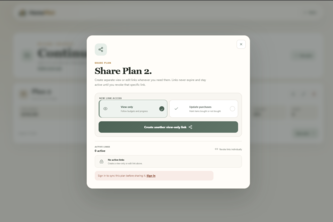
- Share persistent links with view-only or update permissions.
- Sync across devices without repeating onboarding.
It supports:
- 80 markets
- 53 currencies
- 104 furnishing essentials
- Three buying tiers
- 14 apartment archetypes (25–2,000 m²)
Inference The tool is described as deterministic in its calculations, meaning it does not rely on AI-generated recommendations but rather on a structured planning engine.
Positioning & Claim Evolution
The author states that HomePilot aims to:
- Turn uncertainty into a practical, personalized roadmap
- Replace generic checklists with room-by-room buying plans
- Help users avoid overspending or postponing purchases due to lack of structure
It positions itself as a planning assistant for homebuyers moving into empty homes.
Inference This is a self-positioned tool focused on financial planning and organizational clarity, not retail or marketplace functionality. It does not claim to offer live pricing or direct purchasing integrations.
Target Customer & ICP
The description states that HomePilot targets:
- Households moving into empty homes
- Users who want to plan purchases by room
- People who struggle with budgeting, timelines, and prioritization during move-in
It supports:
- Multiple users within a household
- Shared access for collaborative planning
- Cross-device usage
Inference The ICP appears to be first-time homebuyers or relocators, especially those with limited time or experience in managing large-scale purchases.
Business Model & Pricing Evidence
No pricing model, monetization strategy, or business model is described in the self-report.
The description does not mention:
- Subscription tiers
- Freemium offerings
- Transaction fees
- B2B vs B2C models
- Paid features beyond core functionality
Inference There is no evidence of a defined business model, though the tool may evolve into one post-hackathon.
Technical & Delivery Signals
The product was built in four days during a hackathon and includes:
- Passwordless authentication via Supabase
- Cross-device synchronization
- Persistent multi-plan storage
- Deterministic planning engine
- Responsive UI for mobile and desktop
- Use of OpenAI CODEX for development
It uses:
- Next.js, React, TypeScript
- Supabase (PostgreSQL + Row Level Security)
- Vercel for deployment
- Tailwind CSS, Zod validation
Inference The technical stack suggests a modern SaaS MVP, with attention to security and scalability. However, no production data or performance metrics are provided.
Traction & Maturity Signals
There is no evidence of traction beyond the hackathon submission:
- No revenue figures
- No customer base
- No user engagement data
- No product usage statistics
- No market adoption indicators
The project is described as a 4-day hackathon MVP, not yet a commercial product.
Inference This is an early-stage prototype with no demonstrated traction or maturity in the market.
Competitive Context
No competitive analysis or mention of existing tools is included in the description.
The author does not reference:
- Competitors in home planning or budgeting
- Similar products (e.g., Roomstyler, Planner 5D, etc.)
- Market gaps or differentiation strategies
Inference There is no evidence of competitive positioning, market research, or awareness of existing solutions.
Open Questions & Risks
- No revenue or customer data: The tool has not yet been monetized or adopted.
- Prototype-only status: Built in four days; no long-term product development history.
- Unverified claims: All features and capabilities are self-reported without external validation.
- Unclear monetization path: No indication of how the company intends to make money.
- Limited scope: Focus on planning only, not retail or purchasing.
Inference The project is in a very early stage with no commercial viability demonstrated. It may be a proof-of-concept rather than a scalable business.
Questions the description leaves open
- What specific market pain points did you identify before building this?
- Have you validated the need for this tool with real users or surveys?
- How do you plan to transition from a hackathon MVP to a sustainable product?
- What is your intended monetization model?
- Are there any existing partnerships, early adopters, or pilot programs?
- What are the biggest technical challenges in scaling the planning engine?
- Do you have plans for mobile app development beyond the web version?
Overall Assessment
Not evidenced
The description provides no evidence of:
- Revenue
- Customers
- Product-market fit
- Traction
- Commercial viability
It is a self-reported hackathon project, not a commercial entity.
Confidence Level Very low
Next Steps
If this were to be considered for investment or partnership, further due diligence would require:
- Evidence of early user traction or pilot data
- Clear business model and monetization strategy
- Market validation and competitive analysis
- Product roadmap and team execution history
User Stories BotA demo video on every pull request
Get a demo video on every new feature
GitHub App that watches your pull requests and records a narrated, captioned demo.
Save time on demo prep and make informed decisions faster with a video walkthrough of every new feature.
Source
Submitted to the OpenAI 2026 hackathon on Devpost. Project home on Devpost. Back to the full gallery on Devpost.
This competitive analysis was produced by top-founders.com (opens in a new tab)
Generated by a language model from this project's public Devpost page — its tagline, the author's own write-up and any built-with tags listed there — as captured in August 2026. Short quotations are the author's words. It is an opinion on the idea as a business, not on the people behind it, and it reflects the description as published then. If the project has moved on, request a correction below. The analysis is not independent research and contains no verified traction, revenue or customer data.
An independent guide by KFG International LLC — not affiliated with, endorsed by, or connected to Devpost or OpenAI.