

Archive position — measured, not model output
0 likes on Devpost
2,263 of the 7,850 archived projects have more likes, and 5,587 share exactly 0 — so this project's #4,535 place in the like-ranked listing is a tie-break inside that group, not a ranking.
Projects (log scale)
Likes on Devpost. ▲ marks this project's group.
Show the figures
| Likes | Projects | Share of archive |
|---|---|---|
| 0 | 5,587 | 71.2% |
| 1 | 1,758 | 22.4% |
| 2 | 284 | 3.6% |
| 3–4 | 132 | 1.7% |
| 5–9 | 75 | 1.0% |
| 10+ | 14 | 0.2% |
 User Stories BotA demo video on every pull request
Get a demo video on every new feature
GitHub App that watches your pull requests and records a narrated, captioned demo.
Save time on demo prep and make informed decisions faster with a video walkthrough of every new feature.
Executive Summary
What the company appears to be
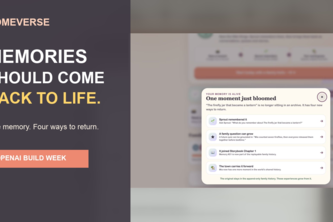
HomeVerse is a self-reported family memory system that turns everyday moments into interactive experiences through an AI companion (Sprout), quizzes, storybooks, and a living virtual town. It uses an append-only event log as its core architecture and integrates GPT-5.6 for memory-aware AI features.
What changed
The project evolved from a private family prototype into a public-facing product concept submitted to the OpenAI 2026 hackathon. The authors state they rebuilt the system from scratch with a clean, shareable structure while preserving core design principles like deterministic history handling and child safety.
Single most important open question
Is there evidence of traction or adoption beyond the authors' own family use case? The description contains no data on users, revenue, or product usage — only claims about intent and architecture.
What The Product Actually Is
The description states that HomeVerse is a system that:
- Turns everyday family moments into a loop involving:
- Saving a moment
- AI companion (Sprout) that remembers the family's history
- Family-specific quizzes generated from memory logs
- Storybook chapters unlocked by starlight earned through check-ins and quiz answers
- A living virtual town where residents follow time-aware routines
It also states:
- The system uses an append-only event log as its core architecture.
- Memory-aware AI features are powered by GPT-5.6 via OpenAI Responses API.
- The town is rendered using Canvas 2D and runs deterministically without waiting on AI.
- A safety guard filters messages before any AI output is considered.
Inference The product appears to be a prototype or early-stage system built for personal/family use, not yet commercialized. It is described as a working, auditable transformation of a real family tool into a focused product.
Positioning & Claim Evolution
The description states:
- HomeVerse was inspired by the authors' own family experience: “Families don’t need another archive.” Instead, it aims to make memories participate in daily life.
- The central idea is that memories should not just survive but keep showing up.
- It positions itself as a system where one memory can return in multiple forms — conversation, quiz, story, or town detail.
Inference The positioning evolved from a personal tool into a product concept with broader appeal. However, the claim of making memories “participate” is not substantiated by evidence of user behavior or adoption beyond the authors' own family.
Target Customer & ICP
The description states:
- The target is families who want to preserve and engage with their memories.
- It is designed for private use, with no real-world data included in the demo.
- The fictional Meadowsons are used to seed a lived-in experience without exposing real identities.
Inference The ICP appears to be private, family-oriented users — possibly parents or caregivers looking to maintain engagement with their children’s memories. No specific demographic or segment is defined beyond this.
Business Model & Pricing Evidence
Not evidenced.
The description does not mention:
- Revenue streams
- Pricing models
- Monetization strategy
- Subscription plans or usage fees
Inference There is no indication of a business model beyond the authors’ own use case. The system is described as private and shareable, but no commercial framework is outlined.
Technical & Delivery Signals
The description states:
- Built with FastAPI + Python for API, event store, projector, safety guard, and OpenAI integration.
- Uses GPT-5.6 via OpenAI Responses API.
- Vanilla JavaScript in a PWA shell.
- Canvas 2D for animated town.
- Docker Compose for one-command startup.
- Append-only event log architecture.
- Deterministic projection of memory history.
Inference The technical stack suggests a lightweight, deterministic system built with modern tools. The use of event sourcing and deterministic projections indicates an intentional focus on data integrity and replayability.
Traction & Maturity Signals
Not evidenced.
The description does not include:
- Customer base
- Revenue figures
- User engagement metrics
- Product adoption rates
- Any form of market validation or feedback from users outside the authors’ family
Inference There is no evidence of traction or maturity beyond the authors' own experience and prototype development. The system is described as a hackathon submission, not a product in active use.
Competitive Context
Not evidenced.
The description does not:
- Mention competitors
- Describe market size or competitive landscape
- Compare HomeVerse to existing solutions in family memory or AI tools
Inference No competitive context is provided. The authors do not reference similar products or platforms, nor do they position HomeVerse within a known category.
Open Questions & Risks
The description states:
- The system is built on a single-person team.
- It uses GPT-5.6, which may raise concerns about cost and scalability.
- The fictional Meadowsons are used to avoid exposing real data — this could be an open question for transparency or trust.
Inference
Key risks include:
- Lack of independent validation or user feedback
- Single-founder development limits scalability
- Heavy reliance on proprietary AI models (GPT-5.6) may pose long-term viability issues
- The fictionalization of data raises questions about authenticity and real-world applicability
Questions the description leaves open
- What is the actual user base beyond the authors' family?
- How does the system handle privacy at scale, especially with multi-user accounts?
- Are there plans to monetize or commercialize the product?
- What are the long-term costs associated with using GPT-5.6 and OpenAI APIs?
- How is the append-only event log scaled or managed for larger datasets?
- Has the system been tested with real families outside of the authors’ own?
Overall Assessment
Not evidenced.
The description does not provide:
- Valuation estimates
- Funding history
- Strategic partnerships
- Market opportunity size
- Exit potential or growth trajectory
Inference There is insufficient evidence to assess whether HomeVerse is a viable investment or partnership target. The project is described as a hackathon submission and prototype, with no commercial traction or financial data available.
User Stories BotA demo video on every pull request
Get a demo video on every new feature
GitHub App that watches your pull requests and records a narrated, captioned demo.
Save time on demo prep and make informed decisions faster with a video walkthrough of every new feature.
Source
Submitted to the OpenAI 2026 hackathon on Devpost. Project home on Devpost. Back to the full gallery on Devpost.
This competitive analysis was produced by top-founders.com (opens in a new tab)
Generated by a language model from this project's public Devpost page — its tagline, the author's own write-up and any built-with tags listed there — as captured in August 2026. Short quotations are the author's words. It is an opinion on the idea as a business, not on the people behind it, and it reflects the description as published then. If the project has moved on, request a correction below. The analysis is not independent research and contains no verified traction, revenue or customer data.
An independent guide by KFG International LLC — not affiliated with, endorsed by, or connected to Devpost or OpenAI.