

Archive position — measured, not model output
0 likes on Devpost
2,263 of the 7,850 archived projects have more likes, and 5,587 share exactly 0 — so this project's #4,533 place in the like-ranked listing is a tie-break inside that group, not a ranking.
Projects (log scale)
Likes on Devpost. ▲ marks this project's group.
Show the figures
| Likes | Projects | Share of archive |
|---|---|---|
| 0 | 5,587 | 71.2% |
| 1 | 1,758 | 22.4% |
| 2 | 284 | 3.6% |
| 3–4 | 132 | 1.7% |
| 5–9 | 75 | 1.0% |
| 10+ | 14 | 0.2% |
 User Stories BotA demo video on every pull request
Get a demo video on every new feature
GitHub App that watches your pull requests and records a narrated, captioned demo.
Save time on demo prep and make informed decisions faster with a video walkthrough of every new feature.
Executive Summary
What the company appears to be
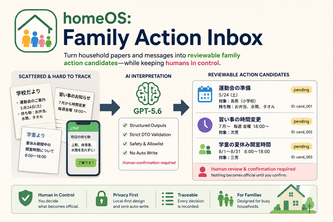
homeOS: Family Action Inbox is a self-reported prototype for managing unstructured household information through AI-assisted candidate action proposals. The system uses GPT-5.6 to interpret messages and generate structured, reviewable action candidates while maintaining strict human control over what becomes official.
What changed
The project description indicates this is a hackathon submission (OpenAI 2026) with a narrow focus on one workflow: unstructured household text → AI-generated candidate proposal → strict validation → pending candidate → human review → explicit confirmation or rejection. It does not appear to have evolved beyond a proof-of-concept.
Single most important open question
Is there any evidence of real-world usage, traction, or commercial intent beyond the prototype?
What The Product Actually Is
The description states that homeOS is a command-line application implemented in Python, designed to process household messages and convert them into structured action candidates using GPT-5.6.
It implements a controlled workflow:
- Household input
- AI-generated candidate proposals via GPT-5.6
- Strict validation against schema and allowlists
- Pending candidate creation
- Human review and explicit confirm/reject
The system enforces that:
- AI can propose actions but cannot create official obligations.
- All outputs must pass strict Structured Outputs validation.
- Unknown fields, invalid subject IDs, or incomplete responses are rejected before candidate creation.
- Confirmation requires a separate human command.
It includes:
- Deterministic conversion from LLM DTO to domain model
- Strict schema alignment and failure behavior
- Audit-oriented work logs
- 45 automated tests
- Live GPT-5.6 API integration (with limited persistence verification)
Not evidenced No evidence of actual product use, revenue, customers, or deployment beyond the prototype.
Positioning & Claim Evolution
The author states that homeOS is built to turn unstructured household information into structured, reviewable action candidates, while keeping humans in control of what becomes official.
It positions itself as a tool for:
- Structuring family obligations
- Making household actions visible and traceable
- Preventing loss of important information
Key claims:
- AI suggests. People decide.
- The system is designed to fail safely.
- Human review cannot be bypassed by UI convention; it's structurally enforced.
Inference This suggests a focus on safety, transparency, and human agency, rather than automation or decision-making.
Not evidenced No evidence of market positioning beyond the hackathon submission. No claims about scalability, adoption, or competitive differentiation in a broader context.
Target Customer & ICP
The description states that homeOS targets households with multiple children, where important information can be lost or overlooked due to lack of structured handling.
It is designed for:
- Families managing school handouts, PDFs, emails, and verbal reminders
- Households needing to track deadlines, events, required items, and child-specific conditions
Not evidenced No evidence of specific customer segments beyond "families with multiple children". No data on family size, income, or usage patterns.
Business Model & Pricing Evidence
The description does not provide any information about:
- Revenue model
- Pricing structure
- Monetization strategy
- Customer acquisition costs
- Unit economics
Not evidenced No evidence of a business model beyond the prototype.
Technical & Delivery Signals
The system is built with:
- Python command-line interface
- GPT-5.6 Structured Outputs integration
- Deterministic DTO-to-domain conversion
- Strict schema validation and unknown-field rejection
- Subject allowlist enforcement
- Zero-write failure behavior
- Public-safe technical logs
- 45 automated tests
- Live API verification (with limited persistence)
Inference The system shows a strong focus on safety, determinism, and auditability, suggesting an engineering-first approach.
Not evidenced No evidence of production deployment, scalability, or performance metrics.
Traction & Maturity Signals
The description states:
- It is a public prototype
- Built for a hackathon (OpenAI 2026)
- Includes 45 automated tests
- Has undergone independent architecture and safety review
- Demonstrated live GPT-5.6 API response
However, it does not provide:
- Evidence of real-world usage
- Customer feedback or adoption
- Revenue or user growth data
- Product roadmap beyond the prototype
Not evidenced No evidence of traction, adoption, or product maturity beyond a proof-of-concept.
Competitive Context
The description does not mention any competitors or market context. It is unclear whether there are existing tools for:
- Household task management
- AI-assisted document processing
- Structured action tracking in family settings
Not evidenced No evidence of competitive landscape, market size, or positioning relative to other solutions.
Open Questions & Risks
- Prototype-only: The system is described as a hackathon prototype with no real-world usage.
- No commercial intent: No evidence of monetization, customer base, or product-market fit.
- Limited scope: The current implementation focuses on one workflow and does not include features like OCR, notifications, or calendar integration.
- Human control is structural: While this is a strength, it may also limit automation potential.
- No persistence verification: Live response persistence was not fully verified.
Inference This project appears to be an experimental tool with no clear path to commercialization or traction.
Questions the description leaves open
- What is the intended transition from prototype to product?
- Are there any real-world users or pilot programs?
- How does this differ from existing household task management tools?
- Is there a plan for monetization or customer acquisition?
- What are the key assumptions about user behavior and adoption?
- How do you intend to scale beyond the current single-user CLI prototype?
Overall Assessment
Not evidenced There is no evidence of commercial traction, revenue, or market validation.
The project appears to be a proof-of-concept prototype built for a hackathon, with strong technical design but no indication of product-market fit, customer adoption, or business model.
Confidence level Low This analysis is based entirely on self-reported information. No independent verification or evidence of real-world usage or commercial viability exists.
User Stories BotA demo video on every pull request
Get a demo video on every new feature
GitHub App that watches your pull requests and records a narrated, captioned demo.
Save time on demo prep and make informed decisions faster with a video walkthrough of every new feature.
Source
Submitted to the OpenAI 2026 hackathon on Devpost. Project home on Devpost. Back to the full gallery on Devpost.
This competitive analysis was produced by top-founders.com (opens in a new tab)
Generated by a language model from this project's public Devpost page — its tagline, the author's own write-up and any built-with tags listed there — as captured in August 2026. Short quotations are the author's words. It is an opinion on the idea as a business, not on the people behind it, and it reflects the description as published then. If the project has moved on, request a correction below. The analysis is not independent research and contains no verified traction, revenue or customer data.
An independent guide by KFG International LLC — not affiliated with, endorsed by, or connected to Devpost or OpenAI.