

Archive position — measured, not model output
1 like on Devpost
505 of the 7,850 archived projects have more likes, and 1,758 share exactly 1 — so this project's #609 place in the like-ranked listing is a tie-break inside that group, not a ranking.
Projects (log scale)
Likes on Devpost. ▲ marks this project's group.
Show the figures
| Likes | Projects | Share of archive |
|---|---|---|
| 0 | 5,587 | 71.2% |
| 1 | 1,758 | 22.4% |
| 2 | 284 | 3.6% |
| 3–4 | 132 | 1.7% |
| 5–9 | 75 | 1.0% |
| 10+ | 14 | 0.2% |
 User Stories BotA demo video on every pull request
Get a demo video on every new feature
GitHub App that watches your pull requests and records a narrated, captioned demo.
Save time on demo prep and make informed decisions faster with a video walkthrough of every new feature.
Executive Summary
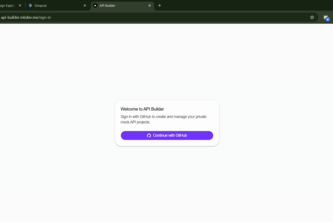
The company appears to be a solo developer project named API Builder, a browser-based API mocking platform for frontend developers. The author states it enables users to create REST APIs without backend code, with features like endpoint creation, response variants, and import/export functionality.
What changed: This is a self-reported hackathon submission describing an early-stage tool built in a short timeframe. There is no evidence of prior traction, revenue, or customer adoption.
The single most important open question: Is there any evidence that developers actually use this tool beyond the author's own development?
What The Product Actually Is
The description states: "API Builder is a browser-based API mocking platform for creating and hosting mock REST APIs without writing backend code."
It allows users to:
- Sign in with GitHub
- Create endpoints using GET, POST, PUT, PATCH, DELETE
- Configure HTTP status codes from 100 to 599
- Manage multiple response variants
- Simulate network delays
- Use dynamic placeholders (route/query parameters)
- Organize endpoints into collections
- Import/export projects as JSON
- Inspect logs
Inference: The tool is described as a frontend developer aid, not a backend service or infrastructure product.
Positioning & Claim Evolution
The author states: "As a developer, working on the frontend without any structured data is tiresome... That's why we built API Builder."
Claim: API Builder solves a real problem for frontend developers who need mock APIs during development.
Inference: The positioning is that of a developer tool to speed up frontend development by providing realistic mock endpoints.
The author also states: "This project establishes a strong foundation for future ideas such as GraphQL mocking support, WebSocket and Server-Sent Events support."
Claim: The tool will evolve into more comprehensive API testing/mock platforms.
Target Customer & ICP
The description states: "API Builder is a browser-based API mocking platform for creating and hosting mock REST APIs without writing backend code."
Inference: The primary customer appears to be frontend developers who need mock APIs during development or testing phases.
The author mentions: "We have built something that solves a real headache for frontend developers when creating interfaces."
Claim: The target is frontend developers working in environments where structured data is needed but not yet available.
Business Model & Pricing Evidence
Not evidenced. The description does not mention any pricing, monetization strategy, or business model.
Technical & Delivery Signals
The description states: "API Builder is built as a full-stack TypeScript application."
Technology stack declared:
- Next.js
- Tailwind CSS
- shadcn/ui
- TypeScript
- Better Auth (authentication)
- Hono (lightweight APIs)
- Drizzle ORM
- Neon PostgreSQL
- Zod (validation)
- Codex and GPT-5.6 (for planning/architecture)
Inference: The tool is built with modern web stack, suggesting attention to current development practices.
Traction & Maturity Signals
Not evidenced. There is no mention of:
- Users or customers
- Revenue or monetization
- Adoption metrics
- Product usage data
- Any form of traction beyond the author's own development
Competitive Context
Not evidenced. The description does not reference any competitors, market size, or competitive landscape.
Open Questions & Risks
- Solo developer project: Only one team member is mentioned (Mangesh Bhardwaj), which raises questions about scalability and long-term maintenance.
- No traction evidence: No customers, revenue, or usage data are provided.
- Unverified claims: All statements are self-reported and unverified.
- Hackathon project: This was submitted to a hackathon, suggesting it is an early prototype rather than a mature product.
Questions the description leaves open
- What specific problems do frontend developers face that this tool solves?
- Have you tested the tool with other developers or in real-world use cases?
- Are there any users or feedback from potential customers?
- How do you plan to monetize the platform if at all?
- What is your roadmap for product development beyond the current features?
Overall Assessment
Not evidenced. There is no information about funding, valuation, or investment interest.
Inference: This appears to be an early-stage hackathon project with no commercial traction or evidence of market demand. It may represent a promising idea but lacks any demonstrated product-market fit or business viability.
User Stories BotA demo video on every pull request
Get a demo video on every new feature
GitHub App that watches your pull requests and records a narrated, captioned demo.
Save time on demo prep and make informed decisions faster with a video walkthrough of every new feature.
Source
Submitted to the OpenAI 2026 hackathon on Devpost. Project home on Devpost. Back to the full gallery on Devpost.
This competitive analysis was produced by top-founders.com (opens in a new tab)
Generated by a language model from this project's public Devpost page — its tagline, the author's own write-up and any built-with tags listed there — as captured in August 2026. Short quotations are the author's words. It is an opinion on the idea as a business, not on the people behind it, and it reflects the description as published then. If the project has moved on, request a correction below. The analysis is not independent research and contains no verified traction, revenue or customer data.
An independent guide by KFG International LLC — not affiliated with, endorsed by, or connected to Devpost or OpenAI.