

Archive position — measured, not model output
0 likes on Devpost
2,263 of the 7,850 archived projects have more likes, and 5,587 share exactly 0 — so this project's #4,460 place in the like-ranked listing is a tie-break inside that group, not a ranking.
Projects (log scale)
Likes on Devpost. ▲ marks this project's group.
Show the figures
| Likes | Projects | Share of archive |
|---|---|---|
| 0 | 5,587 | 71.2% |
| 1 | 1,758 | 22.4% |
| 2 | 284 | 3.6% |
| 3–4 | 132 | 1.7% |
| 5–9 | 75 | 1.0% |
| 10+ | 14 | 0.2% |
 User Stories BotA demo video on every pull request
Get a demo video on every new feature
GitHub App that watches your pull requests and records a narrated, captioned demo.
Save time on demo prep and make informed decisions faster with a video walkthrough of every new feature.
Executive Summary
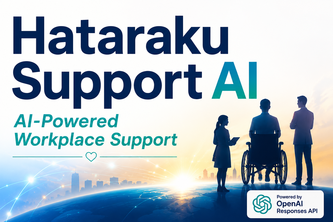
What the company appears to be: Hataraku Support AI is a self-reported AI-powered communication tool designed to help people with disabilities, employers, and support staff create better job matches by analyzing strengths, job tasks, and workplace accommodations.
What changed: The project was submitted as part of the OpenAI 2026 hackathon. It represents an early-stage prototype built using GPT-5.6 and Next.js, intended to support inclusive hiring and workplace communication.
The single most important open question: Is there evidence of traction or commercial interest from employment support organizations or companies that would use this tool?
What The Product Actually Is
The description states that Hataraku Support AI is an application that analyzes a person's strengths, challenges, preferred working conditions, and a company's job requirements. It generates structured suggestions including:
- Suitable job assignments
- Task breakdowns
- Reasonable workplace accommodations
- Discussion points for the individual, employer, and support staff
It is described as a communication support tool, not a medical diagnostic or hiring decision-making system.
Evidence: The author’s own write-up.
Inference: The product appears to be an AI-powered interface that processes user inputs and outputs structured recommendations using OpenAI's API. It is built with Next.js, React, TypeScript, and Tailwind CSS.
Positioning & Claim Evolution
The project claims to help people with disabilities, employers, and support staff communicate more effectively about job assignments and workplace accommodations.
It positions itself as a tool that supports inclusive hiring and collaboration rather than automating or replacing human judgment.
Evidence: The author’s own write-up, particularly the “Inspiration” and “What it does” sections.
Inference: The positioning is centered on responsible AI use in employment support contexts. It avoids making claims about medical diagnosis or hiring decisions.
Target Customer & ICP
The description states that Hataraku Support AI targets three groups:
- People with disabilities
- Employers
- Support staff
It is intended for use by employment support organizations and companies aiming to build more inclusive workplaces.
Evidence: The author’s own write-up, particularly the “Inspiration” and “What's next” sections.
Inference: The ICP likely includes employment support centers, HR departments, and disability inclusion teams within organizations. No specific customer segments or personas are detailed.
Business Model & Pricing Evidence
Not evidenced.
The description does not mention any pricing model, monetization strategy, or business model. It is unclear whether the tool will be offered as a SaaS product, a free service, or part of a larger platform.
Evidence: None provided.
Technical & Delivery Signals
The application was built using:
- OpenAI Responses API
- GPT-5.6
- Structured Outputs
- Next.js
- React
- TypeScript
- Tailwind CSS
- Vercel
It uses server-side management of the OpenAI API key to avoid exposure in the browser.
Evidence: The author’s own write-up, particularly “How we built it.”
Inference: The tool is a web-based application with structured AI outputs. It appears to be a prototype or MVP, not a production-ready product.
Traction & Maturity Signals
Not evidenced.
There is no mention of users, customers, revenue, or adoption. The project was submitted as part of a hackathon and has no indication of having moved beyond the prototype stage.
Evidence: None provided.
Competitive Context
Not evidenced.
The description does not reference existing tools or platforms in the disability employment support space, nor does it compare Hataraku Support AI to any competitors.
Evidence: None provided.
Open Questions & Risks
- Lack of traction or commercialization: The project is described as a hackathon submission with no evidence of real-world use or adoption.
- Unclear business model: No indication of how the tool will be monetized or scaled.
- Responsible AI claims without verification: While the team emphasizes responsible use, there is no evidence of ethical frameworks or governance in place.
- Prototype nature: The tool appears to be a proof-of-concept rather than a mature product.
Evidence: Self-reported description only.
Questions the description leaves open
- What specific employment support organizations or companies have expressed interest in using this tool?
- How is the AI output validated for accuracy and inclusivity?
- Are there any plans to integrate with existing HR or disability support platforms?
- What are the key performance indicators (KPIs) you would use to measure success?
- Has the team conducted any user research or testing with people with disabilities, employers, or support staff?
Overall Assessment
Not evidenced.
There is no evidence of revenue, customers, or traction to assess commercial viability. The project is described as a hackathon submission and lacks any indication of a path to market or product-market fit.
Evidence: Self-reported only.
Confidence level: Low. The description provides no data on commercial potential, user adoption, or financial metrics.
User Stories BotA demo video on every pull request
Get a demo video on every new feature
GitHub App that watches your pull requests and records a narrated, captioned demo.
Save time on demo prep and make informed decisions faster with a video walkthrough of every new feature.
Source
Submitted to the OpenAI 2026 hackathon on Devpost. Project home on Devpost. Back to the full gallery on Devpost.
This competitive analysis was produced by top-founders.com (opens in a new tab)
Generated by a language model from this project's public Devpost page — its tagline, the author's own write-up and any built-with tags listed there — as captured in August 2026. Short quotations are the author's words. It is an opinion on the idea as a business, not on the people behind it, and it reflects the description as published then. If the project has moved on, request a correction below. The analysis is not independent research and contains no verified traction, revenue or customer data.
An independent guide by KFG International LLC — not affiliated with, endorsed by, or connected to Devpost or OpenAI.