

Archive position — measured, not model output
1 like on Devpost
505 of the 7,850 archived projects have more likes, and 1,758 share exactly 1 — so this project's #536 place in the like-ranked listing is a tie-break inside that group, not a ranking.
Projects (log scale)
Likes on Devpost. ▲ marks this project's group.
Show the figures
| Likes | Projects | Share of archive |
|---|---|---|
| 0 | 5,587 | 71.2% |
| 1 | 1,758 | 22.4% |
| 2 | 284 | 3.6% |
| 3–4 | 132 | 1.7% |
| 5–9 | 75 | 1.0% |
| 10+ | 14 | 0.2% |
 User Stories BotA demo video on every pull request
Get a demo video on every new feature
GitHub App that watches your pull requests and records a narrated, captioned demo.
Save time on demo prep and make informed decisions faster with a video walkthrough of every new feature.
Executive Summary
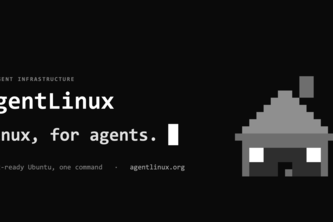
What the company appears to be: AgentLinux is a self-reported Linux-based plugin or tool designed to simplify the installation and management of AI agents and their frameworks on Linux systems. It was built as a hackathon project by one developer, Nikita Ivanov.
What changed: The author states that they built this tool in response to personal frustration with the complexity of installing AI agent frameworks like Codex and GSD, aiming for an experience similar to installing standard Linux packages such as vim or glibc. The tool includes a QA automation component built using Codex.
The single most important open question: Is there any evidence that AgentLinux has been adopted by users beyond its creator, or whether it functions as described in real-world conditions?
Note: This analysis is based entirely on the self-reported description provided by the author. No third-party verification, traction data, revenue figures, customer names, or independent sources are available.
What The Product Actually Is
The description states that AgentLinux is a "Linux plugin" which helps with provisioning parts of an agent harness on Linux distributions, including user configuration and installation of agents themselves.
It also includes a QA automation feature built using Codex, intended to test agent projects by iterating over fixed time periods and stopping when no new bugs are found within specific thresholds.
Inference: The tool appears to be a developer-focused utility for managing AI agent environments on Linux, with an emphasis on automating testing workflows. However, the exact nature of how it integrates into Linux systems or what constitutes its "plugin" form is not detailed.
Positioning & Claim Evolution
The author positions AgentLinux as a way to make installing AI agents as simple as installing standard Linux packages like vim and glibc.
They claim that they built it because there was nothing close to this functionality available, suggesting a gap in the market for such a tool.
Claim: The product aims to simplify agent installation and management on Linux.
Inference: This is a self-perception of utility rather than evidence of adoption or traction.
Target Customer & ICP
The description does not explicitly identify target customers or personas. It implies that the primary users are developers working with AI agents, particularly those using frameworks like Codex and GSD.
Claim: The tool targets developers managing AI agent environments.
Inference: No explicit segmentation or customer data is provided; this is inferred from context of use.
Business Model & Pricing Evidence
There is no evidence in the description regarding pricing, monetization strategies, or business model. The project was built as a hackathon submission and appears to be open-source or experimental in nature.
Not evidenced: No indication of revenue streams, pricing models, or commercial viability.
Technical & Delivery Signals
The author reports building the tool using technologies such as Claude Code, Codex, Docker, HTML, QEMU, Shell, and TypeScript. They also mention automating QA testing with Codex, iterating over time periods and stopping based on bug discovery thresholds.
Claim: The system uses Codex for QA automation.
Inference: Technical implementation details are sparse; the tool seems to be a prototype or proof-of-concept rather than a production-ready solution.
Traction & Maturity Signals
The description mentions that the project is rapidly growing in scope, and that testing efforts have become increasingly complex. It also reports that Codex surfaced 10 issues during an 11-hour run involving nearly 130 test ideas.
However, there is no evidence of user adoption, customer feedback, or product maturity beyond this single developer's experience.
Not evidenced: No data on users, customers, or real-world usage. The project remains unverified outside the author’s own development environment.
Competitive Context
The author states that they did not find anything close to AgentLinux when looking for existing solutions, implying a lack of direct competitors in this specific domain at the time of creation.
Claim: No similar tools were found.
Inference: This is based on the author’s subjective search and does not reflect actual competitive landscape or market presence.
Open Questions & Risks
- The tool is described as a hackathon project with no known users beyond the creator.
- There is no evidence of scalability, performance testing, or integration into broader systems.
- The QA automation relies heavily on Codex, which may limit its applicability if that service becomes unavailable or changes.
- No mention of security considerations, maintainability, or long-term support plans.
Open question: Lack of external validation or adoption suggests low confidence in real-world utility.
Questions the description leaves open
- What is the actual mechanism by which AgentLinux provisions agents on Linux systems?
- How does it differ from existing tools like Docker, virtual environments, or package managers?
- Have you tested this tool with other developers or teams beyond yourself?
- Is there any plan to make it publicly available or accessible to others?
- What are the limitations of the Codex-based QA automation in practice?
Overall Assessment
This is a self-reported hackathon project by one individual, with no evidence of traction, revenue, or customer adoption. The tool appears to be experimental and lacks verification beyond the author’s own account.
Assessment: Not suitable for investment or partnership consideration at this stage due to lack of evidence of product-market fit, user base, or commercial viability.
Confidence level: Low — based on minimal self-reported information only.
User Stories BotA demo video on every pull request
Get a demo video on every new feature
GitHub App that watches your pull requests and records a narrated, captioned demo.
Save time on demo prep and make informed decisions faster with a video walkthrough of every new feature.
Source
Submitted to the OpenAI 2026 hackathon on Devpost. Project home on Devpost. Back to the full gallery on Devpost.
This competitive analysis was produced by top-founders.com (opens in a new tab)
Generated by a language model from this project's public Devpost page — its tagline, the author's own write-up and any built-with tags listed there — as captured in August 2026. Short quotations are the author's words. It is an opinion on the idea as a business, not on the people behind it, and it reflects the description as published then. If the project has moved on, request a correction below. The analysis is not independent research and contains no verified traction, revenue or customer data.
An independent guide by KFG International LLC — not affiliated with, endorsed by, or connected to Devpost or OpenAI.