

Archive position — measured, not model output
0 likes on Devpost
2,263 of the 7,850 archived projects have more likes, and 5,587 share exactly 0 — so this project's #4,462 place in the like-ranked listing is a tie-break inside that group, not a ranking.
Projects (log scale)
Likes on Devpost. ▲ marks this project's group.
Show the figures
| Likes | Projects | Share of archive |
|---|---|---|
| 0 | 5,587 | 71.2% |
| 1 | 1,758 | 22.4% |
| 2 | 284 | 3.6% |
| 3–4 | 132 | 1.7% |
| 5–9 | 75 | 1.0% |
| 10+ | 14 | 0.2% |
 User Stories BotA demo video on every pull request
Get a demo video on every new feature
GitHub App that watches your pull requests and records a narrated, captioned demo.
Save time on demo prep and make informed decisions faster with a video walkthrough of every new feature.
Executive Summary
What the company appears to be
Hatch'd is an AI operator for marketing agencies that connects to where teams already work, learns from the actual record of how work flows, and automates parts of the operational loop — particularly those that are machine-checkable (factual) while preserving human judgment for creative or subjective tasks (taste). It is built as a self-contained system that ingests fragmented inputs from various tools and channels, normalizes them into a queue, and routes them with structured briefs. The system includes a gate where the operator reviews outputs before final approval.
What changed
The project description reflects a shift from traditional agent design — which assumes all steps are equally automatable — to one that splits the operator’s job into factual (verifiable) and taste-based (non-verifiable) components. This architecture is intended to build trust through objective validation early on, while reserving subjective decisions for human review.
Single most important open question
Is there evidence of real-world usage or adoption by marketing agencies? The description states the system was built for a single operator and tested over 10 mornings, but does not indicate whether this has been scaled beyond that limited context.
Note: All claims in this summary are based on the self-reported project description. No external verification is available.
What The Product Actually Is
The description states that Hatch'd is an AI operator for marketing agencies. It connects to where teams already work, learns from the actual record of how work flows, and automates parts of the operational loop — particularly those that are machine-checkable (factual) while preserving human judgment for creative or subjective tasks (taste).
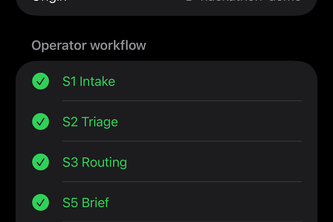
It processes inputs from fragmented sources such as project-tool bots, chat DMs, channels, email, and voice memos. These are normalized into a deduped work queue, with voice transcribed on ingest.
The system performs:
- Ingest & normalization
- Triage (type, client, medium, urgency, deadline)
- Routing + brief generation
- Gate for approval/rejection
- Factual oracles to verify correctness of deliverables
It is built using technologies including Kotlin, Swift, Python, OpenAI APIs, gRPC, SQLite, Slack SDK, and GitHub Actions.
Claim: The product is an AI operator that learns from real work records.
Evidence: Author’s write-up; no independent confirmation.
Inference: The system is designed to be modular and scalable across different agencies or workflows.
Justification: The description implies a framework for mapping subsystems, suggesting scalability beyond the initial use case.
Positioning & Claim Evolution
The author states that Hatch'd was inspired by observing how an art director actually works — not just what he says he does. They found that the real work is embedded in fragmented communications (DMs, voice memos, video cuts), not in structured briefs or tools.
They claim:
- Traditional agents fail because they treat every step as equally automatable.
- The solution splits the operator’s job into factual and taste-based halves.
- Factual steps are verified by oracles; taste steps are handled through a gate that forces structured reasons for rejections.
- Trust is earned through measurable metrics like reject rate reduction over time.
This evolution moves away from generic AI automation toward a more nuanced approach based on empirical observation of operator behavior and workflow.
Claim: The positioning is rooted in empirical analysis of real-world workflows.
Evidence: Author’s write-up; no external validation.
Inference: This positions Hatch'd as a specialized tool for high-trust, low-friction automation within creative teams.
Justification: By focusing on factual verifiability and structured feedback loops, it aims to reduce human oversight over time.
Target Customer & ICP
The description states that Hatch'd is built for marketing agencies, specifically targeting operators who manage complex, multi-client workflows involving editors across multiple locations.
It targets:
- Creative studio owners
- Art directors or agency leaders managing cross-regional teams
- Teams with fragmented communication channels and high-volume inbound work
The system is designed to integrate into existing workflows where operators already use tools like Slack, project management bots, email, and voice memos.
Claim: The target customer is marketing agencies with distributed teams.
Evidence: Author’s write-up; no explicit segmentation or customer data provided.
Inference: The ICP likely includes mid-to-large-sized creative studios with multiple clients and geographically dispersed editors.
Justification: The complexity of the described workflow suggests a need for coordination across time zones and communication styles.
Business Model & Pricing Evidence
There is no mention of pricing, business model, or monetization strategy in the description. The project appears to be a hackathon submission, not a commercial product.
Claim: No evidence of pricing or business model.
Evidence: Author’s write-up; no financial details provided.
Technical & Delivery Signals
The system is built using:
- Android SDK 34
- Kotlin, Swift, Python
- OpenAI APIs (GPT-5.6 Terra Medium)
- gRPC, SQLite, Slack SDK
- GitHub Actions for CI/CD
- Protocol buffers, pytest, websockets, XcodeGen, XCTest
It handles:
- Ingestion of voice, text, video, and image-based signals
- Structured extraction using GPT-5.6
- Routing and brief generation tailored to individuals
- Factual verification via oracles (e.g., compliance checks, version control)
- A gate that requires structured reasons for rejections
Claim: The system is technically robust and integrates with common tools.
Evidence: Technology stack listed; no independent validation.
Inference: The architecture supports both automation and human-in-the-loop decision-making.
Justification: Use of oracles, gates, and structured feedback suggests a hybrid model.
Traction & Maturity Signals
The description mentions:
- Testing over 10 mornings
- Processing 65,491 messages from one operator
- Handling 11,154 files with full tracking
- Mapping ten subsystems for future development
However, there is no evidence of:
- Revenue or customer base
- Live deployment beyond the hackathon
- Adoption by other agencies
- Any measurable impact on productivity or time saved
Claim: Limited internal testing and validation.
Evidence: Author’s write-up; no external metrics.
Inference: The system is in early development stage, likely post-hackathon prototype.
Justification: No mention of production use or customer feedback beyond the single operator.
Competitive Context
The description does not reference competitors directly. However, it implies a niche within AI agents for creative workflows — particularly those that attempt to automate real-world operations rather than just generate content.
It contrasts itself with:
- Generic AI agents that assume all steps are automatable
- Tools that rely on structured inputs or templates
Claim: The product addresses a gap in current AI agent design.
Evidence: Author’s write-up; no competitive analysis provided.
Inference: It competes with tools focused on content creation or task automation, but not specifically with workflow orchestration for creative teams.
Justification: The focus on factual vs. taste-based workflows is unique and not clearly described in the market.
Open Questions & Risks
- No real-world traction or adoption beyond a single operator.
- Unclear scalability — no evidence of how it would scale to multiple agencies or users.
- Highly customized architecture based on one operator’s behavior; may not generalize well.
- Limited data on performance metrics beyond internal testing.
- No pricing, monetization, or go-to-market strategy.
- Self-reported nature — all claims are unverified.
Claim: Risk of over-engineering for a narrow use case.
Evidence: Author’s write-up; no external validation.
Inference: The system may not be easily adaptable to other industries or workflows without significant rework.
Justification: The architecture is tied to one specific operator's patterns and feedback loop.
Questions the description leaves open
- What was the exact scope of the 10-day testing period? Was it representative of typical agency operations?
- How many agencies or operators have you tested this with beyond the initial case study?
- Can you provide any metrics on time saved or efficiency gains from using Hatch'd?
- Is there a plan to expand beyond voice, text, and image inputs into other formats like PDFs or spreadsheets?
- What are the technical challenges in scaling this system for multiple users or agencies?
- How do you intend to monetize this product? Are there any pilot customers or partnerships in place?
- What is the current level of autonomy (i.e., how much human intervention is required)?
- How does the system handle edge cases where inputs are ambiguous or incomplete?
Overall Assessment
Not evidenced.
Claim: No investment or partnership potential can be determined.
Evidence: Author’s write-up; no financials, traction, or commercial viability data provided.
Inference: The project shows promise in solving a specific problem but lacks the evidence to support a commercial or strategic investment decision.
Justification: Without real-world usage, measurable impact, or clear monetization strategy, it remains an experimental concept.
User Stories BotA demo video on every pull request
Get a demo video on every new feature
GitHub App that watches your pull requests and records a narrated, captioned demo.
Save time on demo prep and make informed decisions faster with a video walkthrough of every new feature.
Source
Submitted to the OpenAI 2026 hackathon on Devpost. Project home on Devpost. Back to the full gallery on Devpost.
This competitive analysis was produced by top-founders.com (opens in a new tab)
Generated by a language model from this project's public Devpost page — its tagline, the author's own write-up and any built-with tags listed there — as captured in August 2026. Short quotations are the author's words. It is an opinion on the idea as a business, not on the people behind it, and it reflects the description as published then. If the project has moved on, request a correction below. The analysis is not independent research and contains no verified traction, revenue or customer data.
An independent guide by KFG International LLC — not affiliated with, endorsed by, or connected to Devpost or OpenAI.