

Archive position — measured, not model output
0 likes on Devpost
2,263 of the 7,850 archived projects have more likes, and 5,587 share exactly 0 — so this project's #4,464 place in the like-ranked listing is a tie-break inside that group, not a ranking.
Projects (log scale)
Likes on Devpost. ▲ marks this project's group.
Show the figures
| Likes | Projects | Share of archive |
|---|---|---|
| 0 | 5,587 | 71.2% |
| 1 | 1,758 | 22.4% |
| 2 | 284 | 3.6% |
| 3–4 | 132 | 1.7% |
| 5–9 | 75 | 1.0% |
| 10+ | 14 | 0.2% |
 User Stories BotA demo video on every pull request
Get a demo video on every new feature
GitHub App that watches your pull requests and records a narrated, captioned demo.
Save time on demo prep and make informed decisions faster with a video walkthrough of every new feature.
Executive Summary
What the company appears to be
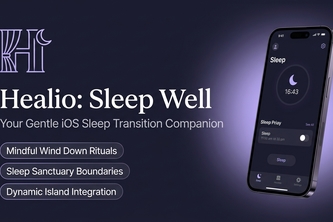
Healio: Sleep Well is a self-reported iOS-native sleep-transition app designed to help users slow down before bed through a visual "Curtain" ritual, offering two modes — Gentle (awareness without restriction) and Strict (firm boundary with selected app access). The project was submitted as part of the OpenAI 2026 hackathon.
What changed
The author describes an evolution from typical sleep blockers that begin with restriction to a gentler middle ground where users first experience a visible bedtime transition before choosing how much structure they want for the night.
Single most important open question
Is there any evidence of user adoption, revenue, or traction beyond the prototype and hackathon submission?
What The Product Actually Is
The description states that Healio is:
- A native iOS sleep-transition companion
- Built with SwiftUI and Apple-native capabilities (UserNotifications, ActivityKit, HealthKit, FamilyControls)
- Designed to support both Gentle and Strict modes of app restriction
- Includes features such as:
- Named sleep windows (night sleep, optional naps)
- Visual Curtain ritual before bedtime
- Bedtime Prep experience with closing-curtain visual
- Sleep calendar displaying HealthKit records by duration
- Editable profile and single permissions area for notifications, health data, app protection, and Live Activity status
Inference The product is an iOS app built using Apple’s native frameworks and tools, leveraging system APIs like FamilyControls and HealthKit. It uses a visual metaphor (the Curtain) to guide users into sleep.
Positioning & Claim Evolution
The author claims:
- Healio explores a "gentler middle ground" between traditional sleep products that explain the night afterward and blockers that start with restriction.
- The core idea is to make the transition into rest visible before the boundary arrives.
- It introduces a "Curtain" ritual as a prelude to sleep, allowing users time to slow down before deciding whether they need a gentle reminder or a firm boundary.
Inference The positioning shifts from generic sleep aids to a more intentional, ritualistic approach that emphasizes user agency and awareness over punitive control.
Target Customer & ICP
The description does not explicitly state:
- Who the target customer is
- Whether there’s an identified ICP (Ideal Customer Profile)
- Any segmentation or persona development
Not evidenced No evidence of defined customer personas, market research, or user interviews.
Business Model & Pricing Evidence
The description states:
- Healio is a native iOS app built for personal use
- It includes features like sleep calendar and HealthKit integration
- There is no mention of monetization strategy, pricing model, or revenue streams
Inference The business model remains undefined. No evidence of paid features, subscriptions, or commercialization plans.
Technical & Delivery Signals
The description states:
- Built with SwiftUI, JavaScript, Python, Swift, Figma, Xcode
- Uses Apple-native technologies: UserNotifications, ActivityKit, HealthKit, FamilyControls, ManagedSettings, DeviceActivity
- Includes an interactive browser walkthrough for judges to explore the product without rebuilding
- The author used GPT-5.6 with Codex throughout development
Inference The technical stack is consistent with native iOS development and Apple ecosystem integration. The use of AI tools suggests rapid prototyping but does not indicate scalability or long-term engineering strategy.
Traction & Maturity Signals
The description states:
- This was submitted to the OpenAI 2026 hackathon
- A simulator prototype demonstrates the complete experience and interaction model
- Next step is a signed physical-device build for validation of real-world behavior (Family Controls, HealthKit, notifications, Live Activity)
Not evidenced No evidence of user adoption, downloads, usage metrics, or post-hackathon traction.
Competitive Context
The description does not mention:
- Competitors in the sleep or digital wellness space
- How Healio differentiates from existing solutions
- Market size or competitive positioning
Not evidenced No competitive analysis or market context provided.
Open Questions & Risks
Key risks and open questions based on the self-reported information:
- The project is described as a hackathon submission with no verified users or revenue
- No evidence of product-market fit, customer feedback, or traction beyond prototype
- The use of Apple’s system APIs (FamilyControls) may limit functionality if not fully supported in all iOS versions or devices
- Heavy reliance on AI tools for development raises questions about long-term maintainability and ownership
- Lack of clarity around monetization or business model
Inference Without any evidence of traction, revenue, or user engagement, the project appears to be an early-stage concept with no commercial viability demonstrated.
Questions the description leaves open
- What is your plan for validating the product with real users beyond the prototype?
- Are you planning to pursue a paid version or subscription model? If so, how will it be priced?
- How do you intend to scale beyond a single developer and a hackathon-level prototype?
- Have you considered how Apple’s privacy policies might affect long-term functionality of Strict Mode?
- What are your plans for expanding beyond iOS, if any?
Overall Assessment
The description states that Healio is a self-reported iOS app built as part of a hackathon. There is no evidence of:
- Revenue
- Customers
- Traction
- Product-market fit
- Commercialization strategy
Inference Based on the self-reported nature of the project and lack of verified data, this appears to be an early-stage idea or prototype with no demonstrated commercial potential at this time.
User Stories BotA demo video on every pull request
Get a demo video on every new feature
GitHub App that watches your pull requests and records a narrated, captioned demo.
Save time on demo prep and make informed decisions faster with a video walkthrough of every new feature.
Source
Submitted to the OpenAI 2026 hackathon on Devpost. Project home on Devpost. Back to the full gallery on Devpost.
This competitive analysis was produced by top-founders.com (opens in a new tab)
Generated by a language model from this project's public Devpost page — its tagline, the author's own write-up and any built-with tags listed there — as captured in August 2026. Short quotations are the author's words. It is an opinion on the idea as a business, not on the people behind it, and it reflects the description as published then. If the project has moved on, request a correction below. The analysis is not independent research and contains no verified traction, revenue or customer data.
An independent guide by KFG International LLC — not affiliated with, endorsed by, or connected to Devpost or OpenAI.