

Archive position — measured, not model output
0 likes on Devpost
2,263 of the 7,850 archived projects have more likes, and 5,587 share exactly 0 — so this project's #4,466 place in the like-ranked listing is a tie-break inside that group, not a ranking.
Projects (log scale)
Likes on Devpost. ▲ marks this project's group.
Show the figures
| Likes | Projects | Share of archive |
|---|---|---|
| 0 | 5,587 | 71.2% |
| 1 | 1,758 | 22.4% |
| 2 | 284 | 3.6% |
| 3–4 | 132 | 1.7% |
| 5–9 | 75 | 1.0% |
| 10+ | 14 | 0.2% |
 User Stories BotA demo video on every pull request
Get a demo video on every new feature
GitHub App that watches your pull requests and records a narrated, captioned demo.
Save time on demo prep and make informed decisions faster with a video walkthrough of every new feature.
Executive Summary
What the company appears to be
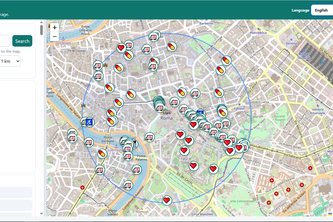
HealthRadar is a self-reported privacy-first web application that allows users to discover health-related resources near a chosen location without requiring an account. It leverages open geographic data sources and runs as a static progressive web app.
What changed
The project was submitted to the OpenAI 2026 hackathon, indicating a development effort focused on building a tool using open-source mapping technologies and AI-assisted development tools.
Single most important open question
Is there any evidence of user adoption or traction beyond the author's own submission?
What The Product Actually Is
The description states that HealthRadar is a privacy-first web app for discovering health-related resources near a chosen location. It supports searching by address, current position, or map selection and displays results on an interactive map.
It allows filtering by category (e.g., pharmacies, hospitals, clinics, doctors, emergency services, AEDs), viewing results on a map, and exporting them as CSV or GeoJSON. Searches can also be shared via URL.
The app uses open geographic data sources, including OpenStreetMap tiles, Nominatim, and Overpass API, and runs as a static progressive web app.
Evidence
- The description states: “HealthRadar is a privacy-first web app for discovering health-related resources near a chosen location.”
- It supports searching by address, current position, or map selection.
- Results are displayed on an interactive map with filtering and export options.
- Built using TypeScript, Vite, Leaflet.js, OpenStreetMap, Nominatim, Overpass API.
Inference The app is designed to be lightweight and functional without requiring user accounts or AI features for runtime decisions.
Positioning & Claim Evolution
The description states that HealthRadar provides a “simple, account-free starting point” for finding local health information when users are traveling, in new neighborhoods, or seeking nearby AEDs.
It emphasizes privacy-first design, and does not claim to replace emergency services or medical advice.
Evidence
- “HealthRadar provides one simple, account-free starting point.”
- “The app uses open geographic data sources and runs as a static progressive web app. It does not require an account or an AI feature to function.”
Inference Positioning centers on accessibility, privacy, and ease-of-use for non-account-holding users seeking local health resources.
Target Customer & ICP
The description does not explicitly define target customers or ideal customer profiles (ICP). It implies a general audience looking for nearby health services, including travelers, newcomers to an area, or individuals seeking AEDs.
Evidence
- “When someone needs local health information—while travelling, in a new neighbourhood, or when looking for a nearby AED—useful places are often spread across separate maps and services.”
Inference The ICP likely includes individuals who need quick access to health resources without account registration, but no specific demographic or behavioral segmentation is stated.
Business Model & Pricing Evidence
There is no evidence of pricing or business model in the description. The app is described as a static PWA with no account requirement and no mention of monetization strategies.
Evidence
- “It does not require an account or an AI feature to function.”
- No mention of subscriptions, fees, partnerships, or revenue streams.
Inference The project appears to be a prototype or hackathon submission without a defined business model or pricing structure.
Technical & Delivery Signals
HealthRadar is built with TypeScript, Vite, Leaflet.js, OpenStreetMap, Nominatim, Overpass API, and runs as a progressive web app. It includes browser caching, service workers, unit tests, and uses AI tools (Codex, GPT-5.6) for development.
Evidence
- “Built with TypeScript, Vite, Leaflet, OpenStreetMap tiles, Nominatim, and the Overpass API.”
- “Includes browser caching, multiple Overpass endpoints, a service worker, and unit tests for distance calculations, data parsing, scoring, and URL state.”
- “Codex and GPT-5.6 were used throughout development to accelerate the TypeScript implementation…”
Inference The app is technically sound for its intended use case, leveraging open-source mapping APIs and modern web technologies. AI was used in development but not at runtime.
Traction & Maturity Signals
There is no evidence of traction or maturity beyond the author’s own submission to a hackathon. No user data, customer base, or performance metrics are provided.
Evidence
- Submitted to the OpenAI 2026 hackathon.
- No mention of users, downloads, usage statistics, or product adoption.
Inference The project is in an early stage, likely a prototype or proof-of-concept, with no demonstrated market traction.
Competitive Context
The description does not provide information about competitors or the competitive landscape. It does not reference similar tools or platforms offering comparable functionality.
Evidence
- No mention of existing tools or platforms that offer similar health resource discovery.
Inference No competitive context is evident in the provided description.
Open Questions & Risks
- No traction or revenue: The project appears to be a hackathon submission with no evidence of adoption.
- Unverified claims: All statements are self-reported and unverified.
- No monetization strategy: No indication of how the product will generate value or revenue.
- Limited scope: The app is built for discovery only, not for direct interaction or care delivery.
Evidence
- Submitted to a hackathon; no user data or adoption metrics.
- No pricing, partnerships, or business model described.
- Not designed for emergency response or medical care.
Questions the description leaves open
- What is the intended path from prototype to product?
- Are there any plans for monetization or user engagement beyond the current functionality?
- How does the team plan to scale access to health data and improve coverage of open-source resources?
- Has the app been tested with real users, or is it purely a development exercise?
- What are the limitations in terms of data accuracy and availability across regions?
Overall Assessment
Not evidenced: There is no evidence of revenue, customers, traction, or a clear business model to support an investment or partnership decision.
The project appears to be a self-reported hackathon submission, built with open-source tools and AI development assistance. It does not demonstrate product-market fit, user adoption, or commercial viability.
Confidence level: Low — based entirely on self-reported information without any independent verification or traction data.
User Stories BotA demo video on every pull request
Get a demo video on every new feature
GitHub App that watches your pull requests and records a narrated, captioned demo.
Save time on demo prep and make informed decisions faster with a video walkthrough of every new feature.
Source
Submitted to the OpenAI 2026 hackathon on Devpost. Project home on Devpost. Back to the full gallery on Devpost.
This competitive analysis was produced by top-founders.com (opens in a new tab)
Generated by a language model from this project's public Devpost page — its tagline, the author's own write-up and any built-with tags listed there — as captured in August 2026. Short quotations are the author's words. It is an opinion on the idea as a business, not on the people behind it, and it reflects the description as published then. If the project has moved on, request a correction below. The analysis is not independent research and contains no verified traction, revenue or customer data.
An independent guide by KFG International LLC — not affiliated with, endorsed by, or connected to Devpost or OpenAI.