

Archive position — measured, not model output
0 likes on Devpost
2,263 of the 7,850 archived projects have more likes, and 5,587 share exactly 0 — so this project's #4,467 place in the like-ranked listing is a tie-break inside that group, not a ranking.
Projects (log scale)
Likes on Devpost. ▲ marks this project's group.
Show the figures
| Likes | Projects | Share of archive |
|---|---|---|
| 0 | 5,587 | 71.2% |
| 1 | 1,758 | 22.4% |
| 2 | 284 | 3.6% |
| 3–4 | 132 | 1.7% |
| 5–9 | 75 | 1.0% |
| 10+ | 14 | 0.2% |
 User Stories BotA demo video on every pull request
Get a demo video on every new feature
GitHub App that watches your pull requests and records a narrated, captioned demo.
Save time on demo prep and make informed decisions faster with a video walkthrough of every new feature.
Executive Summary
Company: HealthTwin Guardian AI
Self-reported basis: The entire analysis is based on a single project description submitted by the company to the OpenAI 2026 hackathon on Devpost. No independent verification, archived evidence or third-party data are available.
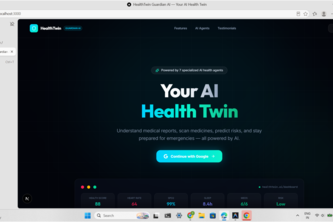
What it appears to be: A healthcare application built as a hackathon project that integrates AI for medical report analysis, medicine recognition, multilingual support and preventive care. It is described as an “AI-powered Digital Health Twin” with features like a dashboard, emergency SOS, and family health management.
What changed: The project was submitted to a hackathon — this is the only change evidenced in the description.
Single most important open question: Is there any evidence of real-world usage, revenue, or customer traction beyond the hackathon submission?
What The Product Actually Is
The description states that HealthTwin Guardian AI is an application built with Next.js, React, Tailwind CSS, and various AI services including Google Gemini 2.5 Flash, Groq Llama 3.3, and OpenAI Text-to-Speech. It includes features such as:
- AI Medical Report Analyzer
- Medicine Scanner
- Personalized Health Assistant
- Multilingual Healthcare Support
- Family Health Management
- Hospital Recommendation System
- Travel Health Assistant
- Emergency SOS
- Modern Healthcare Dashboard
The application is described as a full-stack platform deployed on Vercel, using PostgreSQL and Supabase for backend services.
Evidence: Self-reported by the author. No independent verification or demonstration of functionality beyond the project submission.
Positioning & Claim Evolution
The tagline states:
“HealthTwin Guardian AI – Making quality healthcare accessible through AI-powered medical insights, medicine recognition, multilingual assistance, and preventive care.”
The description further claims:
- It is an “AI-powered Digital Health Twin”
- It supports multilingual conversations
- It provides a dashboard for modern healthcare management
- It integrates with wearable devices in its future roadmap
Inferences:
- The product positions itself as a consumer-facing health assistant.
- It aims to democratize access to healthcare through AI.
- It is described as a platform that could evolve into a full ecosystem of health tools.
Claim vs. Fact: All claims are self-reported and unverified.
Target Customer & ICP
The description does not explicitly define the target customer or ideal customer profile (ICP). It mentions:
- Family Health Management
- Travel Health Assistant
- Emergency SOS
These suggest a consumer-facing audience, but no segmentation or targeting is described.
Evidence: Not evidenced. No mention of specific user personas, demographics, or use cases beyond general healthcare support.
Business Model & Pricing Evidence
There is no evidence in the description of:
- Revenue model
- Pricing strategy
- Monetization approach
- Customer acquisition costs
- Sales process or go-to-market plan
Evidence: Not evidenced. The project is described as a hackathon submission with no commercial structure.
Technical & Delivery Signals
The project was built using:
- Frontend: Next.js, React, Tailwind CSS, Framer Motion
- Authentication: Clerk
- AI Services: Google Gemini 2.5 Flash, Groq Llama 3.3, Groq Whisper, OpenAI Text-to-Speech
- Backend: REST APIs, PostgreSQL, Supabase
- Deployment: Vercel
It was successfully deployed and is described as responsive.
Inferences:
- The team has experience with modern full-stack development.
- It integrates multiple AI models into a single platform.
- It uses cloud infrastructure for deployment.
Evidence: Self-reported. No evidence of production use, scalability or performance data.
Traction & Maturity Signals
The project was submitted to the OpenAI 2026 hackathon and is described as:
- Built in a short timeframe (hackathon)
- Deployed successfully
- Demonstrated functionality across multiple features
No evidence of:
- Users or customers
- Revenue or monetization
- Product-market fit
- Growth metrics
- Adoption or retention data
Evidence: Not evidenced. The only signal is that it was submitted to a hackathon.
Competitive Context
The description does not mention any competitors or market positioning relative to others in the healthcare AI space.
Evidence: Not evidenced. No competitive analysis, market size, or differentiation strategy provided.
Open Questions & Risks
- Unverified claims: All features and capabilities are self-reported.
- No traction or revenue: The project is a hackathon submission with no evidence of real-world usage.
- Lack of customer data: No evidence of users, feedback, or adoption.
- Ambiguity in business model: No indication of how the product will monetize or scale.
- Technical risks: Healthcare AI applications require high accuracy and regulatory compliance — these are not addressed.
Inferences:
- The project is early-stage and unproven.
- It may lack real-world validation or commercial viability.
- Regulatory, safety, and ethical concerns in healthcare AI are not discussed.
Questions the description leaves open
- What specific healthcare use cases have you validated with users?
- How do you plan to ensure accuracy and safety of AI medical insights?
- Have you considered regulatory compliance (e.g., HIPAA, GDPR)?
- What is your go-to-market strategy for reaching end-users or healthcare providers?
- Are there any pilot programs or partnerships in development?
- What are the key assumptions behind the product roadmap?
- How do you plan to monetize this platform?
Overall Assessment
Not evidenced: There is no evidence of revenue, customers, traction, or commercial viability beyond a hackathon submission.
Confidence level: Low. The project is described as a prototype with no independent validation.
Assessment: At this stage, HealthTwin Guardian AI appears to be an early-stage idea or proof-of-concept. It lacks any evidence of real-world adoption, revenue, or scalability. Any investment or partnership would require further due diligence into product-market fit, user feedback, and commercial strategy.
User Stories BotA demo video on every pull request
Get a demo video on every new feature
GitHub App that watches your pull requests and records a narrated, captioned demo.
Save time on demo prep and make informed decisions faster with a video walkthrough of every new feature.
Source
Submitted to the OpenAI 2026 hackathon on Devpost. Project home on Devpost. Back to the full gallery on Devpost.
This competitive analysis was produced by top-founders.com (opens in a new tab)
Generated by a language model from this project's public Devpost page — its tagline, the author's own write-up and any built-with tags listed there — as captured in August 2026. Short quotations are the author's words. It is an opinion on the idea as a business, not on the people behind it, and it reflects the description as published then. If the project has moved on, request a correction below. The analysis is not independent research and contains no verified traction, revenue or customer data.
An independent guide by KFG International LLC — not affiliated with, endorsed by, or connected to Devpost or OpenAI.