

Archive position — measured, not model output
1 like on Devpost
505 of the 7,850 archived projects have more likes, and 1,758 share exactly 1 — so this project's #542 place in the like-ranked listing is a tie-break inside that group, not a ranking.
Projects (log scale)
Likes on Devpost. ▲ marks this project's group.
Show the figures
| Likes | Projects | Share of archive |
|---|---|---|
| 0 | 5,587 | 71.2% |
| 1 | 1,758 | 22.4% |
| 2 | 284 | 3.6% |
| 3–4 | 132 | 1.7% |
| 5–9 | 75 | 1.0% |
| 10+ | 14 | 0.2% |
 User Stories BotA demo video on every pull request
Get a demo video on every new feature
GitHub App that watches your pull requests and records a narrated, captioned demo.
Save time on demo prep and make informed decisions faster with a video walkthrough of every new feature.
Executive Summary
Project: AgentVille
Source: Author-supplied self-description from Devpost submission for OpenAI 2026 hackathon
Analysis Basis: Self-reported only — no external verification, no revenue, customer or traction data
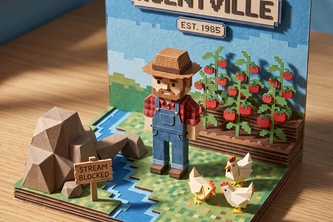
AgentVille is described as a small voxel-style game inspired by Farmville, designed as an educational tool to teach users how to write instructions for AI agents. The project was built in a weekend using Codex 5.6 Sol in Ultra mode, with the author stating that idea, PRD and implementation were all made with Codex. It is positioned as a playful introduction to AI agent instruction, with aspirations toward a larger Duolingo-inspired version.
Key Open Question: Is there evidence of user engagement or adoption beyond the single developer's weekend effort?
What The Product Actually Is
The description states:
- AgentVille is a "small voxel style farmville-inspired game"
- It is turned into an "Educational tool to learn the user how to write instructions for AI Agents"
Inferred from the author’s own words, it is not clear whether this is a playable prototype or a conceptual framework. The project was built using Codex 5.6 Sol in Ultra mode and includes technologies like canvas, CSS3, HTML5, JavaScript, Node.js, OpenAI, GitHub, and Godot.
Evidence:
- The author describes the product as a "small voxel style farmville-inspired game"
- It is described as an educational tool for AI agent instruction
- Built with Codex 5.6 Sol in Ultra mode
Inference:
- The project appears to be a prototype or proof-of-concept, not a finished product
Positioning & Claim Evolution
The description states:
- Tagline: “Teach Bert to think like an agent observe evidence, make a choice, act in a voxel farm, debug failure, and prove the world changed... all in 5 playful minutes.”
- The project is described as an educational tool for AI agents
- The author claims it was built in a weekend using Codex
Evidence:
- The tagline suggests a playful, interactive learning experience
- The claim of teaching users how to write instructions for AI agents is central to the positioning
- The author states that idea, PRD and implementation were all made with Codex
Inference:
- The project is positioned as an experimental or exploratory tool, not a commercial product
- It may be intended to demonstrate a new way of interacting with AI agents
Target Customer & ICP
The description states:
- AgentVille is an educational tool for users who want to learn how to write instructions for AI agents
- The author mentions that it was built in a weekend and is not yet shippable
Evidence:
- The target audience is described as learners or users interested in AI agent instruction
- No specific customer segments, personas or use cases are detailed
Inference:
- The ICP is likely early-stage developers or students exploring AI agent interactions
- There is no evidence of a defined customer base or user feedback
Business Model & Pricing Evidence
The description states:
- AgentVille is an educational tool built in a weekend
- It is described as a prototype, not a commercial product
- The author mentions aspirations for a larger Duolingo-inspired version
Evidence:
- No pricing model or revenue streams are mentioned
- No business model is described beyond the educational purpose
Inference:
- There is no evidence of a monetization strategy or business model at this stage
- The project appears to be experimental, not commercial
Technical & Delivery Signals
The description states:
- Built with Codex 5.6 Sol in Ultra mode
- Technologies used include canvas, CSS3, HTML5, JavaScript, Node.js, OpenAI, GitHub, and Godot
- The author claims that idea, PRD and implementation were all made with Codex
Evidence:
- The project was built using AI-assisted development tools (Codex)
- Technologies listed suggest a web-based or game-like interface
- The author used Codex for the entire process from idea to implementation
Inference:
- The project is likely a prototype or proof-of-concept, not a scalable product
- The use of Codex suggests an experimental approach to development
Traction & Maturity Signals
The description states:
- Built in a weekend
- Not yet shippable
- The author is proud of completing it in a short time
Evidence:
- No user engagement, adoption or usage data is provided
- The project is described as incomplete and not ready for shipping
- No metrics or feedback from users are mentioned
Inference:
- There is no evidence of traction or user engagement
- The project is at an early stage of development
Competitive Context
The description states:
- AgentVille is inspired by Farmville
- It aims to be a Duolingo-inspired educational tool for AI agents
- No direct competitors are mentioned
Evidence:
- The author references Farmville and Duolingo as inspirations
- No mention of existing tools or platforms in the AI agent instruction space
Inference:
- There is no evidence of competitive analysis or market positioning
- The project appears to be standalone, not part of an existing ecosystem
Open Questions & Risks
The description states:
- Built in a weekend
- Not yet shippable
- No revenue, customer or traction data
Evidence:
- The project is described as incomplete and experimental
- No evidence of user feedback or market validation
Inference:
- Risk of misalignment with actual user needs or market demand
- Lack of commercial viability or scalability
- No evidence of a sustainable path to product-market fit
Questions the description leaves open
- What specific learning outcomes are you trying to achieve with AgentVille?
- Have you tested the educational tool with any users, and if so, what feedback did you receive?
- How do you plan to scale beyond a weekend prototype into a shippable product?
- What is your vision for monetization or long-term business model?
- Are there any existing tools or platforms in the AI agent instruction space that you are aware of?
Overall Assessment
The description states:
- AgentVille is a weekend project built with Codex
- It is described as an educational tool for AI agents
- The author has no intention to commercialize it at this time
Evidence:
- No revenue, customer or traction data are provided
- The project is not yet shippable
- No business model or monetization strategy is evident
Inference:
- At this stage, AgentVille is a prototype with no clear path to investment or partnership
- It may be an experimental idea with potential for future development, but lacks evidence of traction or commercial viability
Assessment:
Not evidenced as a viable investment or partnership opportunity at this time.
User Stories BotA demo video on every pull request
Get a demo video on every new feature
GitHub App that watches your pull requests and records a narrated, captioned demo.
Save time on demo prep and make informed decisions faster with a video walkthrough of every new feature.
Source
Submitted to the OpenAI 2026 hackathon on Devpost. Project home on Devpost. Back to the full gallery on Devpost.
This competitive analysis was produced by top-founders.com (opens in a new tab)
Generated by a language model from this project's public Devpost page — its tagline, the author's own write-up and any built-with tags listed there — as captured in August 2026. Short quotations are the author's words. It is an opinion on the idea as a business, not on the people behind it, and it reflects the description as published then. If the project has moved on, request a correction below. The analysis is not independent research and contains no verified traction, revenue or customer data.
An independent guide by KFG International LLC — not affiliated with, endorsed by, or connected to Devpost or OpenAI.