

Archive position — measured, not model output
1 like on Devpost
505 of the 7,850 archived projects have more likes, and 1,758 share exactly 1 — so this project's #544 place in the like-ranked listing is a tie-break inside that group, not a ranking.
Projects (log scale)
Likes on Devpost. ▲ marks this project's group.
Show the figures
| Likes | Projects | Share of archive |
|---|---|---|
| 0 | 5,587 | 71.2% |
| 1 | 1,758 | 22.4% |
| 2 | 284 | 3.6% |
| 3–4 | 132 | 1.7% |
| 5–9 | 75 | 1.0% |
| 10+ | 14 | 0.2% |
 User Stories BotA demo video on every pull request
Get a demo video on every new feature
GitHub App that watches your pull requests and records a narrated, captioned demo.
Save time on demo prep and make informed decisions faster with a video walkthrough of every new feature.
Executive Summary
What the company appears to be
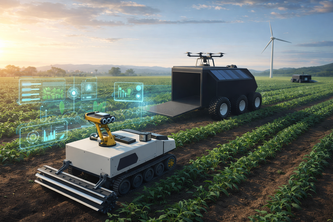
AgriNova is an AI-powered autonomous robot designed for agricultural use, intended to automate crop monitoring, soil analysis, and precision irrigation. It is described as a self-contained system powered by solar energy, using sensors, drones, and data visualization tools.
What changed
The project was submitted to the OpenAI 2026 hackathon, indicating it is in an early-stage development phase. No commercial traction or revenue has been reported.
Single most important open question
Is there any evidence of real-world testing, pilot deployment, or customer feedback that would indicate whether AgriNova's concept can be scaled beyond a prototype?
What The Product Actually Is
The description states that AgriNova is an AI-powered autonomous robot for agriculture. It performs:
- Crop monitoring
- Soil analysis
- Precision irrigation
It uses:
- Smart sensors (soil moisture, temperature, nutrients)
- Solar power
- Drone support for aerial analysis
- Data visualization dashboard
- Wireless communication between units
The system is built using:
- TinkerCAD (for design)
- Arduino, Raspberry Pi, Python, OpenCV
- IoT, edge computing, robotics, automation technologies
Inference The product is described as a prototype or proof-of-concept, not yet deployed in real farms.
Positioning & Claim Evolution
The author positions AgriNova as:
- A tool to make farming smarter, sustainable, and autonomous
- An innovation blending AI, robotics, and environmental care
It claims to:
- Reduce waste
- Increase yield
- Support sustainability through renewable energy use
Inference The positioning is aspirational and aligned with current trends in smart agriculture. However, no evidence of market validation or adoption exists.
Target Customer & ICP
The description implies the target customer is:
- Farmers facing challenges with soil health, water scarcity, and crop monitoring
No further segmentation or customer persona details are provided.
Inference The ICP appears to be small-to-medium-scale farmers in regions affected by resource constraints. This is not confirmed.
Business Model & Pricing Evidence
There is no evidence of:
- Revenue model
- Pricing structure
- Customer acquisition strategy
- Monetisation approach
The description does not mention any sales, licensing, or subscription models.
Inference The business model remains undefined and speculative.
Technical & Delivery Signals
Key technical elements mentioned:
- AI logic for real-time analysis
- Dual-unit system (robot + drone)
- Solar-powered design
- Integration of sensors, IoT, edge computing, and data visualization
- Use of TinkerCAD, Arduino, Raspberry Pi, Python, OpenCV
Inference The project shows a strong technical foundation in hardware and software integration. However, no evidence of production readiness or scalability.
Traction & Maturity Signals
The description states:
- A fully functional 3D model was built
- A dual-unit system (bot + drone) was designed
- AI logic for analysis was developed
- Solar-powered design was implemented
No evidence of:
- Real-world deployment
- Customer feedback
- Prototype testing
- Market validation
Inference The project is at a pre-commercial prototype stage, with no demonstrated traction or maturity.
Competitive Context
The description does not mention any competitors. It does not reference existing solutions in precision agriculture, robotics, or smart farming technologies.
Inference No competitive landscape is described; the author may not have considered market context.
Open Questions & Risks
- No commercial traction: The project is presented as a hackathon submission with no evidence of real-world use.
- Unproven scalability: The system is described as a prototype, with no indication of how it would scale to multiple farms or integrate into existing operations.
- Limited verification: All claims are self-reported and unverified.
- No pricing or monetisation strategy: No business model is evident.
- Unproven technical feasibility: While the tech stack is mentioned, there is no evidence of successful deployment or performance in real conditions.
Questions the description leaves open
- What specific problems in agriculture are you solving, and how do you know these are real?
- Have you tested AgriNova in any actual farming environment?
- How does the system handle variability in terrain, weather, or soil types?
- Is there a plan to validate the AI logic with real data from farms?
- What is your path to market and customer acquisition?
- Are there any partnerships or pilot programs already underway?
Overall Assessment
Not evidenced.
The project is described as a hackathon submission, not a commercial product or service. There is no evidence of:
- Revenue
- Customers
- Traction
- Market validation
- Product-market fit
Confidence level Low.
This is an early-stage idea with strong technical elements but no demonstrated commercial viability or real-world application. Any investment or partnership would be based on potential, not performance.
User Stories BotA demo video on every pull request
Get a demo video on every new feature
GitHub App that watches your pull requests and records a narrated, captioned demo.
Save time on demo prep and make informed decisions faster with a video walkthrough of every new feature.
Source
Submitted to the OpenAI 2026 hackathon on Devpost. Project home on Devpost. Back to the full gallery on Devpost.
This competitive analysis was produced by top-founders.com (opens in a new tab)
Generated by a language model from this project's public Devpost page — its tagline, the author's own write-up and any built-with tags listed there — as captured in August 2026. Short quotations are the author's words. It is an opinion on the idea as a business, not on the people behind it, and it reflects the description as published then. If the project has moved on, request a correction below. The analysis is not independent research and contains no verified traction, revenue or customer data.
An independent guide by KFG International LLC — not affiliated with, endorsed by, or connected to Devpost or OpenAI.