

Archive position — measured, not model output
1 like on Devpost
505 of the 7,850 archived projects have more likes, and 1,758 share exactly 1 — so this project's #546 place in the like-ranked listing is a tie-break inside that group, not a ranking.
Projects (log scale)
Likes on Devpost. ▲ marks this project's group.
Show the figures
| Likes | Projects | Share of archive |
|---|---|---|
| 0 | 5,587 | 71.2% |
| 1 | 1,758 | 22.4% |
| 2 | 284 | 3.6% |
| 3–4 | 132 | 1.7% |
| 5–9 | 75 | 1.0% |
| 10+ | 14 | 0.2% |
 User Stories BotA demo video on every pull request
Get a demo video on every new feature
GitHub App that watches your pull requests and records a narrated, captioned demo.
Save time on demo prep and make informed decisions faster with a video walkthrough of every new feature.
Executive Summary
What the company appears to be
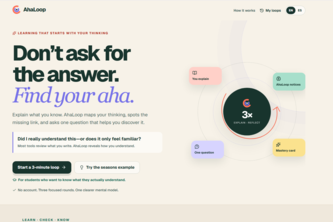
AhaLoop is an AI-powered learning coach designed for students. The product enables students to explain their understanding of a topic in their own words, then uses GPT-5.6 to analyze that explanation and generate a thought map, identify misconceptions, and pose a Socratic question to prompt reflection. This process repeats over three rounds, culminating in a Mastery Card summarizing learning progress.
What changed
The project was built from scratch during OpenAI Build Week using Codex and GPT-5.6. It is presented as a proof-of-concept tool for educational AI that emphasizes reasoning over answer-giving.
Single most important open question
Is there evidence of real-world adoption or traction by students, educators, or institutions to validate the utility and demand for this approach?
What The Product Actually Is
The description states that AhaLoop is an AI-powered learning coach. It allows students to explain what they understand about a topic in their own words. GPT-5.6 analyzes the explanation and generates:
- A thought map
- Identification of strong connections, missing links, and misconceptions
- One Socratic question
This process is repeated for three rounds before generating a Mastery Card summarizing learning progress.
Evidence The author's write-up describes how the tool works in detail.
Inference The product appears to be a web-based application built with Next.js, React, and TypeScript, using OpenAI APIs and local browser storage. It supports English and Spanish and does not require an account.
Positioning & Claim Evolution
The description states that most AI learning tools give students answers, but AhaLoop avoids this by asking reflective questions instead of providing direct answers. The goal is to help students understand whether they truly grasp a concept or just feel familiar with it.
Evidence The inspiration section and the “What it does” section describe the core positioning.
Inference The tool positions itself as an alternative to traditional AI tutoring systems that deliver content or solutions directly, instead focusing on scaffolding understanding through questioning.
Target Customer & ICP
The description states that AhaLoop is designed for students. It supports educational levels and topics chosen by users, with no mention of institutional or teacher use beyond potential future features.
Evidence The write-up mentions “student” as the primary user and describes how they interact with the tool.
Inference The target customer is likely K-12 or higher education students who are learning independently or in a self-directed manner. There is no evidence of a specific ICP beyond general student use cases.
Business Model & Pricing Evidence
The description does not contain any information about pricing, monetization, or business model.
Evidence Not evidenced.
Inference Since the tool works without an account and is presented as a demo product, it may currently be non-commercial or experimental. Future versions might introduce accounts or dashboards, which could imply a path to monetization.
Technical & Delivery Signals
The project was built using:
- Next.js
- React
- TypeScript
- Tailwind CSS
- Framer Motion
- OpenAI Responses API
- Structured Outputs with Zod
- Local browser storage
- Vercel
GPT-5.6 powers the educational analysis and Socratic question generation. The OpenAI API key and internal instructions remain securely on the server.
Evidence The “How we built it” section provides technical details.
Inference The tool is a client-side application that uses AI APIs for core functionality, suggesting minimal backend infrastructure beyond secure API handling.
Traction & Maturity Signals
The description does not provide any data on usage, customers, or product maturity beyond its development during a hackathon.
Evidence Not evidenced.
Inference The tool is at a very early stage—likely a prototype or MVP. It was built in one week and has no mention of real-world deployment or user feedback.
Competitive Context
The description does not include any information about competitors or market positioning relative to existing AI learning platforms.
Evidence Not evidenced.
Inference AhaLoop appears to be positioned as an alternative to traditional AI tutoring tools that provide answers directly. However, there is no evidence of how it compares to other educational AI products on the market.
Open Questions & Risks
- No revenue or customer data: The tool has no demonstrated traction or monetization.
- Single-founder team: Only one member listed (Pablo G. Zúñiga), which may limit scalability and execution capacity.
- Limited scope: Currently works without accounts, suggesting a lack of long-term engagement features.
- Unverified claims: All descriptions are self-reported and unverified; there is no independent validation of its effectiveness or impact.
Evidence The description lacks any data on adoption, performance metrics, or user feedback.
Questions the description leaves open
- What specific educational outcomes have you observed in test scenarios?
- Have you conducted any pilot studies with real students or teachers?
- How do you plan to scale beyond the current prototype?
- Are there any partnerships or institutional trials planned?
- What are your plans for monetization and long-term sustainability?
Overall Assessment
Not evidenced.
Inference Given the lack of traction, revenue, or customer data, and the early-stage nature of the product, there is insufficient evidence to support an investment or partnership decision at this time. The tool shows promise in concept but requires further validation before any strategic move can be justified.
User Stories BotA demo video on every pull request
Get a demo video on every new feature
GitHub App that watches your pull requests and records a narrated, captioned demo.
Save time on demo prep and make informed decisions faster with a video walkthrough of every new feature.
Source
Submitted to the OpenAI 2026 hackathon on Devpost. Project home on Devpost. Back to the full gallery on Devpost.
This competitive analysis was produced by top-founders.com (opens in a new tab)
Generated by a language model from this project's public Devpost page — its tagline, the author's own write-up and any built-with tags listed there — as captured in August 2026. Short quotations are the author's words. It is an opinion on the idea as a business, not on the people behind it, and it reflects the description as published then. If the project has moved on, request a correction below. The analysis is not independent research and contains no verified traction, revenue or customer data.
An independent guide by KFG International LLC — not affiliated with, endorsed by, or connected to Devpost or OpenAI.