

Archive position — measured, not model output
1 like on Devpost
505 of the 7,850 archived projects have more likes, and 1,758 share exactly 1 — so this project's #547 place in the like-ranked listing is a tie-break inside that group, not a ranking.
Projects (log scale)
Likes on Devpost. ▲ marks this project's group.
Show the figures
| Likes | Projects | Share of archive |
|---|---|---|
| 0 | 5,587 | 71.2% |
| 1 | 1,758 | 22.4% |
| 2 | 284 | 3.6% |
| 3–4 | 132 | 1.7% |
| 5–9 | 75 | 1.0% |
| 10+ | 14 | 0.2% |
 User Stories BotA demo video on every pull request
Get a demo video on every new feature
GitHub App that watches your pull requests and records a narrated, captioned demo.
Save time on demo prep and make informed decisions faster with a video walkthrough of every new feature.
Executive Summary
What the company appears to be
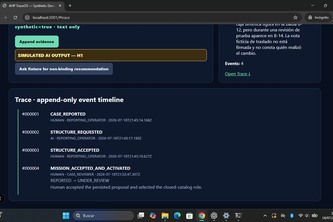
AHP TraceOS is a self-reported proof-of-concept application designed for the OpenAI Build Week 2026 hackathon. It is described as a system that structures synthetic incident reports through human-AI workflows, emphasizing traceability, governance, and human validation of AI-generated outputs.
What changed
The project was developed over a short timeframe (a hackathon) with a single developer, using AI tools like Codex and GPT-5.6 for assistance. It includes technical elements such as append-only storage, structured response contracts, and deterministic validation, but no evidence of production deployment or real-world use.
Single most important open question
Is there any evidence that AHP TraceOS has moved beyond a prototype or hackathon demo into actual usage by users or organizations?
What The Product Actually Is
The description states that AHP TraceOS is an application designed to transform free-form incident descriptions into traceable workflows involving both human and AI components. It claims to:
- Separate confirmed, inferred, and missing information;
- Generate structured mission proposals;
- Recommend competent functions from a controlled catalog;
- Preserve literal verifiable excerpts of original input;
- Incorporate synthetic evidence;
- Provide non-binding AI recommendations;
- Require human acceptance for structure and mission;
- Reserve decision-making and closure to authorized individuals;
- Maintain an append-only history;
- Reconstruct cases after reloads;
- Detect incompatible or corrupted histories without silent overwrites;
- Differentiate errors by stage and cause.
The system is built using Next.js, React, TypeScript, and integrates with OpenAI APIs. It uses local storage for append-only logging and includes deterministic validation of responses.
Confidence High — based on the detailed self-description of functionality and architecture.
Positioning & Claim Evolution
The author positions AHP TraceOS as a tool that addresses concerns about opacity in AI-generated outputs, particularly in safety-critical environments like industrial or regulatory contexts. The core claim is that while AI can assist, it should not make final decisions; instead, the system enforces human validation and traceability.
This positioning evolved from the author’s background in chemical engineering and occupational health and safety, where accountability and documentation are paramount. The framework "La IA asiste, la persona valida y el sistema registra" (AI assists, person validates, system records) underpins the product's design philosophy.
Confidence Medium — claims are consistent with stated intent but lack external validation or traction data.
Target Customer & ICP
The description does not name specific customers or personas. However, it implies a target audience in environments requiring strict governance and traceability, such as:
- Industrial safety teams;
- Regulatory compliance units;
- Risk management departments;
- Any organization where AI decisions must be auditable and accountable.
The system is designed to handle synthetic inputs, suggesting early-stage prototyping rather than real-world adoption.
Confidence Low — no explicit customer or persona data provided.
Business Model & Pricing Evidence
There is no evidence of a business model or pricing strategy in the description. The project was built for a hackathon and does not mention monetization, licensing, subscriptions, or any revenue-generating mechanism.
Confidence Not evidenced.
Technical & Delivery Signals
The system is described as having:
- An append-only local storage architecture;
- Deterministic structured response validation;
- Server-side integration with OpenAI;
- A domain model governed by rules;
- Controlled commands and transitions;
- Error differentiation by stage and cause;
- 41 automated tests;
- Type checking, linting, and build verification;
- Independent technical and documentation review.
It also includes a demo interface based on synthetic data and was merged into main via a trazable pull request with 21 commits.
Confidence High — detailed technical implementation is described.
Traction & Maturity Signals
There is no evidence of traction, users, customers, or adoption beyond the author’s own development. The project is explicitly described as a hackathon submission and lacks any indication of deployment in production or real-world use.
Confidence Not evidenced.
Competitive Context
The description does not mention competitors or similar products. It focuses on its unique governance model and traceability features, but no comparison to existing tools or platforms is made.
Confidence Not evidenced.
Open Questions & Risks
- Prototype-only status: The project is described as a hackathon demo with no evidence of production use.
- Single-person team: Only one developer was involved in the creation.
- No revenue or customer data: No indication of monetization, users, or market traction.
- Limited scope: Designed for synthetic inputs; unclear if it scales to real-world complexity.
- Self-reported maturity: All claims are from the author and lack independent verification.
Confidence Medium — risks are inferred from lack of evidence rather than direct observation.
Questions the description leaves open
- What is the actual use case or problem you're solving in real-world environments?
- Have you tested this system with real users or stakeholders beyond yourself?
- How would you scale this beyond a single-person development model?
- Are there any plans to integrate with existing enterprise systems or workflows?
- What are your thoughts on privacy, security, and legal compliance in production settings?
- Is there any plan for monetization or commercial deployment?
Overall Assessment
The description indicates that AHP TraceOS is a proof-of-concept built during a hackathon by one individual. There is no evidence of traction, revenue, customers, or even a clear path to production use.
While the technical design shows promise and alignment with governance principles, there is insufficient evidence to support investment or partnership interest at this stage.
Confidence Low — the project appears to be in an early prototype phase without demonstrated commercial viability.
User Stories BotA demo video on every pull request
Get a demo video on every new feature
GitHub App that watches your pull requests and records a narrated, captioned demo.
Save time on demo prep and make informed decisions faster with a video walkthrough of every new feature.
Source
Submitted to the OpenAI 2026 hackathon on Devpost. Project home on Devpost. Back to the full gallery on Devpost.
This competitive analysis was produced by top-founders.com (opens in a new tab)
Generated by a language model from this project's public Devpost page — its tagline, the author's own write-up and any built-with tags listed there — as captured in August 2026. Short quotations are the author's words. It is an opinion on the idea as a business, not on the people behind it, and it reflects the description as published then. If the project has moved on, request a correction below. The analysis is not independent research and contains no verified traction, revenue or customer data.
An independent guide by KFG International LLC — not affiliated with, endorsed by, or connected to Devpost or OpenAI.