

Archive position — measured, not model output
0 likes on Devpost
2,263 of the 7,850 archived projects have more likes, and 5,587 share exactly 0 — so this project's #4,473 place in the like-ranked listing is a tie-break inside that group, not a ranking.
Projects (log scale)
Likes on Devpost. ▲ marks this project's group.
Show the figures
| Likes | Projects | Share of archive |
|---|---|---|
| 0 | 5,587 | 71.2% |
| 1 | 1,758 | 22.4% |
| 2 | 284 | 3.6% |
| 3–4 | 132 | 1.7% |
| 5–9 | 75 | 1.0% |
| 10+ | 14 | 0.2% |
 User Stories BotA demo video on every pull request
Get a demo video on every new feature
GitHub App that watches your pull requests and records a narrated, captioned demo.
Save time on demo prep and make informed decisions faster with a video walkthrough of every new feature.
Executive Summary
What the company appears to be
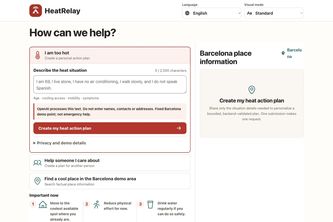
HeatRelay is a self-reported pilot application built for the OpenAI 2026 hackathon. The author describes it as an informational tool that transforms heat warnings into practical, bounded action plans tailored to individuals or others they care about. It supports multilingual input and output (25 languages), includes right-to-left layout support, and integrates with weather data from Open-Meteo and place information from a reviewed snapshot of Barcelona climate-shelter data.
What changed
The project is presented as a working prototype built in eight milestones using GPT-5.6 for structured outputs, React/TypeScript frontend, FastAPI backend, and Docker deployment on Fly.io. It evolved from an early version with too much text to one that prioritizes showing one clear next action first.
Single most important open question
Is there any evidence of real-world usage or feedback from users beyond the author’s own testing?
What The Product Actually Is
The description states that HeatRelay offers three working scenarios:
- Create a personal heat-action plan.
- Create a plan for someone you care about.
- Search separately for factual information about nearby cool places in the Barcelona demo area.
It uses GPT-5.6 to extract facts and select from backend-approved codes, but does not generate new facts such as addresses or phone numbers. The system bypasses normal planning when urgent symptoms are reported and switches to a fixed 112 emergency branch.
The interface supports 25 languages including Arabic, Persian, Hebrew, and Urdu with RTL layouts. It also includes Standard, Enhanced Visibility, and High Contrast modes.
Evidence
- The author states: “HeatRelay offers three working scenarios…”
- The author states: “GPT-5.6 has two narrow jobs in the normal-plan workflow. First, it extracts only the facts stated in the submitted description into a closed schema.”
- The author states: “The model does not invent weather, phone numbers, addresses, opening hours, coordinates, official links, or place facts.”
Inference This is an informational pilot application with safety-boundary logic and multilingual capabilities. It is not described as having any revenue-generating features or customer base.
Positioning & Claim Evolution
The author positions HeatRelay as a tool that answers the immediate question: “what should I do next?” when faced with heat warnings, particularly for vulnerable populations such as those who are alone, have limited mobility, or do not speak the local language.
It evolved from an early version with too much text to one focused on showing one clear next action first. The author emphasizes simplicity and safety-boundary design over generality.
Evidence
- The author states: “I kept thinking about people who may be alone, have limited mobility, do not speak the local language, or simply feel overwhelmed by too much information.”
- The author states: “That idea became HeatRelay: a Barcelona pilot that turns a short description of a heat situation into a practical, bounded next step.”
Inference The positioning reflects an intent to serve under-served groups during heat emergencies. It is not positioned as a commercial product or platform but rather as a proof-of-concept.
Target Customer & ICP
The author describes the intended audience as people who are alone, have limited mobility, do not speak the local language, or feel overwhelmed by too much information during heat warnings.
There is no explicit mention of specific personas or segments beyond this general description.
Evidence
- The author states: “I kept thinking about people who may be alone, have limited mobility, do not speak the local language, or simply feel overwhelmed by too much information.”
Inference The ICP appears to be individuals in vulnerable situations during heat emergencies, especially those with language barriers or accessibility needs.
Business Model & Pricing Evidence
There is no evidence of any business model or pricing structure. The project is described as a pilot and not a commercial product.
Evidence
- The author states: “HeatRelay is an informational pilot. It is not a diagnosis, medical advice, or a replacement for emergency services.”
- The author states: “For now, HeatRelay remains deliberately bounded: a working Barcelona pilot that tries to turn a stressful heat warning into one clear next step.”
Inference No commercial model or pricing data are evident; it is presented as a non-revenue-generating prototype.
Technical & Delivery Signals
The application was built using:
- Frontend: React, TypeScript, Vite
- Backend: FastAPI, Pydantic
- Deployment: Docker on Fly.io
- AI tools: GPT-5.6 (structured outputs), Codex
- Data sources: Open-Meteo for weather, reviewed snapshot of Barcelona climate-shelter data
It includes:
- 4,000+ automated tests
- Mobile responsiveness and accessibility features (e.g., VoiceOver support)
- HTTPS, security headers, rate limiting, request limits
- RTL layout handling
- Localization using bundled catalogs instead of runtime translation
Evidence
- The author states: “I built the frontend with React, TypeScript, and Vite, and the backend with FastAPI and Pydantic.”
- The author states: “I used Codex as my main implementation environment across eight milestones...”
- The author states: “More than 4,000 automated backend and frontend tests.”
Inference The technical stack suggests a focused, controlled development approach. The use of deterministic code for safety-critical elements and structured AI outputs indicates an emphasis on reliability over flexibility.
Traction & Maturity Signals
There is no evidence of traction or adoption beyond the author’s own testing and implementation.
Evidence
- The author states: “HeatRelay is an informational pilot.”
- The author states: “This project was submitted to the OpenAI 2026 hackathon on Devpost.”
Inference No data about user engagement, retention, or real-world usage is provided. It remains a prototype with no indication of market traction.
Competitive Context
There is no evidence of competitors or competitive landscape mentioned in the description.
Evidence
- No mention of existing tools or platforms addressing similar use cases for heat warnings or multilingual emergency planning.
Inference The project does not appear to be part of an established ecosystem, nor does it reference any direct competitors.
Open Questions & Risks
Key risks include:
- Lack of real-world testing or user feedback beyond the author.
- No evidence of scalability beyond a single city (Barcelona).
- The system is described as a pilot with no commercial viability or monetization path.
- Reliance on a fixed dataset for place information raises concerns about applicability outside Barcelona.
Evidence
- The author states: “HeatRelay is an informational pilot.”
- The author states: “The standalone place search remains separate from the personal plan and uses a fixed Barcelona demo point rather than browser geolocation.”
Inference Without external validation or usage data, there is significant uncertainty about whether this solution addresses real needs or scales effectively.
Questions the description leaves open
- What specific feedback did you receive during testing from users in vulnerable groups?
- How do you plan to validate the accuracy of the action plans generated by GPT-5.6?
- Are there any plans for expanding beyond Barcelona or integrating with local emergency services?
- What is your strategy for ensuring long-term maintenance and updates of the place database?
- Has the multilingual catalog been reviewed by native speakers for cultural appropriateness?
Overall Assessment
Not evidenced.
Evidence
- No financials, revenue, or funding data are provided.
- No indication of commercial interest or strategic fit is evident.
- The project is described as a hackathon submission and pilot with no clear path to market.
Inference This is not a viable investment or partnership opportunity based on the available information. It lacks evidence of traction, scalability, or business model.
User Stories BotA demo video on every pull request
Get a demo video on every new feature
GitHub App that watches your pull requests and records a narrated, captioned demo.
Save time on demo prep and make informed decisions faster with a video walkthrough of every new feature.
Source
Submitted to the OpenAI 2026 hackathon on Devpost. Project home on Devpost. Back to the full gallery on Devpost.
This competitive analysis was produced by top-founders.com (opens in a new tab)
Generated by a language model from this project's public Devpost page — its tagline, the author's own write-up and any built-with tags listed there — as captured in August 2026. Short quotations are the author's words. It is an opinion on the idea as a business, not on the people behind it, and it reflects the description as published then. If the project has moved on, request a correction below. The analysis is not independent research and contains no verified traction, revenue or customer data.
An independent guide by KFG International LLC — not affiliated with, endorsed by, or connected to Devpost or OpenAI.