

Archive position — measured, not model output
1 like on Devpost
505 of the 7,850 archived projects have more likes, and 1,758 share exactly 1 — so this project's #549 place in the like-ranked listing is a tie-break inside that group, not a ranking.
Projects (log scale)
Likes on Devpost. ▲ marks this project's group.
Show the figures
| Likes | Projects | Share of archive |
|---|---|---|
| 0 | 5,587 | 71.2% |
| 1 | 1,758 | 22.4% |
| 2 | 284 | 3.6% |
| 3–4 | 132 | 1.7% |
| 5–9 | 75 | 1.0% |
| 10+ | 14 | 0.2% |
 User Stories BotA demo video on every pull request
Get a demo video on every new feature
GitHub App that watches your pull requests and records a narrated, captioned demo.
Save time on demo prep and make informed decisions faster with a video walkthrough of every new feature.
Executive Summary
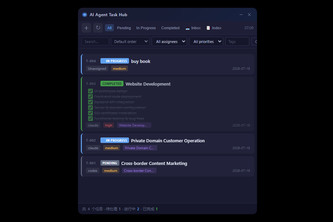
The description states that AI Agent Task Hub is a desktop application built with Electron that coordinates multiple AI coding agents through a shared Markdown file (TASKS.md). The author describes it as a "todo list built specifically for AI-driven projects", intended to solve coordination issues between autonomous agents operating on the same machine. It includes features such as a floating panel, task management workflow, live file watching, and Obsidian integration.
The project appears to be a personal hackathon submission with no evidence of commercial traction or revenue. The author claims it runs without a database or server, relying solely on Markdown as a coordination protocol. There is no indication of funding, customers, partnerships, or product-market fit beyond the self-reported description.
Single most important open question
Is this a functional prototype or a proof-of-concept that has not yet been tested in real-world AI agent workflows?
What The Product Actually Is
The description states that AI Agent Task Hub is:
- A desktop panel built with Electron
- A shared task registry using a single
TASKS.mdMarkdown file - A coordination layer for multiple AI coding agents (e.g., Claude Code, Codex CLI, Mavis)
- A tool that allows agents to read and write to the same file without an API or authentication
- A lightweight application with no backend or database
It is described as a "todo list built specifically for AI-driven projects" where:
- Agents claim tasks by changing their status in
TASKS.md - The panel displays real-time updates from agent activity
- It supports task management features like status workflow, priority, assignee, subtasks, tags, due dates, dependencies, and recurring tasks
- It includes a quick capture window for new tasks
- It integrates with Obsidian via symlinking
TASKS.mdinto an Obsidian vault
The author also mentions that the application:
- Uses Markdown as its database
- Has a secure IPC bridge between renderer and main process
- Implements a protocol for agents to understand how to interact with
TASKS.md - Ships as both an installer and portable executable
Inference The product is a desktop application designed to act as a shared coordination layer for AI agents working on the same machine, using Markdown as a lightweight protocol.
Positioning & Claim Evolution
The description states that:
- The product was inspired by the need to coordinate multiple AI coding agents
- Traditional to-do apps are not suited for autonomous agents
- The solution uses a plain Markdown file as a coordination protocol
- It aims to be simpler than databases and APIs, yet functional for machine-level workflows
- The goal is to provide a "single source of truth" that both humans and agents can read and modify
The author claims the system:
- Eliminates duplication of work between agents
- Prevents clobbering of changes
- Provides visibility into agent activity through a floating panel
- Allows for human intervention in case of conflicts or errors
Inference The positioning evolved from solving an internal problem (agent coordination) to offering a general-purpose solution for AI-driven development environments. However, the claim is that it's built for AI agents rather than humans, suggesting a niche use case.
Target Customer & ICP
The description states:
- The product targets users who run multiple AI coding agents on the same machine
- These users include developers or teams working with autonomous AI tools like Claude Code, Codex CLI, Mavis
- It is aimed at those who want to coordinate agents without complex infrastructure or APIs
- It caters to individuals or small teams using AI for code generation and automation
Inference The ICP appears to be technical users or developers who are already using AI coding agents and need a way to manage them collectively, particularly in environments where multiple agents operate concurrently.
Business Model & Pricing Evidence
The description states:
- No pricing information is provided
- There is no mention of monetization strategy
- The product is described as a personal hackathon submission
- It ships as both an installer and portable executable with auto-start and tray support
Not evidenced No indication of revenue model, pricing tiers, or commercial viability.
Technical & Delivery Signals
The description states:
- Built with Electron (frameless transparent window, system tray, global shortcuts, native notifications)
- Uses Markdown as the database
- Implements a secure IPC bridge using contextBridge preload
- Agent protocol is human-readable and designed to be debuggable in Notepad
- Supports cross-platform packaging via electron-builder (NSIS installer and portable .exe)
- Includes live file watching and desktop notifications
- Integrates with Obsidian through symlinking
Inference The technical approach shows a minimal, lightweight architecture focused on simplicity and ease of use. It avoids complex infrastructure in favor of file-based coordination.
Traction & Maturity Signals
The description states:
- This is a hackathon submission (OpenAI 2026)
- No evidence of revenue, customers, or adoption
- The author notes it "actually ships" — packaged as installer and portable exe
- It includes features like auto-start, tray support, and global hotkeys
- It was built by one person (yinghau shek)
Not evidenced No data on user base, usage metrics, customer feedback, or product adoption beyond the author's own account.
Competitive Context
The description states:
- The author notes that traditional to-do apps are not designed for AI agents
- It addresses a gap in coordination between autonomous agents
- It is positioned as an alternative to databases or APIs for agent communication
- No mention of direct competitors or similar products
Not evidenced No information on existing tools, platforms, or solutions addressing the same problem space.
Open Questions & Risks
The description states:
- The system relies entirely on Markdown as a database — which may not scale well
- Concurrent edits by multiple agents could cause conflicts (though mitigated with ownership rules)
- Parsing Markdown tables back into structured data was challenging
- Global hotkey conflicts were resolved through fallback chains
- Transparent frameless window behavior on Windows required several iterations
Inference Risks include:
- Scalability limitations due to reliance on a single file-based protocol
- Potential for race conditions or data corruption in concurrent editing scenarios
- Limited robustness if the Markdown parser fails or becomes outdated
- Lack of enterprise-grade features or integrations
Questions the description leaves open
- What specific AI coding agents have you tested this with, and how well do they integrate?
- Have you encountered any issues with concurrent edits in real-world usage?
- How does the system handle task dependencies when multiple agents are involved?
- Is there a plan to support cross-machine coordination or distributed agent workflows?
- What is your long-term vision for monetization or product development beyond this hackathon project?
Overall Assessment
The description states:
- This is a personal hackathon submission
- No evidence of traction, revenue, or commercial viability
- The author built it alone and it ships as a prototype
- It addresses a niche problem for AI developers using multiple agents
Not evidenced No indication of investment potential, partnership opportunities, or scalability beyond the current scope.
Inference At this stage, the project appears to be a proof-of-concept with limited commercial appeal. It may have value as a prototype for future development but lacks evidence of market demand or product-market fit.
User Stories BotA demo video on every pull request
Get a demo video on every new feature
GitHub App that watches your pull requests and records a narrated, captioned demo.
Save time on demo prep and make informed decisions faster with a video walkthrough of every new feature.
Source
Submitted to the OpenAI 2026 hackathon on Devpost. Project home on Devpost. Back to the full gallery on Devpost.
This competitive analysis was produced by top-founders.com (opens in a new tab)
Generated by a language model from this project's public Devpost page — its tagline, the author's own write-up and any built-with tags listed there — as captured in August 2026. Short quotations are the author's words. It is an opinion on the idea as a business, not on the people behind it, and it reflects the description as published then. If the project has moved on, request a correction below. The analysis is not independent research and contains no verified traction, revenue or customer data.
An independent guide by KFG International LLC — not affiliated with, endorsed by, or connected to Devpost or OpenAI.