

Archive position — measured, not model output
1 like on Devpost
505 of the 7,850 archived projects have more likes, and 1,758 share exactly 1 — so this project's #551 place in the like-ranked listing is a tie-break inside that group, not a ranking.
Projects (log scale)
Likes on Devpost. ▲ marks this project's group.
Show the figures
| Likes | Projects | Share of archive |
|---|---|---|
| 0 | 5,587 | 71.2% |
| 1 | 1,758 | 22.4% |
| 2 | 284 | 3.6% |
| 3–4 | 132 | 1.7% |
| 5–9 | 75 | 1.0% |
| 10+ | 14 | 0.2% |
 User Stories BotA demo video on every pull request
Get a demo video on every new feature
GitHub App that watches your pull requests and records a narrated, captioned demo.
Save time on demo prep and make informed decisions faster with a video walkthrough of every new feature.
Executive Summary
What the company appears to be
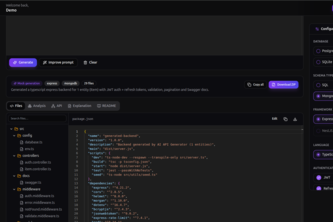
The author describes AI API Generator as a tool that converts data schemas (SQL, Prisma, Mongoose) or plain English descriptions into complete, production-ready backend code in seconds. It generates models, CRUD APIs, authentication, validation, documentation, and tests.
What changed
This is a self-reported project submitted to the OpenAI 2026 hackathon. No prior version or evolution is described; it appears to be a new product concept built from scratch by one person (Touqeer Hussain).
Single most important open question
Is there any evidence of real-world usage, revenue, or customer traction beyond the author’s own description? The project has no demonstrated commercial adoption.
What The Product Actually Is
The description states that AI API Generator turns a schema — SQL, Prisma, Mongoose, or plain English — into a complete backend project. It includes:
- Models, controllers, services, and routes
- JWT authentication with refresh tokens, bcrypt hashing
- Validation (Zod/Joi), error handling, rate limiting, CORS, security headers
- Pagination, filtering, sorting, search on list endpoints
- Swagger/OpenAPI documentation, unit-test templates, seed data, README
- Export as ZIP or individual files
It works with or without an OpenAI key via a deterministic mock generator for offline use.
Evidence
- The author describes the full output structure.
- It uses specific technologies like Next.js, React, Express, Zod, Swagger, Monaco editor, OpenAI API.
- It supports multiple input formats and generates runnable code.
Inference The tool is designed to reduce boilerplate for backend engineers by automating common patterns in REST APIs.
Positioning & Claim Evolution
The author positions AI API Generator as a solution to the repetitive task of building scaffolding for new projects. They claim it allows users to go from schema to production-ready backend in seconds, eliminating hours or days of undifferentiated plumbing.
Evidence
- The write-up explicitly states: “Every backend engineer has lived the same Groundhog Day...”
- It frames the tool as a way to avoid rebuilding the same scaffolding repeatedly.
- The tagline says: “Turn a SQL, Prisma, or Mongoose schema, or plain English, into a complete, production-ready backend in seconds.”
Inference This is positioned as an efficiency tool for developers working on backend APIs, targeting engineers who want to accelerate development cycles.
Target Customer & ICP
The description implies the primary user is backend engineers or full-stack developers who are building REST APIs and need to scaffold them quickly.
Evidence
- The inspiration section focuses on backend engineers doing repetitive work.
- It targets those who build CRUD endpoints, handle authentication, validation, etc.
Inference It likely appeals to solo developers, startups, or small teams looking for rapid prototyping or boilerplate reduction.
Business Model & Pricing Evidence
There is no mention of pricing, monetization strategy, or business model in the self-reported description.
Evidence
- No revenue streams, subscriptions, or pricing tiers are described.
- The tool can be used offline with a mock generator, suggesting no immediate paywall.
Inference It appears to be a free tool for now, possibly intended as a demo or open-source project. Commercial viability is not evident.
Technical & Delivery Signals
The author provides technical details about how the product was built:
- Frontend: Next.js 15 (App Router), React 19, TypeScript, Tailwind CSS, Monaco editor
- AI layer: OpenAI Responses API with structured JSON output contracts
- Schema analysis: Dependency-free analyzer for SQL DDL, Prisma models, Mongoose schemas, and English descriptions
- Backend: Next.js API routes, JWT sessions (jose), bcrypt hashing, Zod validation
- Security: Sanitized input, anti-prompt-injection instructions, rate limiting
- Export: JSZip + FileSaver for ZIP export
Evidence
- Detailed breakdown of stack and architecture.
- Mention of prompt engineering, JSON schema contracts, fallback mechanisms.
Inference The tool is built with modern web technologies and includes robustness features like offline support and structured AI output.
Traction & Maturity Signals
There is no evidence of traction, customers, or revenue. The project was submitted to a hackathon and has no archived history or usage data.
Evidence
- No mention of users, customers, or adoption.
- No metrics on downloads, active users, or engagement.
- It’s described as a hackathon submission, not a product in the market.
Inference This is an early-stage idea with no demonstrated traction. The maturity level is low.
Competitive Context
The author does not reference competitors directly, but the concept overlaps with tools that automate backend scaffolding or generate APIs from schema definitions.
Evidence
- No competitor names or references.
- The tool claims to be unique in its ability to work offline and support multiple input types.
Inference It likely competes with tools like Prisma, Postman, Swagger, or other API generation platforms, but no direct comparison is made.
Open Questions & Risks
Several risks are implied by the lack of evidence:
- No commercial traction: No revenue, customers, or adoption data.
- Unproven market demand: The author doesn’t describe any market research or user feedback.
- Dependency on AI quality: Relies heavily on OpenAI API; performance may degrade without it.
- Limited scalability: Built by one person (Touqeer Hussain), so no team or infrastructure for growth.
- Offline mode is a workaround: The mock generator is presented as a fallback, not a core feature.
Inference The tool is experimental and untested in real-world conditions. Its long-term viability depends on whether it can gain traction beyond the hackathon.
Questions the description leaves open
- What specific feedback have you received from users or judges during the hackathon?
- Have you validated this idea with potential customers before building it?
- How do you plan to monetize this tool if at all?
- Are there any plans for team expansion or product roadmap beyond the current MVP?
- What is your strategy for handling prompt injection or security concerns in real-world usage?
- Do you have a plan for scaling beyond the current tech stack and single developer?
Overall Assessment
Not evidenced
There is no evidence of revenue, customers, traction, or commercial viability. The project is described as a hackathon submission with no indication of market readiness or business model.
Confidence Low — based entirely on self-reported claims and no external validation.
Risk Level
High — due to lack of evidence for product-market fit, scalability, or monetization strategy.
Conclusion
This appears to be an experimental tool with a promising concept but no demonstrated traction. It is not ready for investment or partnership without further proof of concept, user feedback, or commercial execution.
User Stories BotA demo video on every pull request
Get a demo video on every new feature
GitHub App that watches your pull requests and records a narrated, captioned demo.
Save time on demo prep and make informed decisions faster with a video walkthrough of every new feature.
Source
Submitted to the OpenAI 2026 hackathon on Devpost. Project home on Devpost. Back to the full gallery on Devpost.
This competitive analysis was produced by top-founders.com (opens in a new tab)
Generated by a language model from this project's public Devpost page — its tagline, the author's own write-up and any built-with tags listed there — as captured in August 2026. Short quotations are the author's words. It is an opinion on the idea as a business, not on the people behind it, and it reflects the description as published then. If the project has moved on, request a correction below. The analysis is not independent research and contains no verified traction, revenue or customer data.
An independent guide by KFG International LLC — not affiliated with, endorsed by, or connected to Devpost or OpenAI.