

Archive position — measured, not model output
0 likes on Devpost
2,263 of the 7,850 archived projects have more likes, and 5,587 share exactly 0 — so this project's #2,514 place in the like-ranked listing is a tie-break inside that group, not a ranking.
Projects (log scale)
Likes on Devpost. ▲ marks this project's group.
Show the figures
| Likes | Projects | Share of archive |
|---|---|---|
| 0 | 5,587 | 71.2% |
| 1 | 1,758 | 22.4% |
| 2 | 284 | 3.6% |
| 3–4 | 132 | 1.7% |
| 5–9 | 75 | 1.0% |
| 10+ | 14 | 0.2% |
 User Stories BotA demo video on every pull request
Get a demo video on every new feature
GitHub App that watches your pull requests and records a narrated, captioned demo.
Save time on demo prep and make informed decisions faster with a video walkthrough of every new feature.
Executive Summary
Company: AI Radar
Self-reported basis: The description is entirely self-reported by the project author(s) and unverified. No third-party evidence or historical data is available.
Commercial due-diligence read: This is a developer tooling project submitted as part of a hackathon, built as a VS Code extension. It claims to help developers understand code changes and risks before writing code using Git, GitHub, and AI. The author states it was built by a team of three in the context of a hackathon. No evidence of revenue, customers, or traction is provided.
Most important open question: Is there a viable market need for this type of developer productivity tool, and does the team have the technical capability to build a scalable product beyond a hackathon prototype?
What The Product Actually Is
The description states that AI Radar is a VS Code extension. It is built using the VS Code Extension API and TypeScript, and uses:
- Local Git history
- Git Blame
- Git Status
- Repository analysis
- GitHub REST API (optional)
- AI-powered engineering recommendations
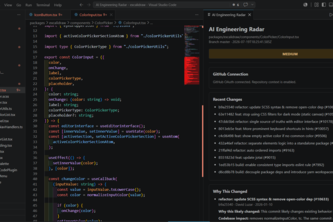
It presents engineering context in a single view within VS Code, including:
- Recent file changes
- Why the file changed
- Related Pull Requests
- Active contributors
- Affected engineering areas
- Risk level
- Recommended tests
- Suggested next actions
The extension uses a custom VS Code WebView to display this information.
Inference: The product is an in-IDE tool for developers working on codebases with multiple contributors, aiming to reduce merge conflicts and improve collaboration by surfacing engineering context before code changes are made.
Positioning & Claim Evolution
The author states that AI Radar helps developers understand code changes and engineering risks before writing code. It aims to solve a problem where developers often don’t realize that someone else has modified the same file or that an active pull request is changing the same area, leading to merge conflicts and duplicated work.
It positions itself as:
- A tool for improving developer awareness
- An AI-powered companion for engineering workflows
- A solution to reduce friction in code review and collaboration
The author also mentions future plans to extend it with:
- AI-generated engineering summaries
- Cross-file dependency analysis
- Branch conflict prediction
- Team collaboration insights
Claim: The product is positioned as a productivity tool that improves developer workflow by surfacing context before changes are made.
Target Customer & ICP
The description states that the tool is built for developers, particularly those working in large codebases with multiple contributors. It is intended to help teams reduce merge conflicts and improve collaboration.
It is designed for use within VS Code, which is a common IDE among developers, especially in software engineering roles.
Inference: The ICP (Ideal Customer Profile) likely includes:
- Developers working on large, collaborative codebases
- Engineering teams using Git and GitHub
- Teams that experience merge conflicts or duplicated work
No evidence of specific customer segments, personas, or use cases beyond this general description is provided.
Business Model & Pricing Evidence
The author does not provide any information about pricing, monetization, or business model. There is no mention of:
- Subscription tiers
- Freemium offerings
- Enterprise licensing
- Marketplace listing details
- Revenue streams
Not evidenced
Technical & Delivery Signals
The extension is built using:
- VS Code Extension API
- TypeScript
- Git internals (history, blame, status)
- GitHub REST API
- AI-powered recommendations (via OpenAI or similar)
It uses a custom WebView to present information.
The author states that the team learned:
- VS Code Extension Development
- Git internals and repository analysis
- GitHub REST APIs
- Engineering workflow automation
- Building developer productivity tools
- Designing AI-assisted developer experiences
Inference: The technical stack is standard for a VS Code extension, with integration points into Git and GitHub. The use of AI is implied but not detailed.
Traction & Maturity Signals
The project was submitted to the OpenAI 2026 hackathon, suggesting it is a prototype or proof-of-concept built in a short timeframe.
It was built by a team of three members.
No evidence of:
- Revenue
- Customers
- User adoption
- Product-market fit
- Iteration history
- Product usage metrics
Not evidenced
Competitive Context
The description does not mention any direct competitors. However, the problem it addresses — improving developer awareness and reducing merge conflicts — is a known challenge in software engineering.
Tools that may be related include:
- GitHub’s pull request tools
- Git-based collaboration tools
- IDE plugins for code review or change tracking
- AI-assisted development tools (e.g., GitHub Copilot, Tabnine)
No evidence of existing products or market positioning is provided.
Not evidenced
Open Questions & Risks
- Prototype vs. Product: The project was built as part of a hackathon and lacks evidence of product-market fit or traction.
- Limited Team Size: Only three members are listed, which may limit execution capability for scaling beyond a prototype.
- No Revenue or Customers: No evidence of monetization or user adoption.
- AI Integration Unclear: The extent to which AI is used is not detailed — it could be minimal or speculative.
- VS Code Extension Market Saturation: The VS Code marketplace is crowded with developer tools, and many are niche or experimental.
Questions the description leaves open
- What specific engineering workflows or pain points does this tool solve that existing tools don’t?
- How does it integrate with different Git hosting platforms (GitHub, GitLab, Bitbucket)?
- What is the current level of AI integration — is it a simple prompt or a more complex model-based system?
- Have you tested this in real-world teams or environments beyond the hackathon?
- What are your plans for monetization and go-to-market strategy?
- How do you plan to handle GitHub API rate limits and scalability concerns?
- Are there any technical limitations or edge cases where the tool fails to provide useful context?
Overall Assessment
Not evidenced
The project is a hackathon submission with no evidence of traction, revenue, or customer adoption. It is not clear whether it has moved beyond prototype stage or if there is sufficient market demand for such a tool.
It may be an interesting idea in concept but lacks commercial due-diligence signals to support investment or partnership interest at this time.
The author states that the team learned valuable skills during development, but no evidence of product-market fit or scalability exists.
User Stories BotA demo video on every pull request
Get a demo video on every new feature
GitHub App that watches your pull requests and records a narrated, captioned demo.
Save time on demo prep and make informed decisions faster with a video walkthrough of every new feature.
Source
Submitted to the OpenAI 2026 hackathon on Devpost. Project home on Devpost. Back to the full gallery on Devpost.
This competitive analysis was produced by top-founders.com (opens in a new tab)
Generated by a language model from this project's public Devpost page — its tagline, the author's own write-up and any built-with tags listed there — as captured in August 2026. Short quotations are the author's words. It is an opinion on the idea as a business, not on the people behind it, and it reflects the description as published then. If the project has moved on, request a correction below. The analysis is not independent research and contains no verified traction, revenue or customer data.
An independent guide by KFG International LLC — not affiliated with, endorsed by, or connected to Devpost or OpenAI.