

Archive position — measured, not model output
1 like on Devpost
505 of the 7,850 archived projects have more likes, and 1,758 share exactly 1 — so this project's #550 place in the like-ranked listing is a tie-break inside that group, not a ranking.
Projects (log scale)
Likes on Devpost. ▲ marks this project's group.
Show the figures
| Likes | Projects | Share of archive |
|---|---|---|
| 0 | 5,587 | 71.2% |
| 1 | 1,758 | 22.4% |
| 2 | 284 | 3.6% |
| 3–4 | 132 | 1.7% |
| 5–9 | 75 | 1.0% |
| 10+ | 14 | 0.2% |
 User Stories BotA demo video on every pull request
Get a demo video on every new feature
GitHub App that watches your pull requests and records a narrated, captioned demo.
Save time on demo prep and make informed decisions faster with a video walkthrough of every new feature.
Executive Summary
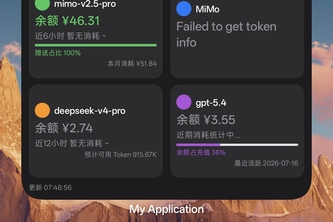
The description states that AI API Dashboard is an Android application with a home-screen widget designed to manage multiple AI APIs, models, usage, tokens, and balances in one place. The author describes it as a tool for developers and users managing multiple AI providers, aiming to reduce fragmentation across platforms.
Key commercial signals:
- The project is self-reported as built by one person (Anh Chu) using Android technologies.
- It supports OpenAI-compatible APIs and is designed to be provider-independent.
- It includes features like API configuration, model discovery, connection testing, and persistent settings.
- No revenue, customers, or usage data are evidenced.
The single most important open question: What is the actual demand for such a tool? The description does not indicate any traction, user base, or monetization strategy.
What The Product Actually Is
The description states that AI API Dashboard is an Android application with a home-screen widget. It allows users to:
- Configure different AI API providers
- Automatically discover available models
- Test connections
- Display important information in one place
It supports OpenAI-compatible APIs and is designed to work with multiple AI providers, rather than focusing on one platform.
The project was built using Android technologies including Kotlin, Jetpack Compose, and REST APIs. It leverages Codex as an AI development assistant during implementation.
Positioning & Claim Evolution
The description states that the inspiration behind the product was to address fragmentation in managing multiple AI providers, API keys, models, and usage information across different platforms.
The author claims the tool brings "different AI APIs together into one dashboard" and allows users to "easily monitor and manage their AI services from their home screen."
The project is positioned as a solution for developers and users who need to manage multiple AI services in a unified way. The description mentions future plans to improve usage analytics, add more providers, and enhance the experience for both technical and non-technical users.
Target Customer & ICP
The description states that the tool is intended for:
- Developers
- Users managing multiple AI providers
- People who need to monitor and manage AI services from their home screen
It is described as useful for both technical and non-technical users, suggesting a broad target audience. However, no specific customer segments or personas are detailed.
Business Model & Pricing Evidence
Not evidenced.
The description does not mention any pricing model, monetization strategy, or business model. It only describes the features of the application without indicating how it would generate revenue.
Technical & Delivery Signals
The description states that:
- The application was built using Android technologies
- It uses Kotlin and Jetpack Compose
- It leverages Codex as an AI development assistant
- It includes API configuration, model discovery, connection testing, and persistent settings
- It supports OpenAI-compatible APIs
- It is designed to be provider-independent
The project was submitted to the OpenAI 2026 hackathon on Devpost.
Traction & Maturity Signals
Not evidenced.
There is no evidence of:
- Revenue
- Customers
- User adoption
- Usage metrics
- Product-market fit
- Any form of traction or growth
The description only mentions that it was built as a hackathon project by one developer.
Competitive Context
Not evidenced.
The description does not provide information about:
- Direct competitors
- Indirect substitutes
- Market size
- Competitive positioning
- Existing solutions in the space
Open Questions & Risks
- Single-person development: The project is described as built by one person (Anh Chu), which raises questions about scalability, maintenance, and long-term viability.
- No traction or monetization strategy: There is no evidence of users, customers, or revenue. The project appears to be a prototype or proof-of-concept.
- Unproven demand: The description does not indicate any market validation or user need beyond the author's stated intent.
- Limited scope: It only supports OpenAI-compatible APIs and is described as a home-screen widget, which may limit its utility for more complex use cases.
Questions the description leaves open
- What specific problem are you solving, and how do you know users have this problem?
- How many developers or users are currently using the dashboard?
- Have you validated demand through interviews or surveys?
- What is your plan for monetization or revenue generation?
- How do you intend to scale beyond a single developer?
- What are the technical challenges in supporting multiple AI providers, and how have you addressed them?
- How does this product differ from existing tools in the market?
Overall Assessment
Not evidenced.
There is no evidence of:
- Revenue or financial performance
- Customer base or user adoption
- Market traction or competitive advantage
- Business model or monetization strategy
The project appears to be a hackathon submission by one developer, with no indication of commercial viability or market demand. The description does not support any conclusion about investment or partnership potential.
User Stories BotA demo video on every pull request
Get a demo video on every new feature
GitHub App that watches your pull requests and records a narrated, captioned demo.
Save time on demo prep and make informed decisions faster with a video walkthrough of every new feature.
Source
Submitted to the OpenAI 2026 hackathon on Devpost. Project home on Devpost. Back to the full gallery on Devpost.
This competitive analysis was produced by top-founders.com (opens in a new tab)
Generated by a language model from this project's public Devpost page — its tagline, the author's own write-up and any built-with tags listed there — as captured in August 2026. Short quotations are the author's words. It is an opinion on the idea as a business, not on the people behind it, and it reflects the description as published then. If the project has moved on, request a correction below. The analysis is not independent research and contains no verified traction, revenue or customer data.
An independent guide by KFG International LLC — not affiliated with, endorsed by, or connected to Devpost or OpenAI.