

Archive position — measured, not model output
0 likes on Devpost
2,263 of the 7,850 archived projects have more likes, and 5,587 share exactly 0 — so this project's #6,423 place in the like-ranked listing is a tie-break inside that group, not a ranking.
Projects (log scale)
Likes on Devpost. ▲ marks this project's group.
Show the figures
| Likes | Projects | Share of archive |
|---|---|---|
| 0 | 5,587 | 71.2% |
| 1 | 1,758 | 22.4% |
| 2 | 284 | 3.6% |
| 3–4 | 132 | 1.7% |
| 5–9 | 75 | 1.0% |
| 10+ | 14 | 0.2% |
 User Stories BotA demo video on every pull request
Get a demo video on every new feature
GitHub App that watches your pull requests and records a narrated, captioned demo.
Save time on demo prep and make informed decisions faster with a video walkthrough of every new feature.
Executive Summary
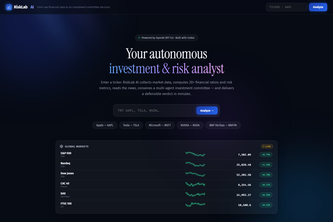
RiskLab AI is a self-reported autonomous AI analyst that processes stock tickers into risk reports using multi-agent debate and quantitative financial analysis. The project was built as part of an OpenAI hackathon by one founder, Josue Nkpoman. It claims to generate BUY/HOLD/SELL assessments in minutes from raw financial data, with simulated investment committee members who genuinely disagree before reaching a decision.
The author states that the system uses GPT-5.6 and Codex for development, with structured outputs to enforce disagreement among agents. It includes sentiment scoring of news, computation of 20+ financial ratios, VaR, volatility, and other metrics, and delivers results in an interactive dashboard and PDF report.
Key open question
Does the described system actually function as claimed, or is this a demonstration that relies on pre-programmed responses rather than true autonomous reasoning?
What The Product Actually Is
The description states that RiskLab AI:
- Takes a stock ticker (e.g., AAPL, TSLA, BNP.PA) as input
- Collects live market data, financial statements and news
- Computes 20+ financial ratios and quantitative risk metrics (Altman Z-score, VaR, Sharpe, beta, etc.)
- Scores headlines for sentiment and impact
- Convenes a simulated investment committee with distinct personas (Chief Risk Officer, Portfolio Manager, Quantitative Analyst, Macro Economist)
- Delivers a BUY/HOLD/SELL assessment with confidence level, three scenarios, dashboard, and PDF report
- Answers follow-up questions by defending its reasoning with actual numbers
Inference The system appears to be a multi-agent AI workflow that integrates data collection, quantitative analysis, and structured debate to produce investment recommendations.
Not evidenced Whether the system actually performs these functions autonomously or is pre-scripted. No evidence of live data feeds, real-time processing, or actual user interaction beyond the hackathon submission.
Positioning & Claim Evolution
The author states that RiskLab AI was inspired by a desire to automate financial analyst workflows using GPT-5.6. It positions itself as an autonomous AI analyst that turns a stock ticker into a risk report, multi-agent debate, and investment assessment in minutes.
Claim
The system automates the entire workflow of a financial analyst — from data gathering to decision-making — without human intervention.
Inference This is a repositioning from a chatbot-style tool to an end-to-end autonomous AI analyst with structured output and reasoning.
Not evidenced No evidence that this is a commercial product or that it has been used beyond the hackathon. The author does not describe any prior market traction, customer feedback, or commercial deployment.
Target Customer & ICP
The description states that RiskLab AI is designed to help investment committees make decisions by providing automated risk reports and multi-agent debate.
Claim
Investment committee members, financial analysts, portfolio managers, and institutional investors who need rapid, data-driven decision support.
Inference The target customer likely includes professionals in finance or risk management who are looking for automation of routine analysis tasks.
Not evidenced No evidence of actual customers, user personas, or market research. No mention of how the product would be monetized or distributed.
Business Model & Pricing Evidence
The description does not include any information about pricing, monetization, or business model.
Not evidenced Whether RiskLab AI is intended to be sold as a SaaS product, offered as a service, or used internally by institutions. No evidence of revenue streams, subscription tiers, or licensing models.
Technical & Delivery Signals
The author states that the system was built using:
- Codex (OpenAI coding agent)
- GPT-5.6
- FastAPI
- pandas
- Python
- yfinance
- Claude as an additional AI assistant
Claim
The system uses structured outputs and JSON schemas to enforce disagreement among agents, and handles messy financial data with fallbacks.
Inference The technical stack suggests a backend pipeline with AI integration for reasoning and data processing. It is built in Python and uses OpenAI models.
Not evidenced No evidence of scalability, deployment infrastructure, or production readiness. No mention of how the system would be hosted or maintained beyond the hackathon.
Traction & Maturity Signals
The description states that this was a hackathon project submitted to the OpenAI 2026 hackathon and built by one person (Josue Nkpoman).
Claim
The system is a proof-of-concept for an AI-driven financial analyst.
Inference No evidence of traction, user adoption, or commercial viability. It is described as a prototype with no indication of real-world usage or feedback.
Not evidenced No revenue, customers, or product-market fit data. No evidence of further development beyond the hackathon.
Competitive Context
The description does not mention any competitors or existing solutions in the financial AI space.
Not evidenced No information on how RiskLab AI compares to existing tools like Bloomberg Terminal, Morningstar, or other AI-powered financial analysis platforms.
Open Questions & Risks
- The system is described as a hackathon project with no commercial traction.
- It relies heavily on GPT-5.6 and Codex — both proprietary and potentially unstable in production.
- No evidence of real-world testing or user feedback.
- The multi-agent debate may be pre-scripted rather than truly autonomous.
- The author does not describe any data sources beyond yfinance, which is limited.
Inference There is a high risk that the system is not yet production-ready and may not function as described outside of a controlled hackathon environment.
Questions the description leaves open
- What specific financial data sources are used, and how is live data integrated into the system?
- How does the system ensure that the agents genuinely disagree rather than just rephrase each other?
- Has the system been tested with real-world financial data beyond the hackathon?
- What is the plan for scaling beyond a single-person development effort?
- Are there any plans to monetize or commercialize this product?
Overall Assessment
Not evidenced No evidence of commercial viability, traction, or market demand.
Inference This is a prototype that may have potential but lacks the evidence to support investment or partnership interest at this stage. It is not clear whether it represents a viable business or just an interesting technical demonstration.
The author states that the system was built for a hackathon and has no commercial deployment or revenue data. The product is described as a proof-of-concept, not a finished product.
User Stories BotA demo video on every pull request
Get a demo video on every new feature
GitHub App that watches your pull requests and records a narrated, captioned demo.
Save time on demo prep and make informed decisions faster with a video walkthrough of every new feature.
Source
Submitted to the OpenAI 2026 hackathon on Devpost. Project home on Devpost. Back to the full gallery on Devpost.
This competitive analysis was produced by top-founders.com (opens in a new tab)
Generated by a language model from this project's public Devpost page — its tagline, the author's own write-up and any built-with tags listed there — as captured in August 2026. Short quotations are the author's words. It is an opinion on the idea as a business, not on the people behind it, and it reflects the description as published then. If the project has moved on, request a correction below. The analysis is not independent research and contains no verified traction, revenue or customer data.
An independent guide by KFG International LLC — not affiliated with, endorsed by, or connected to Devpost or OpenAI.