

Archive position — measured, not model output
0 likes on Devpost
2,263 of the 7,850 archived projects have more likes, and 5,587 share exactly 0 — so this project's #4,461 place in the like-ranked listing is a tie-break inside that group, not a ranking.
Projects (log scale)
Likes on Devpost. ▲ marks this project's group.
Show the figures
| Likes | Projects | Share of archive |
|---|---|---|
| 0 | 5,587 | 71.2% |
| 1 | 1,758 | 22.4% |
| 2 | 284 | 3.6% |
| 3–4 | 132 | 1.7% |
| 5–9 | 75 | 1.0% |
| 10+ | 14 | 0.2% |
 User Stories BotA demo video on every pull request
Get a demo video on every new feature
GitHub App that watches your pull requests and records a narrated, captioned demo.
Save time on demo prep and make informed decisions faster with a video walkthrough of every new feature.
Executive Summary
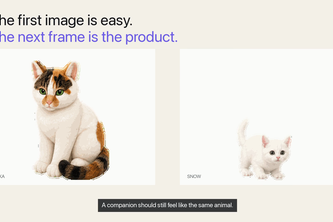
What the company appears to be: The project described as "Hatch Pet — your real pet, alive in Codex" is a self-reported personal generative product that transforms user-uploaded photos of animals into animated companions for the Codex desktop environment. It is presented as a reusable skill built using OpenAI's Codex platform and GPT-5.6, with an emphasis on preserving identity and personality through deterministic workflows.
What changed: The author states this is an extension of prior work published by OpenAI under Apache-2.0 license, building upon that baseline to create a more robust system for generating pet companions in Codex. Key additions include multi-photo identity handling, personality-to-motion mapping, state-aware animation, and deterministic installation tooling.
Single most important open question: Is there evidence of any real-world usage or adoption beyond the author's own testing and demonstration? The self-reported description contains no information about customers, revenue, traction or market validation.
Note: This analysis is based entirely on the self-reported project description provided by the caller. No external verification, historical data, or third-party sources are available. All claims in this report are drawn from the author's own submission and are unverified.
What The Product Actually Is
The description states that Hatch Pet is:
- A "reusable Codex skill"
- Designed to turn 3–5 photos of one animal plus an optional personality note into an installable animated Codex Desktop companion
- Built using GPT-5.6 Sol and tools like Python, Pillow, and GitHub
- Capable of preserving identity across software states and mapping temperament to motion
- Producing nine state-aware animation rows plus sixteen renderer-selected gaze directions in the exact Codex v2 8x11 atlas
- Including validation checks for geometry, transparency, cropping, continuity, direction, identity, cadence, and prop contact
- Featuring a repair mechanism that regenerates only failed rows
- Installing with backup and checksum readback
Inference: The product appears to be a specialized tool within the Codex ecosystem for creating personalized digital pets using AI-generated assets from user-provided images.
Positioning & Claim Evolution
The author claims:
- This is an extension of prior OpenAI work published under Apache-2.0
- It builds upon that baseline to create a more complete system for generating pet companions in Codex
- The core innovation lies in identity preservation, personality mapping, and deterministic workflows
- The system supports multiple animals (dogs, rabbits, birds) with plans for broader validation
Inference: The positioning appears to be as a technical demonstration of generative personalization capabilities within the Codex platform, rather than a commercial product or service.
Target Customer & ICP
The description does not identify specific target customers or personas. It implies:
- Users who own pets and want personalized digital companions in Codex
- Developers or enthusiasts working with the Codex platform
- Individuals interested in generative AI tools for personal use
Not evidenced: No explicit customer segments, buyer personas, or market targeting information is provided.
Business Model & Pricing Evidence
There is no evidence of a business model or pricing structure in the description. The author states:
- The project is open-source and built on top of prior OpenAI work
- It includes a public install path and judge fast path that do not require rebuilding
- No mention of monetization, subscriptions, fees, or commercial offerings
Inference: The project appears to be non-commercial in nature, possibly intended for demonstration or personal use.
Technical & Delivery Signals
The description indicates:
- Built using Codex, GPT-5.6 Sol, Python, Pillow, and GitHub
- Combines image generation with deterministic Python and Pillow tooling
- Includes visual review processes (labeled sheets, blind sheets, animated strips)
- Features structural validation and independent visual QA gates
- Implements minimal-row repair and atomic installation
- Supports macOS but not Windows at time of submission
Inference: The technical approach suggests a hybrid of AI generation and deterministic scripting for reliability and consistency.
Traction & Maturity Signals
The description states:
- Two installable Codex v2 reference packages have been created
- Reproducible installation on two macOS machines and one independent Snow run
- Public install path available without rebuilding
- Testing instructions provided for judges
Not evidenced: No evidence of customer adoption, usage metrics, revenue, or market traction beyond the author’s own testing.
Competitive Context
The description mentions:
- OpenAI published an Apache-2.0 curated hatch-pet workflow before Build Week
- This submission is described as a meaningful extension of that baseline
- No other competitors are explicitly named
Inference: The competitive landscape appears to be limited to prior work from OpenAI and potentially similar generative personalization tools, though no direct comparison or market positioning is made.
Open Questions & Risks
Key risks identified:
- The project is self-reported and unverified; no independent validation
- No evidence of real-world usage or adoption
- No commercial traction or revenue data
- Limited to macOS support at time of submission
- Relies heavily on author's own testing and demonstration
- No indication of scalability, performance, or long-term viability
Inference: The lack of external validation and market evidence raises questions about the product’s readiness for broader deployment or investment.
Questions the description leaves open
- What is the actual user base or adoption rate beyond your own testing?
- Are there any plans to expand support beyond macOS?
- How do you intend to scale this beyond personal use cases?
- What are the long-term maintenance and update strategies for these companions?
- Is there any intention to monetize or commercialize this tool?
Overall Assessment
Assessment: Not evidenced.
The self-reported description provides no information about revenue, customers, traction, or market validation. The project appears to be a technical demonstration or prototype with no evidence of commercial viability or strategic value for investment or partnership purposes.
Note: This conclusion is based solely on the author's own account and lacks any external corroboration or data points regarding real-world performance or business impact.
User Stories BotA demo video on every pull request
Get a demo video on every new feature
GitHub App that watches your pull requests and records a narrated, captioned demo.
Save time on demo prep and make informed decisions faster with a video walkthrough of every new feature.
Source
Submitted to the OpenAI 2026 hackathon on Devpost. Project home on Devpost. Back to the full gallery on Devpost.
This competitive analysis was produced by top-founders.com (opens in a new tab)
Generated by a language model from this project's public Devpost page — its tagline, the author's own write-up and any built-with tags listed there — as captured in August 2026. Short quotations are the author's words. It is an opinion on the idea as a business, not on the people behind it, and it reflects the description as published then. If the project has moved on, request a correction below. The analysis is not independent research and contains no verified traction, revenue or customer data.
An independent guide by KFG International LLC — not affiliated with, endorsed by, or connected to Devpost or OpenAI.