

Archive position — measured, not model output
1 like on Devpost
505 of the 7,850 archived projects have more likes, and 1,758 share exactly 1 — so this project's #1,106 place in the like-ranked listing is a tie-break inside that group, not a ranking.
Projects (log scale)
Likes on Devpost. ▲ marks this project's group.
Show the figures
| Likes | Projects | Share of archive |
|---|---|---|
| 0 | 5,587 | 71.2% |
| 1 | 1,758 | 22.4% |
| 2 | 284 | 3.6% |
| 3–4 | 132 | 1.7% |
| 5–9 | 75 | 1.0% |
| 10+ | 14 | 0.2% |
 User Stories BotA demo video on every pull request
Get a demo video on every new feature
GitHub App that watches your pull requests and records a narrated, captioned demo.
Save time on demo prep and make informed decisions faster with a video walkthrough of every new feature.
Executive Summary
What the company appears to be
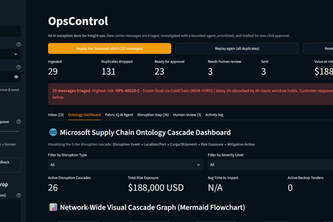
Freight Desk Ops Control (OpsControl) is a self-reported AI-powered supply chain control tower that processes freight carrier messages (EDI feeds, emails, SMS) into structured exceptions and mitigation plans using GPT-5.6 and agent-based workflows. It claims to convert disruption signals into dependency-aware impact analysis and human-approved mitigation.
What changed
The project evolved from a reference design for asynchronous multi-agent exception management in logistics into a product prototype intended for real freight brokers, with an emphasis on operational AI that makes uncertainty visible and routine work easy.
Single most important open question
Does the author's self-reported functionality map to any actual commercial traction or customer feedback? There is no evidence of revenue, customers, or adoption beyond the demo scenario.
Note: This analysis is based solely on the self-reported project description provided by the caller. No external verification, archived data, or third-party sources were used. All claims are attributed to the author's own account and are unverified.
What The Product Actually Is
The description states that OpsControl is an AI exception desk for freight operations. It takes raw carrier messages (EDI feeds, emails, SMS) as input and uses GPT-5.6 to parse them into structured exceptions (type, severity, shipment, location). A bounded investigation agent evaluates the blast radius of disruptions and drafts customer emails and internal action plans.
Key components include:
- Structured-output triage using GPT-5.6
- Bounded agent reasoning with tool-calling capabilities (shipment lookup, ETA impact, port conditions)
- Confidence-routed mitigation composer
- Inbox UI for human review and approval
- Idempotency key deduplication
- Operator authentication via PIN 2468 + RBAC permissions
The system is built using FastAPI + SQLite core, Codex with GPT-5.6, and includes a seed-replay harness and pytest suite.
Inference: The product appears to be a prototype or proof-of-concept rather than a production-ready solution, based on its development approach (PRD-driven milestones, demo replayability) and lack of evidence for deployment or scaling.
Positioning & Claim Evolution
The author positions OpsControl as an AI supply chain control tower that converts disruption signals into dependency-aware impact analysis and human-approved mitigation. It is described as a tool for handling the chaos of carrier data floods by turning them into prioritized queues, customer-ready drafts, and focused review lists.
It evolved from a reference design published in a case study to a product prototype aimed at freight brokers who face too much data at critical moments.
Claims:
- Converts asynchronous multi-agent exception management architecture into a usable product.
- Makes uncertainty operationally useful instead of hiding it.
- Integrates supply chain disruption ontology and graph-based querying (Fabric IQ).
- Supports one-click alternative carrier booking with ROI callouts.
- Implements guardrails as features, not afterthoughts.
Claim vs Fact: These are self-reported claims about intent and functionality. No evidence supports whether these features have been tested in production or validated by users.
Target Customer & ICP
The description states that OpsControl is designed for freight brokers who experience data overload during disruptions. The author notes that "freight operations rarely fail because a team lacks data. They fail because a small team has too much of it at the worst possible moment."
It targets:
- Freight brokers managing large volumes of carrier updates
- Teams needing to prioritize and respond quickly to exceptions
- Users requiring visibility into disruption cascades and mitigation actions
There is no mention of specific customer segments beyond "freight brokers" or use cases beyond logistics exception handling.
Not evidenced: No evidence of actual customers, pilot programs, or market validation. The ICP remains conceptual.
Business Model & Pricing Evidence
No explicit business model or pricing information is provided in the description.
The author mentions:
- SMTP delivery adapters
- Customer-specific communication profiles (NovaPharm, Atlanta Retail)
- PIN-gated approval and RBAC permissions
- SSO integration and SOC2 WORM compliance features
These suggest enterprise-level functionality but do not indicate monetization strategy or pricing tiers.
Not evidenced: No evidence of revenue streams, pricing models, or customer contracts.
Technical & Delivery Signals
The system is built using:
- GPT-5.6 (via Codex)
- FastAPI + SQLite
- Python stack including Pytest and Streamlit
- GitHub for version control
- Structured outputs for triage parsing
- Bounded agent loops with function tools
- SHA-256 hash deduplication
- Operator authentication via PIN 2468 & RBAC
Key technical constraints:
- Agent investigation capped at five steps
- Low-confidence cases routed to human review queue
- Idempotent ingestion
- Demo reliability treated as a product requirement
Inference: The system is built with operational AI principles in mind, emphasizing trust boundaries and human-in-the-loop workflows. However, no evidence of scalability or production deployment exists.
Traction & Maturity Signals
The project was submitted to the OpenAI 2026 hackathon on Devpost. It includes:
- A demo replaying 32 realistic seed messages
- Simulated scenarios including duplicates and corrupted feeds
- Interactive UI elements like PyDeck geospatial maps, Fabric IQ chat history, and activity logs
The author claims successful implementation of core extension points such as feed drop batch ingestion, SMTP delivery adapters, and adaptive feedback loops.
Not evidenced: No evidence of real-world usage, customer feedback, or product adoption beyond the demo environment. The maturity level is inferred from the presence of a working prototype but not validated by traction metrics.
Competitive Context
The description does not mention direct competitors or market positioning relative to existing supply chain control towers or logistics AI platforms.
It references:
- Microsoft Supply Chain Disruption Ontology
- Fabric IQ graph database integration
- AIS tracking APIs (MarineTraffic / Spire)
- Spot rate APIs (Project44 / FourKites)
These suggest alignment with enterprise-grade logistics and supply chain tools, but no competitive landscape is described.
Not evidenced: No evidence of competitor analysis or market differentiation strategies.
Open Questions & Risks
- Unverified claims: All functionality is self-reported without external validation.
- Prototype-only status: The system appears to be a demo/prototype, not a deployed product.
- No traction data: No evidence of revenue, customers, or usage beyond simulated scenarios.
- Limited team size: Only two team members are mentioned, raising questions about scalability and execution capacity.
- Dependency on GPT-5.6: Heavy reliance on a single model raises concerns about availability, cost, and consistency in production environments.
- Lack of enterprise features proven: Features like SSO, SOC2 compliance, and API integrations are mentioned but not demonstrated in real-world use.
Inference: The project lacks commercial viability indicators such as customer feedback, revenue, or product-market fit.
Questions the description leaves open
- What specific freight broker use cases have you validated with actual users?
- How do you plan to scale beyond the current demo environment?
- Have you tested the system with real carrier feeds and live disruptions?
- What is your roadmap for integrating with existing TMS or ERP systems?
- Are there any pilot customers or early adopters currently using this?
- How will you handle model drift and continuous learning in production?
- What are the key assumptions behind the confidence scoring mechanism?
- Can you provide evidence of how the system handles edge cases not covered in the demo?
Overall Assessment
Not evidenced: There is no evidence of revenue, customers, or traction to support a commercial due-diligence read.
The project appears to be a hackathon prototype that demonstrates technical capability but lacks any indication of market readiness, customer validation, or business sustainability. The author's claims about functionality and future development are unverified.
Confidence Level: Low — based entirely on self-reported content with no external corroboration or evidence of commercial traction.
User Stories BotA demo video on every pull request
Get a demo video on every new feature
GitHub App that watches your pull requests and records a narrated, captioned demo.
Save time on demo prep and make informed decisions faster with a video walkthrough of every new feature.
Source
Submitted to the OpenAI 2026 hackathon on Devpost. Project home on Devpost. Back to the full gallery on Devpost.
This competitive analysis was produced by top-founders.com (opens in a new tab)
Generated by a language model from this project's public Devpost page — its tagline, the author's own write-up and any built-with tags listed there — as captured in August 2026. Short quotations are the author's words. It is an opinion on the idea as a business, not on the people behind it, and it reflects the description as published then. If the project has moved on, request a correction below. The analysis is not independent research and contains no verified traction, revenue or customer data.
An independent guide by KFG International LLC — not affiliated with, endorsed by, or connected to Devpost or OpenAI.