

Archive position — measured, not model output
1 like on Devpost
505 of the 7,850 archived projects have more likes, and 1,758 share exactly 1 — so this project's #1,108 place in the like-ranked listing is a tie-break inside that group, not a ranking.
Projects (log scale)
Likes on Devpost. ▲ marks this project's group.
Show the figures
| Likes | Projects | Share of archive |
|---|---|---|
| 0 | 5,587 | 71.2% |
| 1 | 1,758 | 22.4% |
| 2 | 284 | 3.6% |
| 3–4 | 132 | 1.7% |
| 5–9 | 75 | 1.0% |
| 10+ | 14 | 0.2% |
 User Stories BotA demo video on every pull request
Get a demo video on every new feature
GitHub App that watches your pull requests and records a narrated, captioned demo.
Save time on demo prep and make informed decisions faster with a video walkthrough of every new feature.
Executive Summary
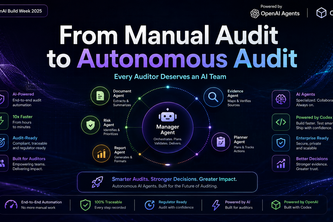
The company appears to be a solo project (1 person) submitted to the OpenAI 2026 hackathon, describing an AI-powered platform for automating audit workflows. The author states that it uses multiple AI agents, RAG, structured outputs and tool calling to perform tasks like audit planning, document analysis, risk assessment, and report generation — with a human-in-the-loop review process.
Key change: This is a self-reported hackathon submission, not a commercial product or company in operation. It has no evidence of revenue, customers, traction or operational history beyond the author’s own description.
Single most important open question: Is this project intended to become a commercial product, and if so, what is the path to market and monetization?
What The Product Actually Is
The description states that the Autonomous Audit Platform is an AI system composed of multiple agents designed to automate audit processes. These include:
- Audit planning
- Document analysis
- Evidence mapping
- Control testing
- Risk assessment
- Observation drafting
- Report generation
It uses:
- OpenAI's API (Responses API)
- Retrieval-Augmented Generation (RAG)
- Tool calling
- Structured outputs
- Next.js, FastAPI, PostgreSQL for architecture
The system is described as multi-agent, with each agent responsible for a specific part of the audit workflow. The final output is reviewed by a human auditor before being finalized.
Inference: The platform is built to replicate an auditor’s workflow using AI agents and is intended to reduce manual effort in audits, not replace auditors entirely.
Positioning & Claim Evolution
The author states that internal auditors spend countless hours on repetitive tasks, and that existing AI assistants are insufficient for completing full audit workflows. The platform is positioned as a way to collaborate like experienced auditors, allowing professionals to focus on judgment rather than routine work.
Claim: “Every auditor deserves an AI team.”
This positioning suggests:
- A niche use case (auditing)
- A human-in-the-loop model
- A shift from manual to automated audit processes
There is no evidence of prior market positioning or customer feedback beyond the hackathon submission. The claim is self-reported and unverified.
Target Customer & ICP
The description states that the platform is intended for internal auditors who perform tasks such as:
- Collecting evidence
- Reviewing policies
- Comparing controls
- Preparing audit reports
It is implied that the target user is a professional auditor, likely within large enterprises or financial institutions.
There is no evidence of:
- Specific customer segments
- Customer personas
- Market size or adoption data
Inference: The ICP is likely enterprise-level internal auditors, but this is not explicitly defined or validated.
Business Model & Pricing Evidence
The description does not include any information about:
- Revenue model
- Pricing structure
- Monetization strategy
- Customer acquisition plan
It only describes the technical architecture and workflow of an AI system for audit automation.
Inference: If this becomes a product, it may be sold to enterprises or audit firms, but no evidence supports how that would work commercially.
Technical & Delivery Signals
The platform is built using:
- OpenAI API
- RAG (Retrieval-Augmented Generation)
- Tool calling
- Structured outputs
- Next.js, FastAPI, PostgreSQL
It uses a multi-agent system to orchestrate specialized AI agents for different audit tasks.
Challenges mentioned include:
- Coordinating multiple AI agents
- Structured outputs for audit reports
- Mapping evidence to controls
- Long-context document reasoning
- Reducing hallucinations
Accomplishments:
- Automated audit planning
- Generated structured audit observations
- Produced enterprise-ready audit reports
- Maintained human-in-the-loop review
Inference: The technical stack and approach suggest a complex, AI-driven system with an emphasis on accuracy and structure. However, no evidence of production deployment or scalability.
Traction & Maturity Signals
The project is described as a hackathon submission, not a commercial product or company in operation.
There is no evidence of:
- Revenue
- Customers
- Users
- Product-market fit
- Product usage data
- Iteration history
- Market traction
Inference: This is an early-stage idea, likely at prototype or proof-of-concept stage. No maturity or traction signals are evident.
Competitive Context
The description does not mention:
- Competitors
- Existing solutions in the audit automation space
- Market dynamics
- Differentiation from other tools
It is unclear whether similar platforms already exist or how this one would compete.
Inference: The competitive landscape is unknown, and no evidence supports any existing market presence or competitive positioning.
Open Questions & Risks
- Solo project: Only one team member (Jason H.) is listed.
- No commercial traction: This is a hackathon submission with no revenue or customer data.
- Unproven business model: No pricing, monetization or go-to-market strategy.
- Unclear scalability: The system is described as built for enterprise use but lacks evidence of deployment or performance at scale.
- High technical complexity: Multi-agent AI systems are difficult to build and maintain, especially in regulated domains like auditing.
Questions the description leaves open
- What is the intended path from this hackathon project to a commercial product?
- Are there any early adopters or pilot customers already interested?
- How does the platform handle regulatory compliance (especially in financial services)?
- What are the technical limitations of current AI agents in audit contexts?
- Is there a plan for ongoing training and updating of the system with new audit standards?
- How is data privacy and security handled, especially when dealing with sensitive enterprise documents?
Overall Assessment
Not evidenced: There is no evidence that this project has moved beyond a hackathon submission or has any commercial traction.
Confidence level: Low — based on self-reported, unverified information only.
Assessment: This appears to be an early-stage idea or prototype. It is not ready for investment or partnership unless further development and validation are demonstrated. The author states it is a solo effort, and no evidence supports any business model, product-market fit, or customer traction.
User Stories BotA demo video on every pull request
Get a demo video on every new feature
GitHub App that watches your pull requests and records a narrated, captioned demo.
Save time on demo prep and make informed decisions faster with a video walkthrough of every new feature.
Source
Submitted to the OpenAI 2026 hackathon on Devpost. Project home on Devpost. Back to the full gallery on Devpost.
This competitive analysis was produced by top-founders.com (opens in a new tab)
Generated by a language model from this project's public Devpost page — its tagline, the author's own write-up and any built-with tags listed there — as captured in August 2026. Short quotations are the author's words. It is an opinion on the idea as a business, not on the people behind it, and it reflects the description as published then. If the project has moved on, request a correction below. The analysis is not independent research and contains no verified traction, revenue or customer data.
An independent guide by KFG International LLC — not affiliated with, endorsed by, or connected to Devpost or OpenAI.